


Synopsis
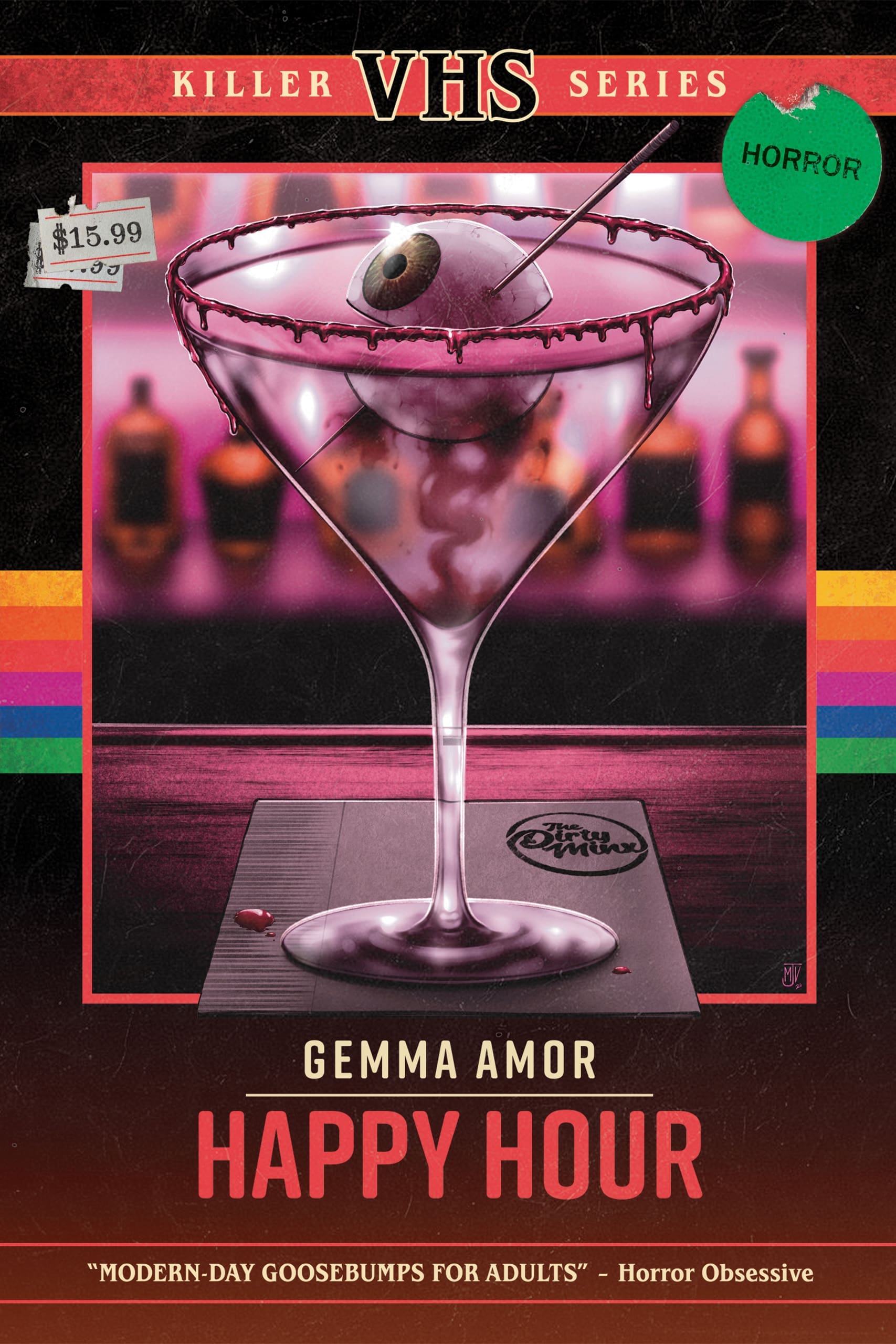
The eccentric onwer of a ’90s underground London cocktail bar has a unique and disturbing way of keeping an eye on everything and everyone, then disappearing those who don’t behave. Famous politicians, glamorous actresses, and international stars are all dying to get in… and to get out.
Happy Hour is the ninth book in the Killer VHS Series, hailed as “the modern-day Goosebumps for Adults” by Horror Obsessive. Killer VHS Series titles are standalone stories featuring found footage elemnets and nostalgic vibes for horror’s ’80s and ’90s glory days.
Review
HAPPY HOUR – GEMMA AMOR
As a child during the late 90s and early 00s growing up in the UK, I mostly saw fame and celebrity status through gossip rags and entertainment news bitchiness. You couldn’t get away from the tabloid vomit discussing which female celeb was too fat or too skinny, or who was shagging who. One thing these vile mags used to show were candid snaps of celebs leaving some nightclub, glammed up to the nines with low waist bootcut jeans, a sparkly handbag, and maybe a pink beret. Occasionally a chihuahua too.
Also, during this time, you had the peak of nightclub culture, with the rise and domination of trance music, breakbeat, pills, Ministry of Sound, the list goes on. It’s in this unique period of excess and gossip that Gemma Amor, author of this year’s fantastic ITCH!, sets her entry into Shortwave’s Killer VHS series, HAPPY HOUR.
HAPPY HOUR follows Brian, owner of exclusive and elusive London nightclub that caters to the rich, the famous, the powerful, and let’s face it, the corrupt, as he is caught stuffing a body into a distiller. But Brian also has plans for his next exclusive guest…
This is a dual timeline narrative, as we chart a single evening in the present at Brian’s private bar – along with witnessing all this establishments eccentricities – and we also experience Brian’s life before his time here, as a struggling for money young man alongside his brother and his brothers not-very-nice girlfriend. They become hooked on 90s club culture, and it’s here that I want to say that Gemma captures this feeling SO DAMN WELL. I was a child during this period, so my clubbing years were the early ‘10s, but I can recall my own nightlife time fully. Through Gemma’s prose, I could smell the stink of dancing sweaty bodies, the sickly sugary taste of alcopops, the thumping beat of God Is A DJ, the cold slap of air as you go outside for a cigarette. It was a transportive experience for me captured in pitch perfect flavours.
But the present timeline is also a showcase in slow tension building, as Brian is confronted by a celebrity that is just the worst. These present-day sections are filled with anxiety inducing tension; they are shocking, subversive, and also accurate to the way that certain celebrities were portrayed as behaving (a lot of the time, with hard evidence of that fact). If one timeline is a carefully mixed cocktail, where the ingredients are measured to the exact millilitre and the garnish is fresh, the other is the screaming fire of 10 Jagerbombs and a pint of Stella that been lobbed into a crowd of partygoers.
HAPPY HOUR is a fantastic novella, one that perfectly captures a hectic part of recent British history, invoking such a strong sense of nostalgia – even if you didn’t experience it yourself – that you’ll find yourself craving both Apple Sourz and a good martini. Gemma Amor never goes where you think she’s going to go, keeping the narrative exciting, compelling, and full of building suspense.
Thanks to Shortwave Publishing for the ARC (sorry for the delay in getting the review out)!


Leave a Reply