
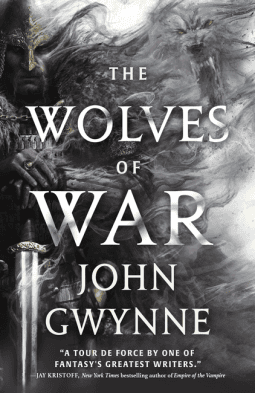


Synopsis
The king of heroic fantasy and New York Times bestselling author John Gwynne returns with a blockbuster epic fantasy inspired by Slavic mythology and packed with ancient magic, heroic sacrifice, and thrilling adventure.
“Gwynne is a rare breed of writer whose gift lies not in his panoply of talents, but in his authenticity. The Wolves of War is a beautiful book.”– Pierce Brown, #1 New York Times bestselling author
“A tour de force by one of fantasy’s greatest writers.” – Jay Kristoff, New York Times bestseller author
THE WOLVES OF WAR ARE BARING THEIR FANGS
The Clans once lived freely, honouring their gods and traditions. Then the northern invaders unleashed a tide of blood and fire. Now the Clans are a conquered people.
Ivan cares not for wars or kings. His only concern is the safety of his family, especially his daughter Halia, whom he would protect with his life. Halia has been trapped in her own body since birth, yet at night she has dreams of running with wolves and speaking with fae creatures of the forest. Many believe her cursed, but Halia’s awakening powers may be the only way she and her family can survive the coming storm.
For the wolves of war are stalking the horizon. Two princes have become mortal enemies, and an iron-toothed witch haunts the shadows. As mighty nations clash, Halia must master her strange magic to protect those she loves. To do so, she must accept a terrifying truth.
Sometimes, the only way through the darkness is to embrace it.
Review
Confession time: I’m not much of a fantasy reader. If you’ve been following my reviews here, you’ll likely notice I gravitate more toward horror and a smattering of sci-fi. The fantasy genre has been bit of a blind-spot for me for the majority of my reading life, and only a rare few of the fantasy novels I have sampled over the years have captured my full attention. Only GRRM and R. Scott Bakker books have been home-runs for me, while most others end up in my DNF pile for a variety of reasons.
Still, I keep trying to find the right ones for me, trending hard toward the grimdark when I do sample the occasional fantasy book. One amongst a handful of names with praise being heaped upon them that have been coming up again and again is John Gwynne. Apparently, he’s much ballyhooed in fantasy circles. Words and phrases like “masterful,” “a generational talent,” and “among the best,” seem to get tossed around a lot when he and his works pop up.
My curiosity was piqued and, naturally, his books have entered my TBR where they have sat for some time now. But when the chance came up to read The Wolves of War, the start of a new two-part series that would allow me to skip the author’s backlog with a fresh entry entry point, I figured it was now or never.
And you know what? The Wolves of War was pretty damn OK!
Inspired by Slavic mythology and tenth-century Eastern Europe, Gwynne’s newest has a fair bit going for it. And while it draws aplenty from real-world mythology, Gwynne makes it abundantly clear that his story is fantasy first, and true to history not much at all. While there’s The Nailed God Christ, and mentions of Greece and Iraq to ground the story in ancient mankind’s history, there’s also monsters aplenty, not to mention witches and dreamwalkers. One segment early-on involves a search party sent into the woods to retrieve abducted compatriots who find themselves squaring off a nightmarish leech monster.
As the title indicates, war is, of course, a centerpiece here. Northman Ingvar rules over the minor but growing kingdom his father created and is pushing deeper into Slavic territories, demanding payment from the forest folk that dwell there. He doesn’t take it kindly when one of his tax collectors returns missing a hand and marches to bring the rival ruler, Mal, to heel. Mal is also behind the abduction of another tribe’s children, which sparks a contest for rulership between the elders of that clan. Tensions are already high within the clan thanks to Ivan’s daughter, Halia, a crippled child one of the elder’s accuses of being a witch. Rightly so, it turns out, as Halia is able to leave behind her tortured body and commune with wolves in a mystical plane, and wreak havoc with magic in order to protect her family as the need arises.
Gwynne is clearly a smart plotter, and one who leans hard into the complications weaving throughout the story and slowly drawing these parallel and widely disconnected elements together. Patience and persistence are rewarded here. Gwynne’s prose is clean and thoroughly readable enough that he manages to make it all look disarmingly simple even when there’s a lot going on and to keep track of.
Of the characters, Gwynne clearly favors Halia. She’s got the most depth and interesting point of view segments in the story, hewing closest to the Hero’s Journey as she begins to make sense of the fantastic powers she possesses. Inspired by his own, sadly deceased, daughter Harriet, you can feel the love Gwynne has for her, particularly in the familial interactions when father Ivan cares for her. That family dynamic, in fact, is one of the best things here, and proves to be force powerful enough that it draws a seasoned killer to their side late in the game. Ingvar, unfortunately, felt a bit flatter in comparison, so concerned with issues of legacy and kingmaking. His segments are certainly not dull, but they also feel a bit more like the tried-and-true fantasy elements that have been done to death already, even in my limited forays into the surrounding literature.
Of course, The Wolves of War is but Book One in a duology. Gwynne spends a lot of time moving pieces and players into position for a thrilling, race to the finish climax that leaves them all dangling in the wait for Book Two. Thankfully, I found myself interested enough in these characters, its setting, and the conflicts brewing that I will most definitely be checking out this story’s second half when it arrives. After that, well, I think I’ve got some catching up to do with those other Gwynne books sitting on my shelf.


Leave a Reply