
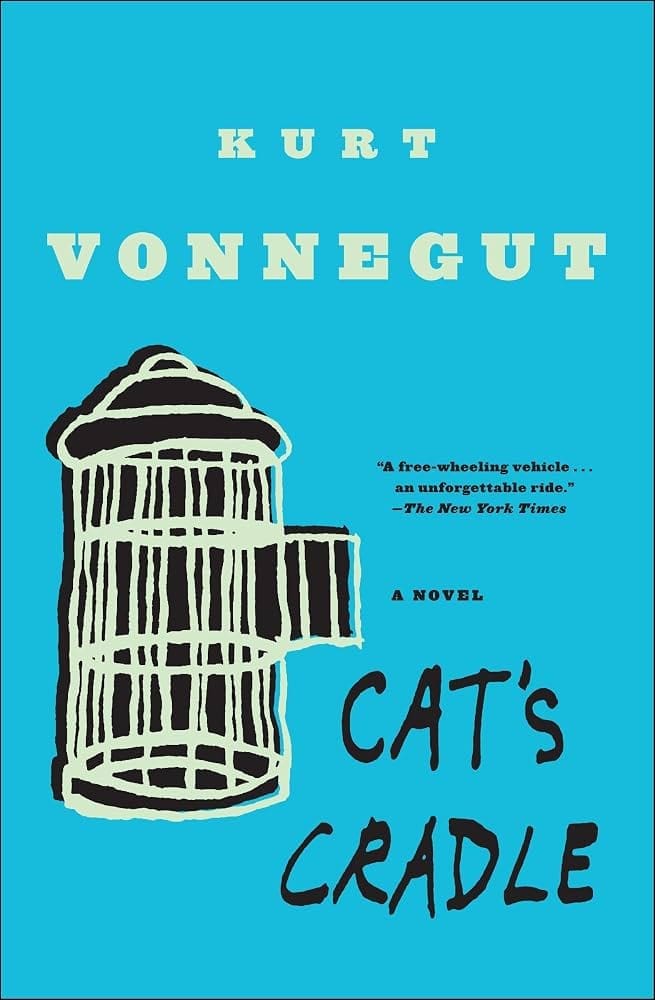


Synopsis
Cat’s Cradle is Kurt Vonnegut’s satirical commentary on modern man and his madness. An apocalyptic tale of this planet’s ultimate fate, it features a midget as the protagonist, a complete, original theology created by a calypso singer, and a vision of the future that is at once blackly fatalistic and hilariously funny. A book that left an indelible mark on an entire generation of readers, Cat’s Cradle is one of the twentieth century’s most important works—and Vonnegut at his very best.
Review
“Perhaps, when we remember wars, we should take off our clothes and paint ourselves blue and go on all fours all day long and grunt like pigs. That would surely be more appropriate than noble oratory and shows of flags and well-oiled guns.”
I am once again back with a Vonnegut. Vonnegut is one of my most favourite authors because his writing gives me a lot of comfort. I don’t even have to exactly understand what he means. His writing has a way of communicating more with me than through the literal written prose and I’ll always be grateful that I’ve latched on to his books albeit very late in my reading journey. Every time I pick up his books I marvel at how good and kind a person can be.
Coming to this book, it is a fictionalized autobiography of a man who sets out to write a biography of the fictionalized world’s Oppenheimer, focusing specifically on what the father of the atomic bomb and his family were doing during the day the bomb dropped. His plan is to title the book – the day the world ended. What happens to him as he tries to talk to the scientist’s kids and his colleagues at the lab for research and where his journey eventually takes him forms the core of the book.
Just like Slaughterhouse- five, it is very hard to review this book. However, just like Slaughterhouse- five, this book is very, very good. It is a relatively short book (~300 pages) with even shorter chapters (127 chapters.) The book has two main themes: science, and religion. And it doesn’t pit them against each other, merely just offers commentary and critique about them both. The book is written in a satirical style exploring both science and religion’s absurdity and banality. Are both of them dooming humanity to failure by offering lies in place of the real truth? Do neither of them really try to stop human stupidity and cruelty?
Skip this paragraph if you want to avoid spoilers. Vonnegut talks about all of this by inventing two things- Ice Nine, a substance more dangerous than the Atomic bomb, developed by the same guy who built the latter, in pursuit of solving some simple problem for the marines without stopping to think if it will destroy the world (I am stunned at the idea of the science and how simple it was to destroy the world) and Bokononism, a fake religion created on purpose to use harmless lies to keep people happy while they suffer. It explores both how comforting religion can be while at the same time offering critique on it when it becomes an organized religion.
While it does all of these poignant stuff, it is actually conveyed in a very accessible, very witty, very dark and absurd style. I have not been a fan of absurdist exposition previously but at the hands of Vonnegut, I grew to enjoy it as well. He’s truly a phenomenal writer and if you haven’t picked up this book yet, definitely give it a try.



Leave a Reply