
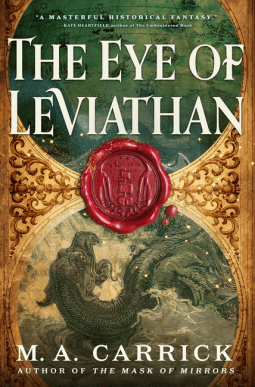


From the author of The Mask of Mirrors comes a sweeping adventure set in a world where fae secretly walk amongst those who seek to persecute them.
In an alternate Spanish Golden Age, the Council of the Sea Beyond has risen to unrivalled power, exploiting the Otherworld’s most precious resources for their own gain. Estevan seeks to uncover their secrets, but he risks the exposure of his own: that he is a faerie, masquerading as a mortal.
The Hungry Girl is the human whose place he took. Lost among the fae and desperate to find some purpose for her existence, she leaps at the chance to help a group of Spanish explorers in the Sea Beyond…only to be horrified at the atrocities they commit.
A faerie pact has separated them – but only together can they bring down Spain’s worlds‑spanning empire and save the homes they have both come to love.
REVIEW:
The Eye of Leviathan is more of what I want to see in fantasy, where you have historical time rifts combining with different eras. For example, what if the Romans had to deal with a horde of zombies invading their world? What if the Aztecs had to deal with the Fae or other mythological creatures entering their world? There’s so much potential here that I really enjoyed reading this. It’s a world full of depth, character, and location, and the world-building itself is so strong that it does what it says on the tin. It’s a novel that features more female characters, and honestly, it needs to be there. I need more female characters I can relate to; Kassandra from AC Odyssey is one example. But in a world where the Spanish live in what is a very patriarchal society, it’s good to see female characters standing up.
Historically, let’s examine something here: what made the Spanish win the New World? Because it is crucial to this novel’s question. It was Divide et Impera. The mainstream idea is that Spain sent a bunch of superhuman soldiers, as is today’s interpretation of it by some people, that they came in, destroyed the Aztecs with superior weaponry and conveniently brushes over the fact that, firstly, the Conquistadors were nothing more than prisoners, like the worst of Spanish society, given weapons and a job. That job was to kill. When Cortés went to the New World, he didn’t necessarily go with a Royal Pardon. When the Conquistadors committed the worst crimes, converting large swathes of the native population, burning down Aztec temples, flattening down Tenochtitlan, the King and parts of the Church spoke out against this. Because when you read, it’s not necessarily a spoiler. The Conquistadors went in search of gold and to improve their lives, but at what cost?
In the Overworld, Spain’s medieval fanatic glory is really explored well enough. Because in that definition of the world, God is almighty. Nothing can come before the King and God himself. And that is often extrapolated within certain scenes in the novel. The Spanish explorers committed the atrocities not because they’re evil; it’s because of the misdirection- what happens when you give a bunch of criminals the same reaction over and over again and history has proven this. Whether it was fascist states in WW2, or dictatorships of the African era of the 1970s, or the Japanese in WW2, it just goes to show that M.A Carrick borrowed a very rich era to pick up from.
Overall, this is a fantastic novel. One of the best I’ve read. And I honestly want Orbit/Little Brown Books to get more historical time rifts/historical fantasy because that is far more exciting than the average mainstream alt history, which is WW2 and not even going into much detail at all.


Leave a Reply