


Synopsis
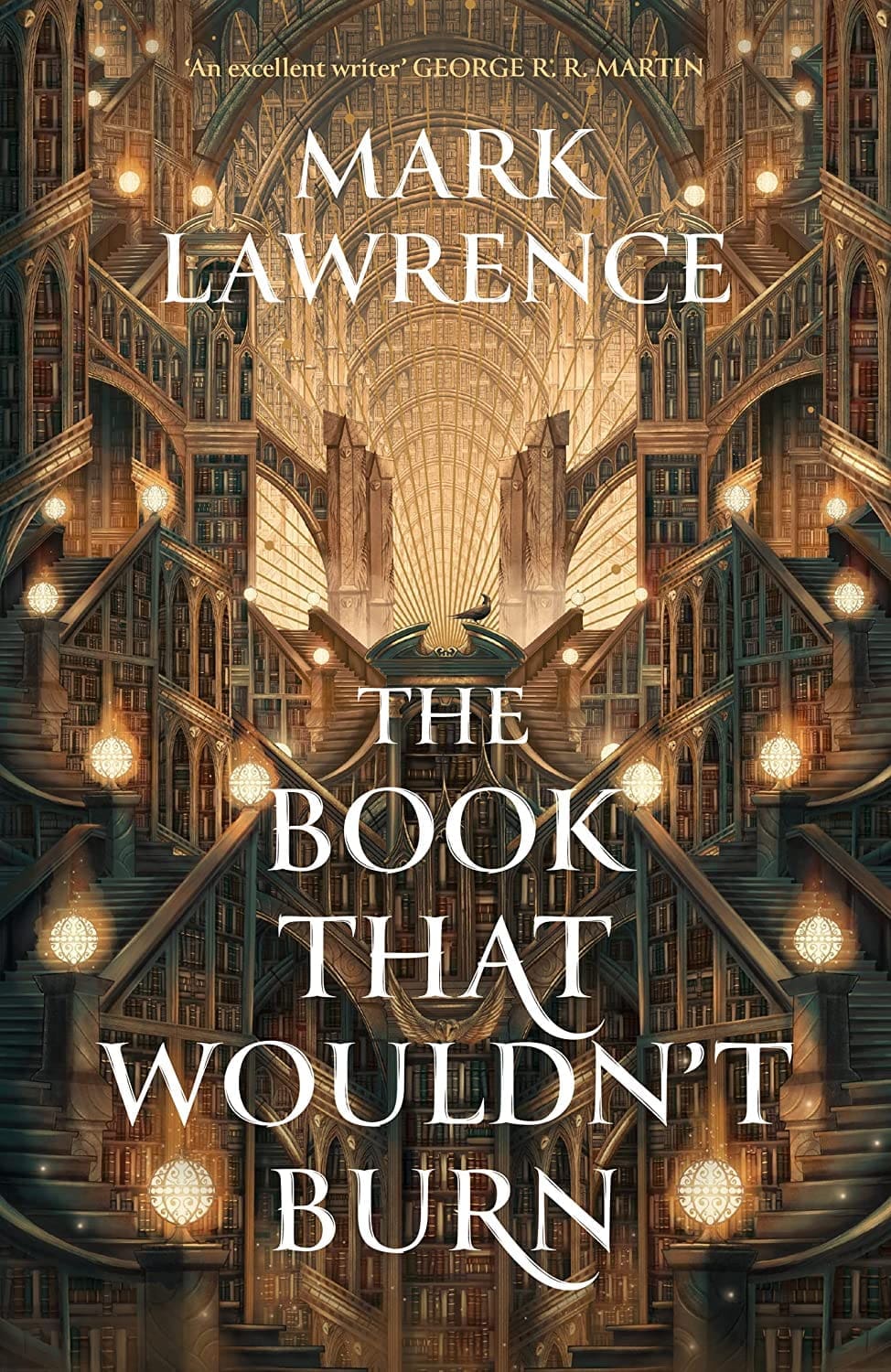
Evar has lived his whole life trapped within a vast library, older than empires and larger than cities.
Livira has spent hers in a tiny settlement out on the Dust where nightmares stalk and no one goes.
The world has never noticed them.
That’s about to change.
As their stories spiral around each other, across worlds and time, each will unlock vast secrets about the world and themselves. This is a tale of truth and lies and hearts, and the blurring of one into another.
Review
This is the first novel I have ever wanted to immediately start over the moment I finished it.
Describing The Book That Wouldn’t Burn without revealing key plot points is nearly impossible, because the details that make this book extraordinary are the ones best discovered on your own. So I’ll focus on what I can tell you without ruining anything.
This is a complex narrative, and Lawrence manages it with a precision that borders on surgical. Every story thread remains clear, concise, and entertaining, even as the layers multiply. There is no fat on this book. Every scene, every line serves the story. That kind of lean, purposeful storytelling is incredibly difficult to achieve in a novel this nuanced, and Lawrence makes it look effortless.
But what takes this book from good to great is how Lawrence manages the reader’s understanding of the story. There were multiple moments where a revelation hit and I wanted to immediately go back to the beginning and reread everything in a completely new light. The Lightbringer series by Brent Weeks is one of my top fantasy series, and what Weeks accomplished once across five books, Lawrence pulls off multiple times in a single novel. If he had delivered just one of those reveals I would have been satisfied. He kept delivering.
The book covers a wide breadth of heavy topics: humanity’s propensity for self-destruction, the weight of multigenerational conflict, the power and responsibility that come with knowledge. And yet, threaded through all of that gravity, there are moments that made me laugh out loud so hard I still catch myself chuckling about them days later. That tonal balance is a rare skill.
The two main characters are compelling not just because of their circumstances but because of how they respond to the challenges they face. They feel real and well-rounded, surrounded by a supporting cast that adds tremendous flavor to the story. Malar in particular deserves a special mention for subtle character growth that is excellently executed throughout.
I’ll also say this: I generally dislike when authors write stories about stories. It almost always feels self-indulgent, a thinly veiled love letter to their own craft. But The Book That Wouldn’t Burn is the first time that theme has truly worked for me. It’s handled with subtlety, rolling naturally into a larger exploration of the responsibility and power associated with knowledge rather than stopping at simple celebration of the written word.
The Book That Wouldn’t Burn is a captivating, multifaceted novel that will stay with you long after you’ve finished it, and then pull you back to read it again. This is Mark Lawrence operating at an extraordinary level. Don’t miss it.


Leave a Reply