
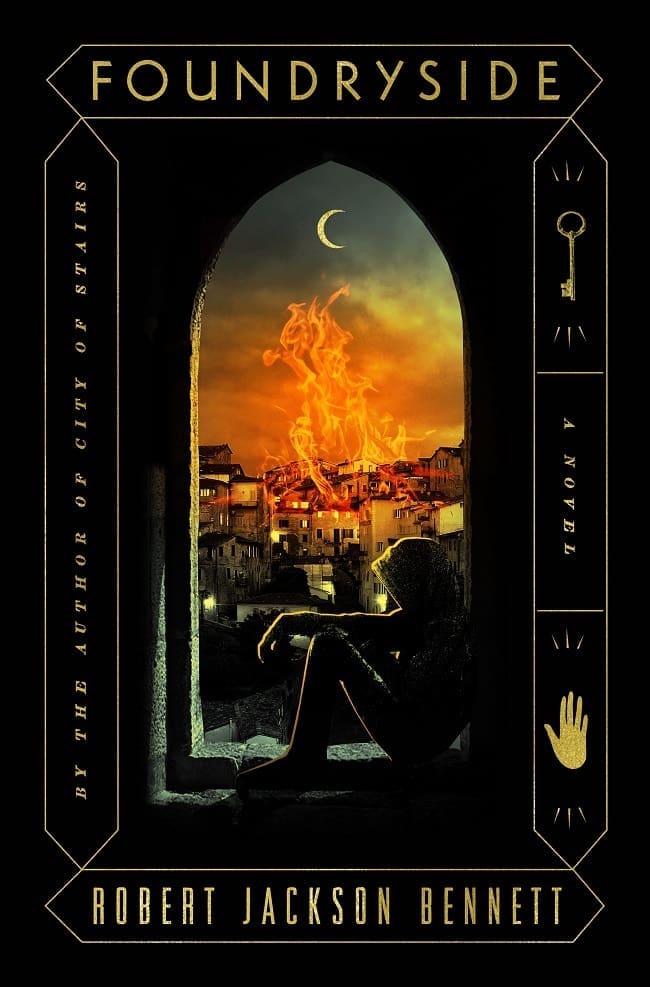


Synopsis
Sancia Grado is a thief, and a damn good one. And her latest target, a heavily guarded warehouse on Tevanne’s docks, is nothing her unique abilities can’t handle.
But unbeknownst to her, Sancia’s been sent to steal an artifact of unimaginable power, an object that could revolutionize the magical technology known as scriving. The Merchant Houses who control this magic–the art of using coded commands to imbue everyday objects with sentience–have already used it to transform Tevanne into a vast, remorseless capitalist machine. But if they can unlock the artifact’s secrets, they will rewrite the world itself to suit their aims.
Now someone in those Houses wants Sancia dead, and the artifact for themselves. And in the city of Tevanne, there’s nobody with the power to stop them.
To have a chance at surviving—and at stopping the deadly transformation that’s under way—Sancia will have to marshal unlikely allies, learn to harness the artifact’s power for herself, and undergo her own transformation, one that will turn her into something she could never have imagined.
Review
A Brilliant World with Characters Still Finding Their Footing
Foundryside follows Sancia Grado, a thief working the streets of Tevanne, a city run by four merchant houses. Her latest job is to steal a box from a heavily guarded warehouse on the docks. Instead of a payday, she walks out holding an artifact that someone powerful will kill to get back. A thief in a city with no real law has few places to run, and an ancient war that should have stayed buried starts waking up.
The world is the best thing here. Scriving is the practice of writing commands onto objects until they believe something new about themselves. A lock can be convinced to open only for the right blood, a plank of wood can be persuaded it is stone, and a belt can be talked into ignoring gravity. The result reads like a cross between sorcery and programming, and Bennett finds clever, surprising uses for it. Some of the most memorable moments come when the rules are pushed too far and things go horribly wrong.
The setting gives that magic weight. The merchant houses hold their own walled campos, each with its own schools, markets, and customs, while everyone else scrapes by in the Commons. Magic is the engine of the city’s wealth, and the book keeps asking who gets to own it and who pays for it. Sancia herself is a former slave with a gift that makes her an excellent thief and a constant target. Behind all of it sit the Hierophants, the vanished makers of the original scrivings. The mystery of what they built and what became of them kept me hungry for more. I finished the book wanting to know what the world looked like before the story began.
The plot pulled me along just as strongly. It opens as a heist, then widens into a chase, with Sancia hunted from several directions at once. The stakes climb from her own survival to the fate of the whole world. Each new reveal about the artifact sharpened my curiosity, and the story made me eager to see what came next. A small band of misfits gathers around her, including a scriver of foul reputation and the sharp assistant who keeps his work on track, plus a city captain trying to bring law to a place that has none.
The prose is workmanlike. It stays clear and unfussy, never flashy and never in the way. Action scenes are easy to follow and the magic is easy to picture, so the ideas and events carry the story without the writing competing for attention.
The characters are where I struggled. I had a hard time connecting with them, and I never felt I understood them well. Conversations often seem to head wherever the plot needs them to go, so the dialogue sounds less like real people and more like a scene being steered. Even the talking key, a clever idea with a tragic past, could not pull me fully in. The romantic subplot arrives suddenly with little reason behind the attraction, which left it feeling unearned. A bit more time spent building those bonds would have made the emotional beats hit harder.
Even so, I came away interested in where the series goes. The world and its history have a great deal of room left to explore, and the foundations laid here are strong. If you love inventive magic systems and want a clever fantasy with a thief at the center, Foundryside is worth picking up.


Leave a Reply