
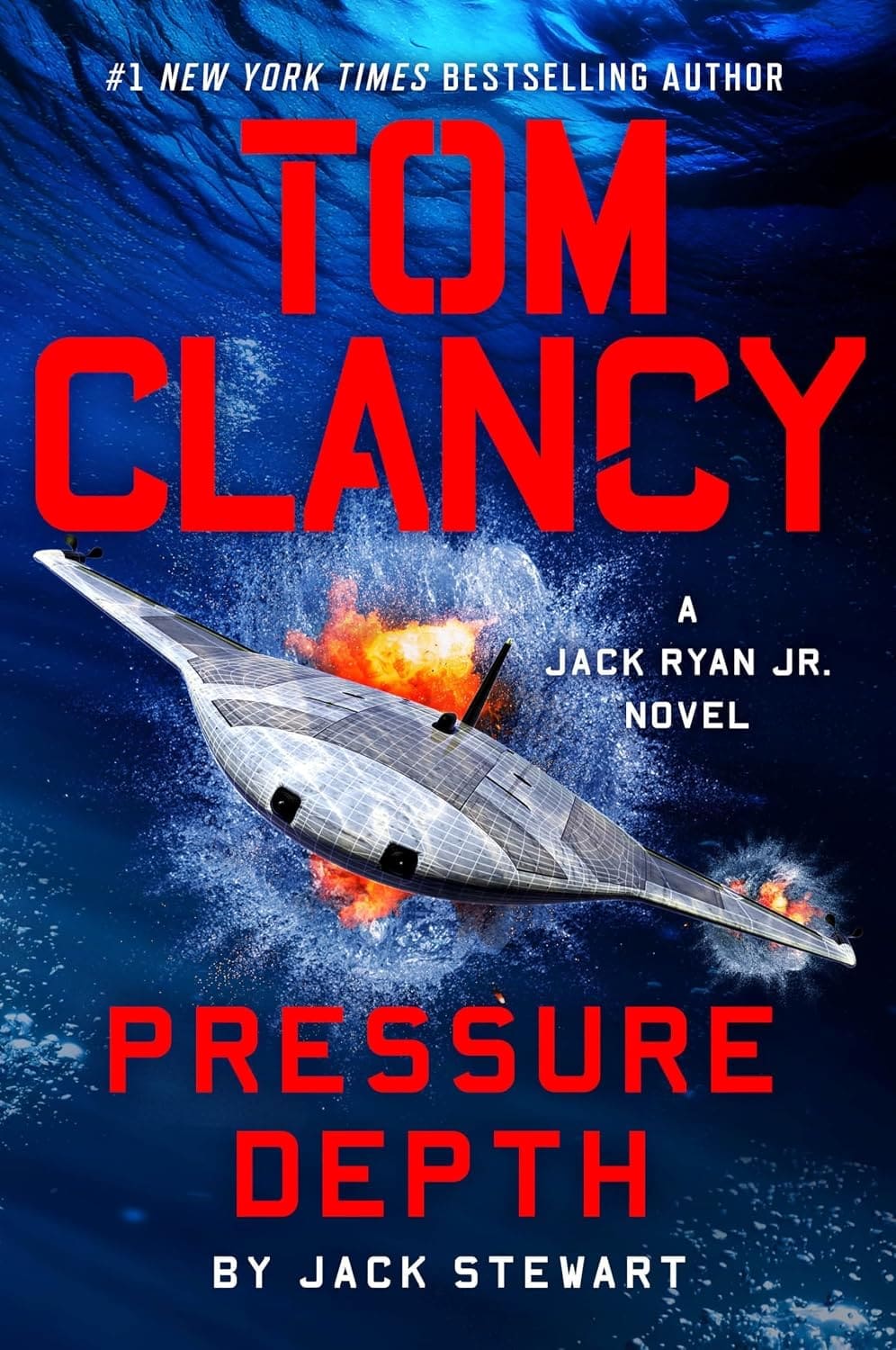


Synopsis:
Some secrets are best left at the bottom of the ocean. But since that’s not in Jack Ryan, Jr.’s nature, he’ll battle all of China to stop them from finding a weapon of immense destructive power in the latest entry in the #1 New York Times bestselling series.
Jack Ryan Jr. is on Guam to work on a project for Hendley Associates. It’s a perfectly ordinary insurance matter, but trouble finds the Ryans wherever they go. So, it’s no surprise when Jack’s involvement with a US Navy dive team working off the coast uncovers a threat to international security.
For years, rumors persisted that the Soviets had placed a device for tracking American submarines on the sea floor. By now, the technology should be outdated. But the Americans are still interested in recovering it. It’s a seemingly routine mission until they make a shocking discovery: the defensive network they thought they were looking for is actually a weapon unlike anything they’ve ever seen.
That explains the arrival of a Chinese special operations team who seem determined to get their hands on the aging tech, even if they have to kill to do it. They’re sure they can handle the Americans. But they don’t know Jack.
Review
After a pair of misfires from Grant Blackwood and an increasing series of missteps and frustrations with the series under Mike Maden, I had all but written off the Jack Ryan, Jr. series. Since spinning-off into his own series from the mainline Jack Ryan books, little effort was made to really establish Junior as somebody worth reading about, never mind rooting for. Past efforts did little to convince me that Junior was nothing more than a cash grab by the Tom Clancy Estate as they attempted to put their own spin on Mitch Rapp and Jack Bauer. The cardboard-thin Junior oscillated between being a rich nepo baby looking for action who survives each adventure due only to the durability of plot armor, and a heavily plot armored rich, whiny nepo baby with a teenager’s maturity that hates such liberal conceits as free speech, climate change, masking up, and protesting fascism, and who consistently ignored his boss’s orders in favor of going rogue but was somehow able to still hold down a job as a secret agent for an off the books black ops org known as The Campus because, again, rich nepo baby plot armor.
Being the product of a dead author’s literary estate means that there’s a high turnover in house writers. In Michigan we joke that if you don’t like the weather, wait an hour or two and it’ll be different. A similar concept applies to the Jack Ryan Universe and its stable of authors. Don’t like the current run? Give it a year or two and somebody new will be at the helm soon enough. After DNF’ing Maden’s Enemy Contact, I sat out the Don Bentley and M.P. Woodward books, but decided to give Jack Stewart and his Pressure Depth a try.
Admittedly, I wasn’t intending on ever picking up another Jack Jack book. I figured him for an irredeemable lost cause after Maden’s nuttery, but larks are gonna lark, I suppose. Stewart’s hook revolving around Junior getting involved with a dive team and having underwater adventures reeled me in. I’m a sucker for big, action-packed sea stories like this.
Junior’s working a white side case for Hendley Associates, the venture capital front for The Campus, in Guam to determine if a sunken ship fits the bill for an insurance claim. He’s really there for the black side of the op, though, to determine if the ship’s haul of radioactive material was stolen and by whom. Nearby, a Naval research ship is conducting tests of an unmanned underwater drone when Chief Carla Bennet discovers Cold War-era Russian tech on the sea floor. Jack is tasked with recovering it, but lo and behold, the Chinese get wind of things and are themselves hellbent on taking control. Jack and Stewart decide to forego any further explorations about the sunken ship, leaving that plot line and plenty of hay made over insurance fraud to resolve only somewhat as they strike out in favor of richer and more compelling plot points hidden in Davey Jones’s locker.
Stewart pulls on some threads from previous Jack Ryan, Sr. books, primarily Andrews & Wilson’s Defense Protocol and Ward Larsen’s Rules of Engagement, both of which feature Junior’s far more interesting, smart, and quirky sister, Katie, the real heir apparent of Jack Ryan, Sr. Seriously, retire both Jack Ryans and let her take center stage, I’m begging you. Neither of these aforementioned books are required reading here, but they do make Pressure Depth’s Chinese plotline feel redundant, particularly after being handled so neatly in Defense Protocol.
Junior doesn’t exactly escape accusations of being Temu James Bond, either, with a storyline that recalls, at times, Thunderball and The Spy Who Loves Me. Thankfully, his relationship with Bennet is kept mostly professional, aside from his lame attempts at flirting, which she promptly and correctly shuts down. This is for the better, as neither character is particularly well-developed beyond being cardboard stock characters. Should they ever find themselves in a romantic entanglement that bears them offspring, I fear their children risk being born with all the dimensionality of a flatfish.
But I guess nobody’s reading these books because the characters are so memorable, keenly defined, charming, and sharply written. When given the inglorious task of writing for a fundamentally uninteresting character like Jack Ryan, Jr., Stewart does the smart thing by putting that character into interesting situations. Action scenes are well staged and exciting, both on land and off. Plunging Junior and his retinue of soldiers to the bottom of the ocean floor makes for a welcome change of pace, not to mention scenery. Typically, such underwater adventures would be aboard a submarine, but not here. Stewart spends a good amount of time tackling the science required for deep sea dives and getting his characters properly pressurized before putting them under different kinds of extreme pressures required to save the world. Where Stewart really shines is in tackling the sense of claustrophobia and overwhelming panic that comes with being trapped underwater and alone in the dark. There’s a horrifying peril to it all, and the sea can be deadly in severely awful ways, like rapid depressurization of the human body, that being trapped on land can’t even fathom.
I greatly enjoyed Stewart’s layman explanations about dive prep and the warnings about what could possibly go wrong, as it provided enough real-world grit to make the more outlandish elements a bit more forgivable. One error I couldn’t ignore, and it’s possible it’s just an artifact particular to this advance copy that will see itself fixed in the final published work, is the references to President Jack Ryan’s cabinet member, Robert Burgess, as the Secretary of War, rather than his proper title of Secretary of Defense. As far as I know, Congress has not passed any laws whatsoever allowing for the change in title, in either the Jack Ryan Universe or here in our real world. “Secretary of War” and the “War Department” are nothing more than silly affectations of our current sadly real-world administration that will hopefully read as incredibly outdated sooner rather than later, bestowed by a 34-time convicted felon, rapist, insurrectionist, and dementia-addled pedophile currently hellbent on poisoning America’s food supplies upon another debauched sex pest Christofascist who can’t bench press properly. Jack Ryan’s better than that, and I would certainly hope that former Navy fighter pilot Stewart is, too.
Pressure Depth doesn’t reinvent the wheel, nor does it miraculously turn Jack Ryan, Jr. into a hero suddenly worthy of his own series, but it’s mostly a decent read, aside from a few minor plot threads. I’ll be curious to check out Stewart’s follow-up. Hopefully he doesn’t drop the ball as badly as Maden did during his tenure, but that feels like a low bar to clear, even in an America currently defined by the lowest bars of them all.




Leave a Reply