
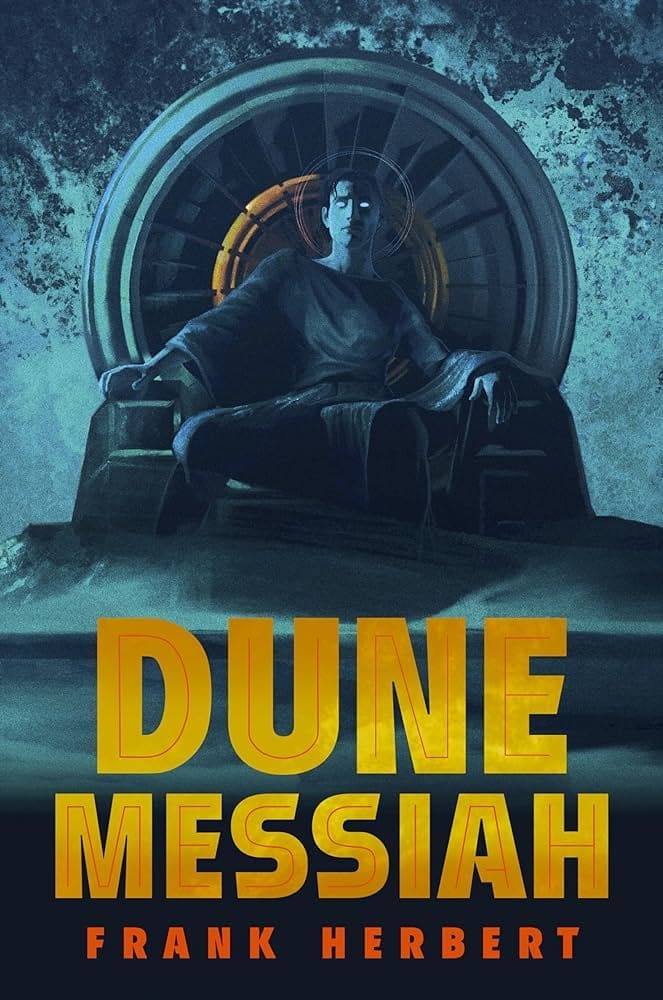


Synopsis
Dune Messiah continues the story of Paul Atreides, better known—and feared—as the man christened Muad’Dib. As Emperor of the known universe, he possesses more power than a single man was ever meant to wield. Worshipped as a religious icon by the fanatical Fremen, Paul faces the enmity of the political houses he displaced when he assumed the throne—and a conspiracy conducted within his own sphere of influence.
And even as House Atreides begins to crumble around him from the machinations of his enemies, the true threat to Paul comes to his lover, Chani, and the unborn heir to his family’s dynasty…
Review
“Here lies a toppled god–
His fall was not a small one.
We did but build his pedestal,
A narrow and a tall one.
- Tleilaxu Epigram”
Once again, I marvel at Herbert’s writing. This book doesn’t reach the high highs Dune reached for me but that doesn’t mean that I find Herbert’s writing and the world he’s creating any less spectacular. This book is set 12 years after the ending of Dune and almost entirely deals with Paul Muad’Dib as the emperor trying to deal with the events he has set in motion and the double edged sword of prescience. Throughout the book, Paul undergoes psychological torture through the constant burden of impending tragedies and all of the story happens in his court and residence.
I wrote more than two whole pages for my Dune review but I am not going to do that here even though Dune Messiah definitely deserves it. I am simply not doing it because I have Children of Dune to get to. I will just note down what I feel are Herbert’s biggest strengths. This book is more of an exploration of Paul’s character in his role as the emperor and the wars being waged in his name. I was already amazed at how much Herbert bares the soul of Paul in Dune #1 but this book is almost exclusively a deconstruction of, and his character study. He’s trapped under the weight of prescience and being a religious dictator. The biggest observation I had is how Herbert doesn’t over explain the symbolism of Paul’s actions. He lets the reader think.
“I told him that to endure oneself may be the hardest task in the universe.”
I also have to commend the author again on how well he constructs political machinations and how he sets up the narratives and payoffs from both sides and how delicious it is to see the plots within plots work. He’s the master of keeping the readers intrigued while he has already expounded the plot points that are going to take place. This book is also darker than Dune and more narrow in scope (only focuses on 6 major characters: Paul, Chani, Irulan, Hayt, Alia, Scytale.) It also completely gives a new context to the events of Dune and reminds readers how stark and tragic reality can be.
“What of the other power groups?”
“One invokes the name of government,” Scytale said. “We will annex the less powerful in the name of morality and progress. Our opposition will die of its own entanglements.”
In conclusion, Dune Messiah is a shorter sequel that packs a huge punch, is a very important book about the consequences of absolute power, and sets up book 3 wonderfully. I cannot wait to read Children of Dune.


Leave a Reply