
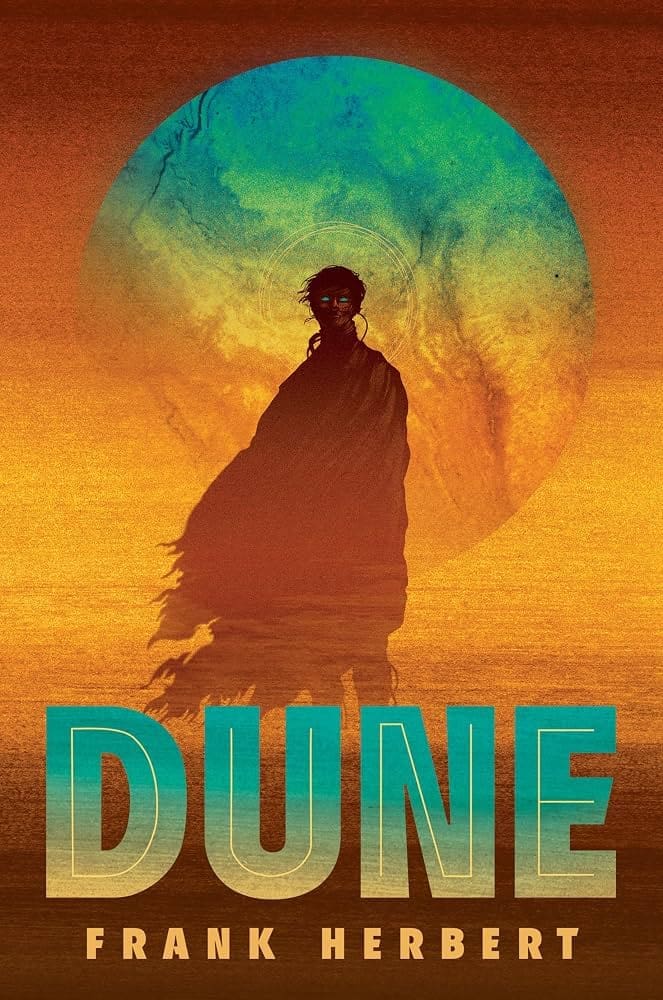


Synopsis
Set on the desert planet Arrakis, Dune is the story of the boy Paul Atreides, heir to a noble family tasked with ruling an inhospitable world where the only thing of value is the “spice” melange, a drug capable of extending life and enhancing consciousness. Coveted across the known universe, melange is a prize worth killing for…
When House Atreides is betrayed, the destruction of Paul’s family will set the boy on a journey toward a destiny greater than he could ever have imagined. And as he evolves into the mysterious man known as Muad’Dib, he will bring to fruition humankind’s most ancient and unattainable dream.
Review
“Why do you test for humans?” he asked.
“To set you free.”
“Free?”
“Once, men turned their thinking over to machines in the hope that this would set them free. But that only permitted other men with machines to enslave them.”
Well that was an easy 6 out of 5 star read. My first marvel is how did Herbert write this in the 1960s? 60 years hence then and he has stolen my breath. Dune joins a special rank of books for me, that includes Lies of Locke Lamora, Jade War, Fifth Season, The Blade Itself, and Sword of Kaigen. All top books for me, but I will never be able to give you a structured answer or point to the specifics of why these books rate so high. I will however endlessly ramble on about it.
We have to start with Hitchcock’s bomb under the table rule. He said, if it suddenly explodes during a normal conversation without the audience knowing it is there, the viewers feel a brief moment of shock. But if the audience sees the bomb planted and knows it will go off at a certain time, an ordinary conversation becomes gripping and tense. He accorded that whenever possible, the public should be informed of the danger ahead of time to create maximum engagement and worry.
“You cannot go on forever stealing what you need without regard to those who come after. The physical qualities of a planet are written into its economic and political record. We have the record in front of us and our course is obvious.”
This idea paid absolute dividends for Dune and Herbert’s writing style. Dune features epigraphs prominently before each chapter that reveals major plot points that are further in the story. And he takes his time to explore the culture, traditions, ecology, technology, politics, and religion widely instead of focusing solely on the plot of the story. In another book this would have led me to complain about the plot being ruined and that people are just standing and talking- but no, in Dune, Herbert has imbued some form of magic with his writing that I found all of this enthralling. A man can just be writing about the desert and how dry it is and what sort of ecosystem is formed in the desert and I can be captivated.
“Folds upon folds of dunes spread beyond their shelter. Away from the setting sun, the dunes exposed greased shadows so black they were like bits of night.”
In a way, this book feels like the deconstruction of a fantasy book. It has the now popular tropes like the chosen one, dictatorial lords, an almost magic system, giant monsters but then Herbert introduces genuine physical, political, and sometimes emotional consequences to all of these fantasy elements. For e.g., the shield technology is amazing but it can’t be used on Arrakis because it will call forth the giant sand worms and drive them to a killing frenzy.
And I love the way he sets up everything- the narrative setups and payoffs are simply brilliant. The Bene Gesserit breeding program and the Gom Jabbar, Dr. Yueh’s betrayal, the way Missionaria Protectiva is seeded in Arrakis prior to the arrival of house Atreides, the way the desert ecology and sandworms function are all exceedingly impressive but even more so are the subplots, foreshadowing, and the political machinations. I love that Herbert shows it to us from both sides as it is delicious to see the geniuses at play from either end. These are not spoilers as they’re from the early chapters and I’m not posting the actual lines that connect but just the preamble to them-
Chapter 2:
“In a few days Standard, the entire household of the Duke Leto will embark on a Spacing Guild liner for Arrakis. The Guild will deposit them at the city of Arrakeen rather than at our city of Carthag. The Duke’s Mentat, Thufir Hawat, will have concluded rightly that Arrakeen is easier to defend.” “Listen carefully, Feyd,”the Baron said. “Observe the plans within plans within plans.”
Chapter 6:
“Knowing where the trap is- that’s the first step in evading it. This is like single combat, Son, only on a larger scale- a feint within a feint within a feint… seemingly without end. The task is to unravel it. Knowing that the Harkonnens stockpile melange, we ask another question: WHo else is stockpiling? That’s the list of our enemies.”
Coming to my one true love- characters, I am just going to say Oh My God. The struggles, growth, bonds, and flaws amongst the characters in Dune are extraordinary. Herbert is so masterful that he bares all the characters so much to the readers sometimes not even very directly but as a direct effect of this causality, we are all the more immersed and believe all of it is real. I didn’t even have to wait more than 5 chapters to see the character work at play. Every character is a work of art in themself- Paul, Jessica, Chani, Count Fenring, Stilgar, Duncan Idaho, Halleck, the Baron, Gaius Helen Mohiam. I could see so many parallels between Leto Atreides and Ned stark- both on the heroic and flawed ends of the spectrum. And except for the last quarter of the book, this story really felt like Lady Jessica’s story and not Paul’s.
“See, Majesty?” he called. “See your traitor’s needle? Did you think that I who’ve given my life to service of the Atreides would give them less now?”
The scope of the story and the breadth, width, and enormity of the world created here is what makes me lose my breath here. And it’s all achieved through just simply characters talking and showing multiple POVs- oh how magical writing truly is. I said it earlier, I will say it again now, and I will keep saying it forever: how was this book written in the 1960s? Herbert’s just violently glorious in his craft. Just as I felt while walking out of the theatre after Denis Villeneuve’s Dune Part Two, I was literally scared after finishing the book. Chapter 47 of this book is the most cinematic piece of writing of any sff book I’ve read so far.
I can truly write another 1000 words more about my appreciation for Dune and another 1000 after that but I’m stopping here because I’ve to go catch Spiderman: Brand New Day. I am sure there aren’t many of you who have not read Dune yet but if there are, please give it a try- especially via the Simon Vance full-cast audiobook. It is one of two books that I’ve ever reduced the speed of to relish it more.


Leave a Reply