
Written by Felix Mosse, author of The Mistral, an epic fantasy novel published on May 28th
There’s a specific kind of reading experience I keep coming back to. Not the feeling of turning pages, but rather the feeling of missing a character when you put the book down. Like you’ve stepped out mid-conversation and they’re still in there somewhere, doing something without you.
That feeling is built. Deliberately, structurally, by writers who understand what they’re doing. Across roughly a decade of script editing – for television, film, and theatre – and the years I spent writing my debut novel The Mistral, I’ve come to think the characters who produce that feeling tend to share five qualities. Not the same personality type. Not the same moral alignment. Not even the same narrative function. Five structural qualities that make a reader willing to go wherever the character goes, and resent it slightly when the book ends.
1. They’re Wrong About Themselves
Not in a charming, self-deprecating way. In a way that costs them something.
The most compelling characters carry a gap between who they believe they are and who they actually are. That gap tends to be visible to the reader before it’s visible to the character, and watching someone operate confidently on a false self-image is one of the most reliable engines in fiction. It creates tension without anyone having to shout, and builds investment without requiring sympathy.
Ged, in Le Guin’s A Wizard of Earthsea, believes early on that his power is the measure of him. His pride is not vanity exactly; it’s a misreading of where he ends and the world begins. The whole novel is the slow, costly process of him learning what he actually is – and the shadow that costs him is, of course, made of the part of himself he refused to see. Sanderson does something similar with Vin in Mistborn. She enters convinced she is, fundamentally, a tool – someone who survives by expecting betrayal and preparing to inflict it first. Three books are built on the distance between that belief and the truth. We can see what she can’t, and the asymmetry is almost unbearably compelling.
What I notice in editorial work is that writers often make their characters accurately self-aware, which feels like a virtue and is actually a problem. Self-knowledge is static. What we follow is the process of someone discovering something about themselves they would have preferred not to know.
2. They Choose. Even Badly.
Agency is the prerequisite for everything else.
A character to whom things only happen is not a character. They’re a viewpoint device. Interesting events can occur around them, but we’re not following them so much as riding behind them. The moment a character makes a real choice – costly, genuinely theirs – the reader’s relationship to them changes.
Here’s the test I use in script notes. If the same plot could happen to a different protagonist without fundamentally changing, your character is essentially interchangeable. They haven’t made a real choice yet. The story is happening to a person-shaped space.
This doesn’t mean the choices have to be good. Characters who consistently make excellent decisions are often the most boring people in their own stories. The choices have to be genuine. Made under pressure, with real options foreclosed, revealing something in the direction taken. A character who could have gone left and went right has given us information. A character to whom the plot simply delivers its next event has given us nothing except what happens next.
3. Their Greatest Strength and Their Greatest Liability are the Same Thing
I have sat in a lot of production meetings where the note on a character is “they need a flaw.” It’s not wrong, exactly, but it tends to produce characters with bolt-on weaknesses that don’t cost them anything structural. A quick temper that flares once and disappears. A fear of commitment that resolves cleanly in act three. A drinking problem that never forces the decisive wrong choice. Those aren’t flaws so much as scheduled visits from one.
A structural quality is different. Remove it, and the character becomes someone else entirely. It’s the same material as their greatest strength, inseparable rather than additional, and every significant decision in the story runs through it.
Ibram Gaunt in Dan Abnett’s Gaunt’s Ghosts series is a brilliant commander precisely because he won’t spend his soldiers the way other commanders will. That same quality makes him a political liability, an insubordination risk, and occasionally gets people killed who might have survived under a more pragmatic general. You cannot extract the virtue from the cost; they’re the same material. Robin Hobb does this with FitzChivalry to such an extent that it’s almost cruel to watch. His loyalty is so absolute it becomes the mechanism by which he is repeatedly, predictably destroyed. If you took the loyalty away, the Farseer trilogy would not exist. There would be no one to break.
When a character’s defining strength is also their most dangerous tendency, the story stops being about whether they will succeed and starts being about what they will pay for being who they are. Plot suspense is a finite resource. Suspense about a person is not.
4. We Recognise Their Desire, Even When We Don’t Like Them
Likeability is a trap. Not because it’s bad to like the people you’re reading about, but because likability can become a substitute for something more fundamental: legibility of desire.
We follow characters whose want we can locate in ourselves. Not admire. Not endorse. Locate. A character who wants power over others is following an impulse most people would publicly disavow and privately recognise. A character who wants to be truly seen by the one person whose opinion they have built their entire identity around is following an impulse so common it’s almost embarrassing. That recognition is what creates investment.
Susanna Clarke does this with rare exactness. Stephen Black in Jonathan Strange & Mr Norrell wants something so specific and so reasonable – to be a person rather than a possession, to belong somewhere of his own choosing – that you feel the shape of the want long before the plot lets him near it. You don’t need to share Stephen’s circumstances to understand what he is reaching for. You just need to have wanted, once, to be seen on your own terms.
The moral dimension of a character’s desire is largely irrelevant to how compelling they are. What matters is whether the reader can feel it as a real thing, rooted in a comprehensible human experience. Characters we find reprehensible can be utterly gripping if their desire is legible. Characters we admire can be unaccountably dull if their desire is too abstract, too noble, too sanitised to recognise as our own.
5. They Feel Like They Exist When We’re Not Looking
This is the hardest quality to engineer and the most immediately recognisable when it works.
The best characters give you a faint, slightly uncanny impression that they are doing something when you close the book. Arguing with someone. Staring out a window. Arriving at a decision you will not get to find out about. They feel continuous rather than constructed, inhabitants of the world of the story rather than instruments of it.
What produces that sensation is, at root, specificity. Characters who feel real are built from details that don’t seem chosen for their utility. The particular way they deflect a certain kind of conversation. The opinion they hold that serves no plot function. The small habit that tells you about the life they had before the story started caring about them. These details don’t explain the character. They make them feel inhabitable.
Abnett does this better than almost anyone working in genre fiction (can you tell I’m a huge fan). His soldiers, even the secondary ones, feel like they were in the middle of something before the scene started and will resume it the moment it ends. The reader’s experience is not of a character being shown to them. It’s of a person being briefly glimpsed.
That’s what’s worth building toward. Not the character you’ve fully explained. The character the reader feels they have only just started to know.
Years of script editing taught me something I then proceeded to ignore for the entire first draft of The Mistral: people rarely care, ultimately, about the things that happen. They care about the people the things happen to. I knew this. I had said it out loud, in notes meetings, with the slight weariness of someone repeating a thing they have repeated before. And I still wrote a draft that was magnificently saturated with cool ideas and almost entirely devoid of stakes, because I was desperate to show off my magic system, or my multiple systems of governance and political shenanigans. (Insert other interesting fantasy mechanic)
The novel only began to work when I stripped the ‘cleverness’ back and let my principal character, Fenne – a duellist, an orphan, a normal person operating inside an extraordinary set of circumstances – actually want something. Once she did, the world I had built around her finally had something to be the world of.
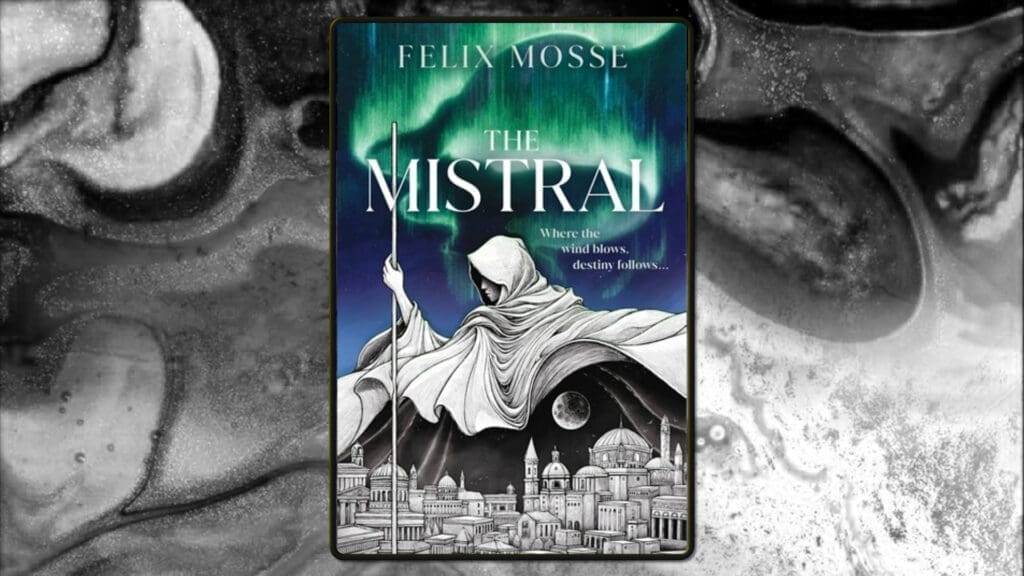
The Mistral is out on May 28th with Penguin Michael Joseph. It is full of political intrigue, ancient mystery, a magic system, and the slow realisation that every character will unearth things about themselves that will change their life, forever. I can’t wait for you all to read it, and see the story I’ve worked on for the past six years. It is epic fantasy as I’ve always been drawn to, but it is also, I hope, primarily about the people moving through it. Because in the end, that is the only thing worth following.
Felix Mosse


Leave a Reply