
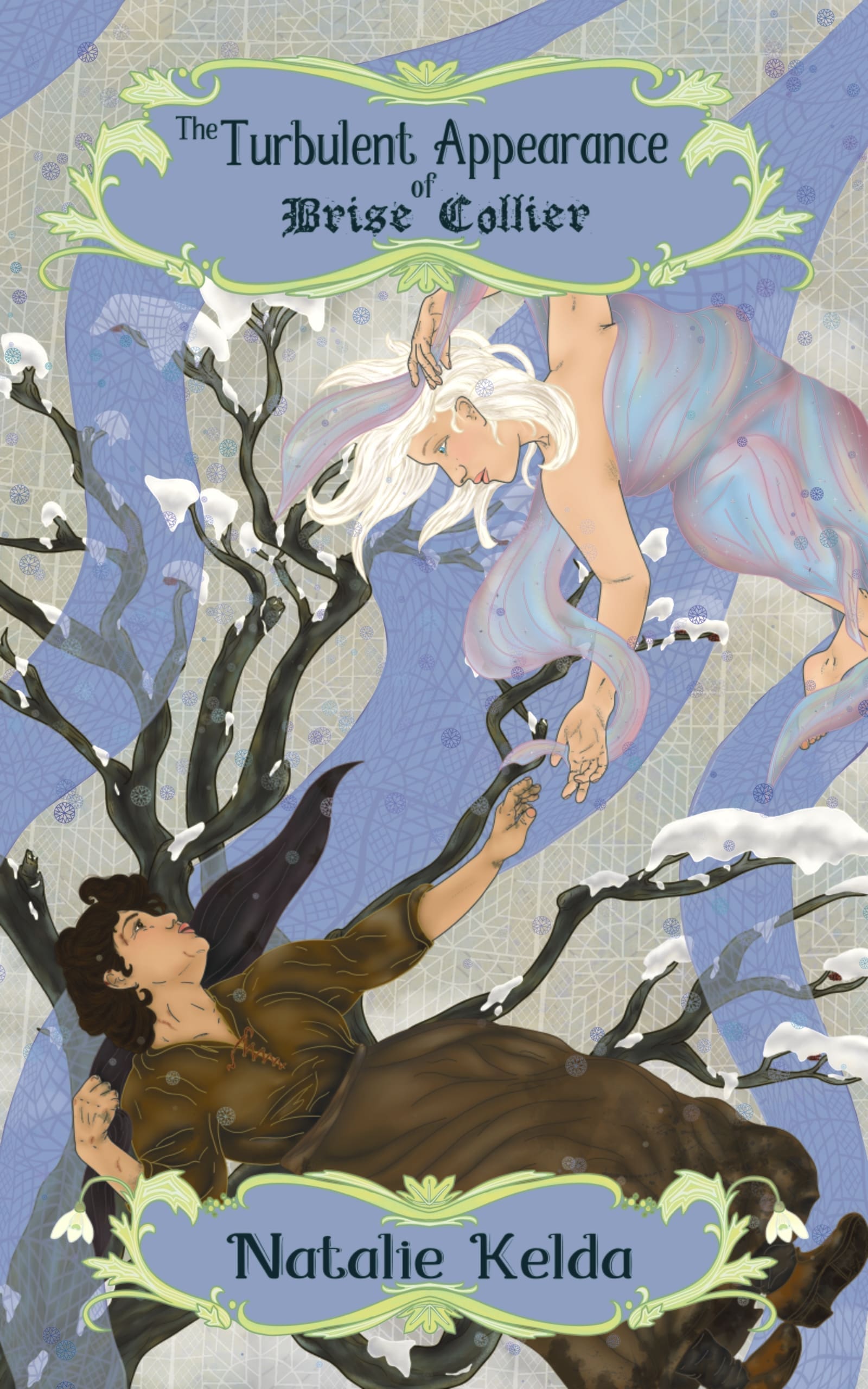


Synopsis
Grief and despondency consumes every moment of Ellie’s waking hours. Or at least every moment that isn’t spent toiling away in the cramped and dark confines of an English coal mine at the turn of the nineteenth century.
She doesn’t believe her dreadful existence can get any worse but then a firedamp explosion claims the lives of two young children right before her eyes.
Brise is an air sprite and has never had a single concern in the eons she has had sentience. Playing chase with her sister in a coal mine as they have done thousands of times before, an open trapdoor captures Brise in a stale air full of firedamp. A spark lights it – changing her life forever.
Ellie didn’t expect to discover a lone survivor from the explosion. But the woman she rescues from the depths of the pit doesn’t quite seem human and her hair and eyes don’t match those of the collier who had entered the pit the day before.
Who is Brise Collier? An evil spirit sent to haunt Ellie, or an angel come to guide her towards hope and healing?
The Turbulent Appearance of Brise Collier is part of the series of standalone novels in the series Folk With a Disregard for Convention which are set in a fantastical version of historical Britain.
Review
This is another excellent work of historical fantasy that fits seamlessly alongside Reflections of Lilje Damselfly, one of Kelda’s related books. Readers who come to this book for the romantic fantasy elements will also gain sensitive insights into the lives of coal mining communities in the early 1800s. The author presents places and historical periods in such an immersive way, that you don’t even realise how much you’re learning about them.
The characters too are very well rounded. In the early chapters of this book, it is made clear that Ellie and her sister’s family don’t take a day together for granted. Death is a regular visitor in their community. It seems that everyone has lost at least one loved one to the mine that keeps them all housed and employed. There is both tenderness and a growing sense of foreboding in the scenes where Ellie gets ready for work with nieces and nephews who are not protected by child labour laws.
This weighted existence is contrasted starkly with the sense of freedom we then experience with Brise, an air sprite untethered from worldly concerns about provision and survival. Time has no meaning as she rides the winds over the British countryside.
This story doesn’t shy away from the specific difficulties faced by women and queer people of this period. Ellie only ever loved one man, and she has been widowed for a long time. The vicar and possibly a few others know that Ellie likes women too, as she was caught kissing a girl when she was young. She is treated with suspicion because of this. Meanwhile an influential young man in the village, James, does not face similar scrutiny for his transgressions involving vulnerable women. However, Ellie’s sister and brother-in-law prove to be a safe place for her.
An accident in the mines brings a fresh wave of tragedy into Ellie’s life. It also plucks Brise from her disembodied existence and places her in the body of a dying woman, Brianna.
I really liked the existential questions that came up. Memories of Brianna’s life are stored in her nervous system, but another part of her, her spirit, has left her physical form. Her skills, her emotions and her past become Brise’s inheritance, and we are left to see what she will do with them. I fully identify with Brise bemoaning the inconveniences of fragile human bodies:
“Bodies, she determined, were sure to cause a lot of the internal brawling of humans.”
Different views are held respectfully. While the story depicts nature spirits as real, it also doesn’t dismiss Ellie’s Christian beliefs. Ellie has no evidence to offer Brise that her human life won’t simply be extinguished, leaving her body to be buried in the earth. Her faith is a source of strength for her, even if the vicar and others don’t see her as a “moral” woman. She and Brise are different. They gently challenge each other, but each woman also lends the other strength in moments of weakness.
Brise has some supernatural encounters, which I won’t spoil, but those who have already read Lilje Damselfly will appreciate nods to familiar mythical beings. Still, Brise is largely left to her own devices, navigating the human world with only Brianna’s experiences as a map.
Not everything is neatly resolved and much of Brise and Ellie’s story is left open to interpretation. Behind the soft romantic elements is the battle to keep the fear of pain from shutting out your capacity to love again. The injustices of Ellie’s society weren’t solved in her lifetime, but it was lovely to see that she, Brise, and her family could fully embrace moments of joy where they found them.


Leave a Reply