
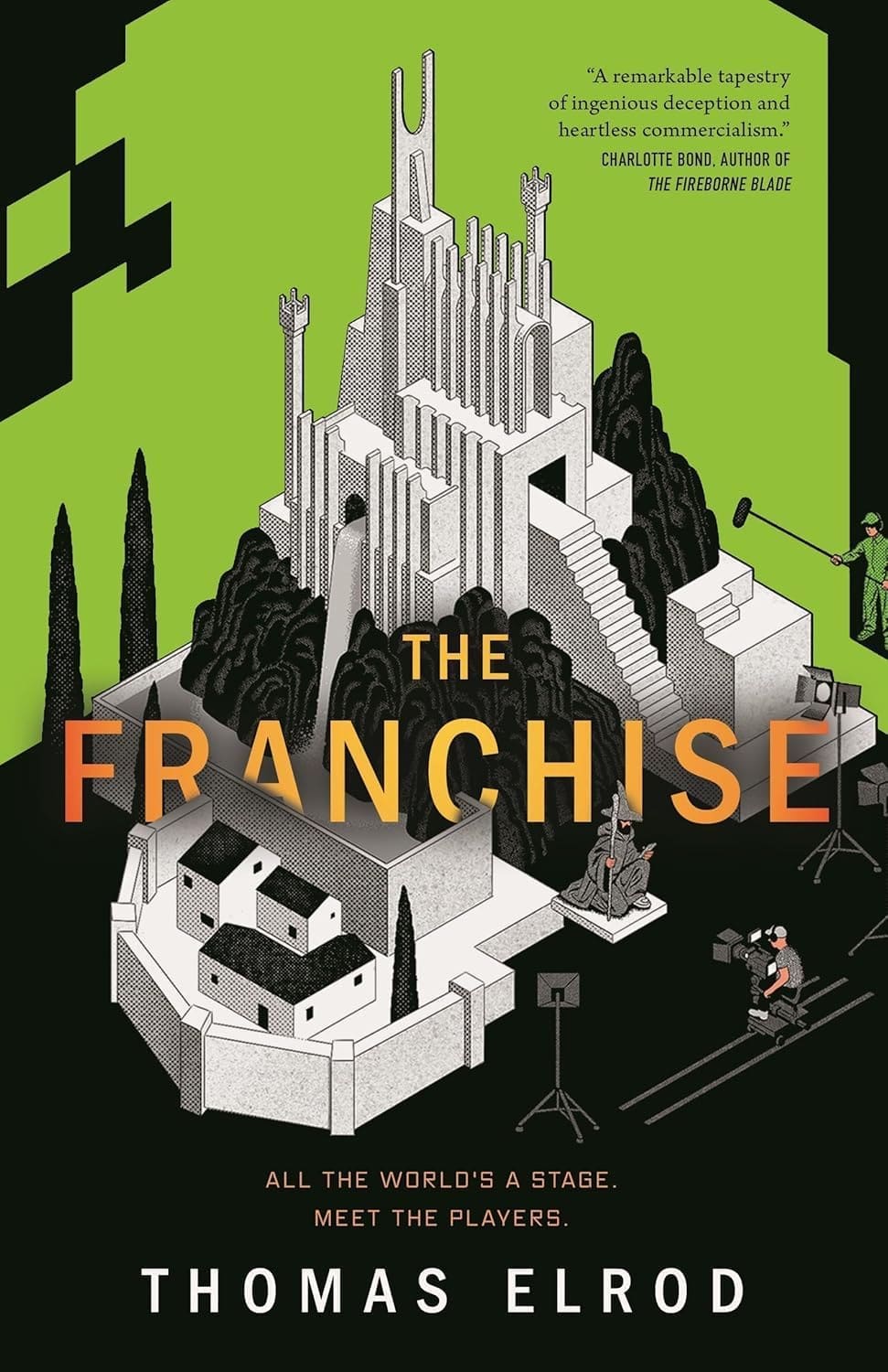


Synopsis
Game of Thrones meets The Truman Show in this epic tale of a Hollywood-owned fantasy world where nothing is quite as it seems to the people who live and die at the studio’s whim.
A land filled with magic and dragons and wizards and warriors.
Thousands of people live and work within its borders, fearful of their enemies and loyal to their king.
The classic fantasy world of The Malicarn has been brought to life on the big screen in a series of phenomenally successful blockbuster movies, almost entirely populated by characters in total belief that their sham fantasy lives are real.
A fan-favorite actor finds himself doubting the studio’s work, but this franchise has an almost unstoppable momentum, and bringing freedom to a population that already believes itself to be free won’t be as easy as he thinks.
Review
This book was an odd experience for me.
I’m a fan of high-concept SFF, and a fan of experimental literary devices. THE FRANCHISE checks both of those boxes, and Elrod can write a truly captivating sequence. He starts dabbling in disorienting perspectives, variably using limited third-person, omniscient, and second-person POV.
But the book as a whole felt largely disjointed, like a patchwork quilt with some patches made of silk and velvet and others made of plain white printer paper. Many chapters were bland, with extremely utilitarian prose; a few standout chapters saw lurid, intense writing.
Like the actual writing style, the structure of the book was all over the place. Elrod is clearly using nonlinear storytelling to some effect—occasionally to great effect. But the first 20% of the book is centered on characters who really aren’t the main characters…and even later in the book, when the main characters take center stage, we keep skipping back-and-forth in the timeline for little apparent reason.
The opening chapters make sense for nonlinear work, helping the midbook reveal and the end of the book land harder. Once we’re in the rising action, however, the flip-flopping mid-scene ended up more frustrating than anything else.
The closing chapters were excellent, though. I absolutely ripped through the last two, totally entranced.
And when it comes to the characters, there’s little to write home about. There are four major characters here, plus a primary antagonist. All five of them are pretty by-the-book: the scientist who sees the horror in soulless technology, the spunky-but-naive girl who carries the torch, the greedy executive who sees only money signs, the bumbling guy who causes chaos despite having good intentions, the Everyman who gets thrust into events beyond him.
There are a few moments late in the book where the characterization takes on some much-needed depth, but it doesn’t really land on an emotional level. One chapter in particular is wonderfully written and crafted, but it’s such an outlier against the rather bland prose and character work throughout the rest of the book that it feels more like a headscratcher than a highlight.
The result is that THE FRANCHISE feels a bit like an unfinished—or maybe unpolished—work. There’s an excellent, five-star book in these pages…but the result in my hands here needed more refinement to get there.
Or maybe I should just say:
This book was interesting.


Leave a Reply