
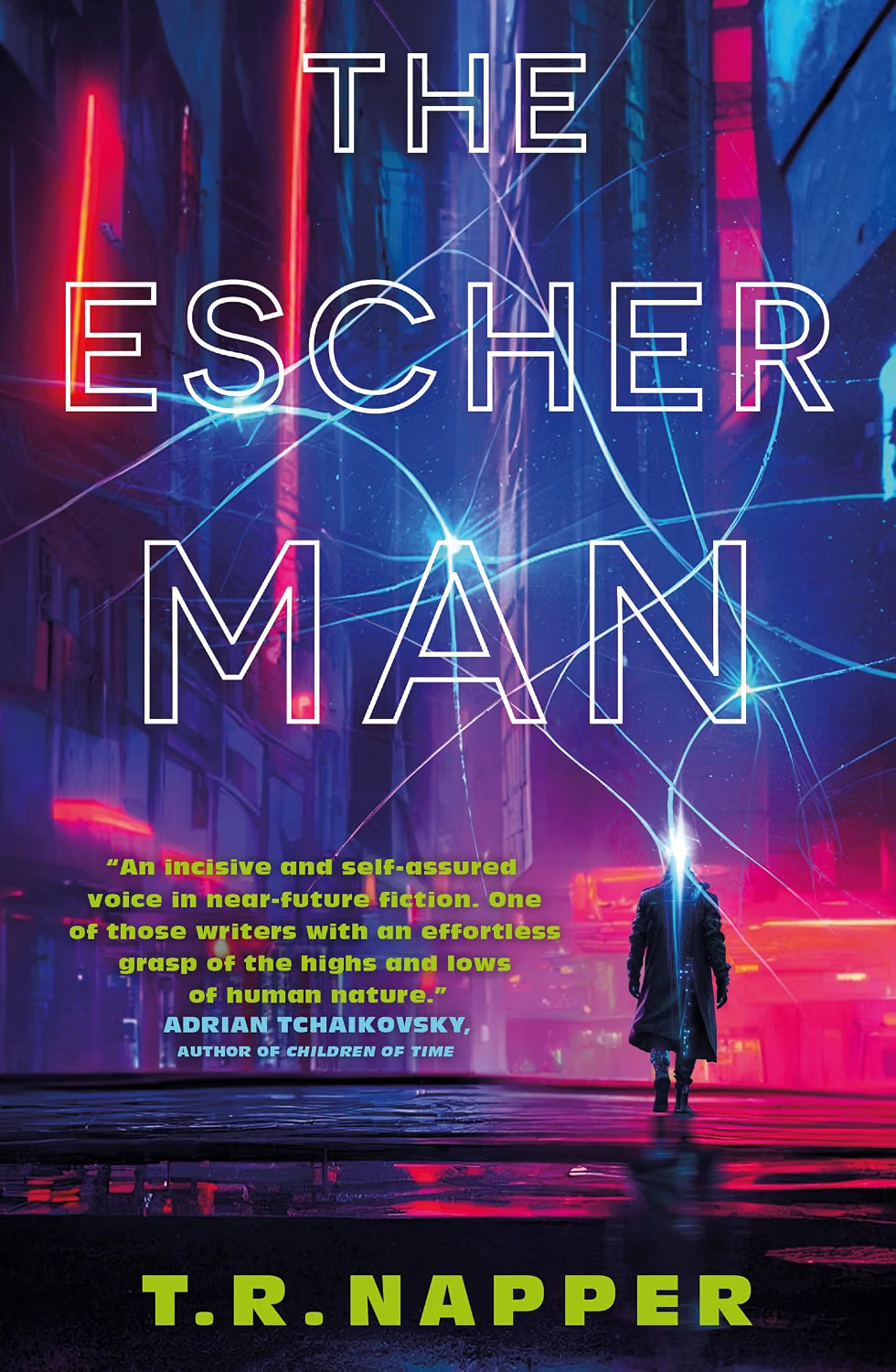


Synopsis
A cartel enforcer across Southeast Asia must escape a world of paranoia and violence to save his family in this cerebral and multi-layered cyberpunk science fiction novel, from the award-winning author of 36 Streets. Perfect for fans of William Gibson’s The Peripheral and Five Minds by Guy Morpuss.
Your name is Endel ‘Endgame’ Ebbinghaus. It is Saturday, 3 September, 2101. You’re head of security for Mister Long, boss of the Macau Syndicate, a drug cartel. Your memories are being wiped and rewritten. You keep this log because you’re hard-pressed to remember what day it is. But today is a special day, mate. This is your last day on the job.”
‘Endgame’ is a violent man, the perfect enforcer. But Endel is also a father and husband—haunted by the memories of his estranged family, and the life they once had.
Endel wants them back, and he wants out. But life in the syndicate isn’t one you can simply leave.
Endgame is a violent man. Or is he? In a world where memory manipulation is the weapon of choice for the powerful, Endel can’t tell friends and enemies apart anymore, can’t be sure if he’s a person or a tool.
Trapped in a taut, twisting nightmare, Endel must find a way to escape the labyrinth they’ve made of his mind, and take revenge.
Quick Review
The Escher Man is a violent story, though beneath that bloody exterior is a thoughtful narrative that is deeply concerned with technology’s impact on memory.
Full Review
Anyone who pays attention to my recent reviews will know that I am a fan of T.R. Napper’s work. I’m convinced that he’s putting out some of the most interesting cyberpunk stories right now (possibly some of the most interesting sci-fi at large). I realize this is extremely subjective, of course, but his books are just so consistently great.
So, it’s no surprise that I loved The Escher Man. It’s a violent story of competing gangs and companies, but there’s a lot of nuance and introspection as well. Every decision Endel makes in this story is driven not by a need for power or money or loyalty to a gang, but rather to his family.
Napper has explored the idea of assisted memory in other stories, he’s mentioned the memory pins his characters (usually) insert into their implants, but this is the most we’ve ever really focused on them. Among the questions he poses is this: what happens when a company or syndicate has direct access to everything that you remember? What happens when they can control which memories you remember, or when they can generate new memories for you—ones that they prefer to your own experiences?
For Endel, the memories people are targeting are more personal: those of his family.
This story takes a while to unfurl, as Endel goes through what are effectively multiple lives, as his memories are made, wiped, and reformatted to match the need of the moment or the whim of those who want to use him. On the surface, The Escher Man is a violent cyberpunk thriller, full of enhanced humans beating each other to a pulp. However, underneath that, Napper explores something much deeper.
I highly recommend The Escher Man. Though this book stands on its own, it feels like the culmination of all his prior work as well. It’s got the brutality of 36 Streets, the complex characters from his shorter stories and novellas, and builds upon a lot of the worldbuilding he’s laid out in those stories—because as far as I can tell this is all happening in a shared world.
Because of that, I don’t know if I’d recommend starting with The Escher Man. If you’re interested in reading Napper’s work, I think his short story collection Neon Leviathan is a superb beginning, because it introduces you to the world and the tone of his stories. 36 Streets and Ghost of the Neon God are both great starting points if you want something with more action. That’s not to say you shouldn’t read The Escher Man, you absolutely should, I just feel like readers will appreciate it more if they’ve read some of Napper’s other work first.
As an aside, I wound up listening to the audiobook of The Escher Man, narrated by Nick Atkinson. He did an incredible job, absolutely nailing the narration for both the violent battles and the more tender scenes. And at just shy of 12 hours long, it’s an easy listen.
Not easy listening, there’s a lot of violence, but you know what I mean.


Leave a Reply