
Synopsis:
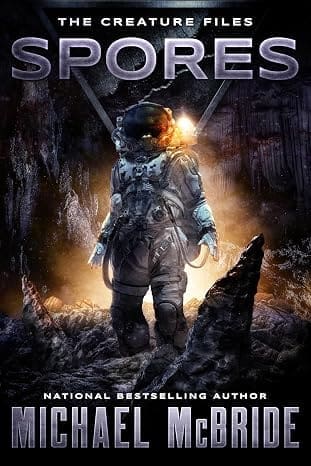


Secrets aren’t the only things that won’t stay buried.
When an earthquake strikes downtown Denver, far from the nearest active fault system, the USGS dispatches Dr. Dayna Raines and an emergency response team to investigate. They discover that the epicenter corresponds to a decommissioned deep injection well once used by the U.S. Army to dispose of chemical weapons, which have eroded the earth and created the unstable cavern system responsible for the seismic activity.
Their mission is to descend into the unknown depths, evaluate the fault zone, and initiate a controlled demolition of the subterranean cavity before another earthquake strikes, causing a mass casualty event. And they’re running out of time.
But military scientists had been experimenting with even deadlier armaments, including a biological organism so lethal that they were forced to bury it two miles down, where no one would ever find it.
Until now.
Review:
Spores is a creepy, heart-pounding story of weapons research gone wrong, real-world history, and a fungal contagion that could mean the end of the world.
I enjoyed this one (I like this sort of horror novel), though I did find parts of it a tad predictable. It begins with an unexpected earthquake centered in the Rocky Mountain Arsenal Wildlife Refuge in Colorado, but within the first couple chapters, it’s evident there’s a lot more going on than unusual seismic activity. There’s an unidentified fungus found at the epicenter, and the scientists brought in to investigate the quake are immediately put under the command of a covert military/government squad responsible for investigating events just like this one.
I really liked that the author included some real-world history to add some plausibility to the tale. I did some research into the Rocky Mountain Arsenal after reading sections of this book, and some of the events mentioned really did happen. There were a series of earthquakes triggered by a deep-injection well in the 1960s (they were using it for chemical waste disposal.) And they were doing some nasty chemical weapons research at the facility back then too, along with some agricultural-related research. All of this plays into the book.
I also liked that the contagion threatening the world was a fungus. In my former career, I worked with a fair amount of fungus in the lab (mostly molds), and I’ve always believed that a super-contagious fungus would be a scarier pandemic scenario than a virus or bacterium. This book fed right into that, and I loved it.
Now, speaking of my former career, I’m also well aware of how long it takes to run certain laboratory tests. This book fell into what I think of as the CSI Effect: Every test done on the fungus was completed in a matter of minutes. Including full genomic sequencing. That speed isn’t possible in the real world. After all of the other research the author clearly did to write this book, I was a little disappointed that they didn’t take the time to do even a quick search on the amount of time required to run those tests.
That aside, I thought this was a fun read. A little The Last of Us, a little The X-Files, and a whole lot of spores to avoid. While this book works well as a standalone, it does leave the ending open for more to come.


Leave a Reply