
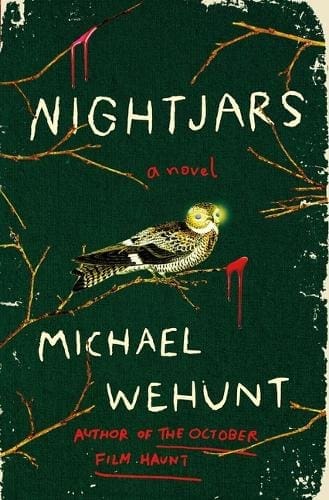


Synopsis:
On a rainy night, Luke Oshel gets stood up halfway through dinner. But before his date walks off to the bathroom and never returns, she leaves an old photograph under her napkin―Luke as a child, a dead body in the shadows of his bedroom, and a terrifying masked man. He has no recollection of this event.
Then more photos disrupt his life―Luke posing with murder victims, covered in blood―and he falls back into the deep paranoia and repressed memories he’s tried to leave behind. All the drugs and alcohol, therapy, and hypnosis sessions have never conquered his deepest fear―that he hasn’t escaped the hidden legacy of his late father, who killed his victims by blood loss. But now there is a new string of serial killings, and the evidence all points to Luke.
Review:
One of the grimmest and most psychologically devastating novels in recent memory, Michael Wehunt’s “Nightjars,” is an utterly original, awfully bleak and relentlessly anxiety-inducing vampire story for the ages. A stunning blend of Appalachian gothic, grisly police procedural and existential bloodsucker horror, Wehunt’s latest reads like Dean Koontz’s “The Bad Place,” meets Keith Rosson’s “Coffin Moon,” meets Michael’s very own gorgeous prose and supernatural proclivity for making readers sweat. A dual-perspective headfuck which has certainly earned its Memento comparison, I read “Nightjars,” with a galloping pulse, dripping palms and a stomach knotted into a tight, cold, white-knuckled fist, and would be thrilled and terrified in equal measure to see it adapted for the silver screen. A cerebral, sinuous and unsparing Appalachian take on the vampire, Wehunt’s latest is an undeniable high-water mark for horror this year, and you can read it for yourself when it releases September 29th from St Martin’s Press.
We follow Luke Oshel, a divorced, recovering addict doing his level best to keep his life together. His date walks out on him one night. When he eventually succumbs to the temptation of the now abandoned Old Fashioned she ordered, and takes it from across the table, what he finds beneath her glass changes everything. Not a napkin, not a phone number, but a polaroid. In it stands a masked man beside a murdered woman, and most shockingly, impossibly, a young Luke Oshel in his childhood bedroom. The picture pulls Luke, his family, and the reader into a labyrinth of repressed memories, trauma and impossible revelations.
Whenever I tell people that I read for pleasure it sort of makes me giggle, because such an exercise is often, understandably conflated with relaxation. So, a disclaimer, if you’re looking for a book you can unwind with, switch off, put your feet up, and let your heart rate drift gently downward to, “Nightjars,” isn’t that book. The psychological horror in this book is some of the most intense around, Wehunt demonstrating that the mind can haemorrhage just as catastrophically as the body, perhaps more, and whilst Luke’s torment undeniably exceeds our own as readers, we’re also put through the wringer. Wehunt could be a phlebotomist (or a vampire) the way that he siphons all semblances of safety, comfort and certainty from this novel. Nobody involved, again, including us, can distinguish memories from nightmares, hard truths from fabrications, intuition from anxiety. Each revelation is quickly followed by 100 other questions, each answer arriving pale and dizzy. It’s a masterclass in sustained tension, and it might break you out in hives, give you a migraine or leave you stuck with your shoulders level to your ears if you read it for too long.
Psychological warfare aside though, “Nightjars,” is not lacking in either depth or commentary. Luke is an unreliable narrator but a tragic unreliable narrator, not a duplicitous one, he is fumbling for the lightswitch with bloodshot eyes and wants to understand as much as we do. Wehunt is commenting upon childhood and generational trauma, the novel asking what sort of adult emerges from a childhood built upon terror, conspiracy and violence. Or to put it less delicately, what happens to your wellbeing when your dad makes you an accessory to murder? Trauma here is inherited, passed selfishly from parent to child as reliably as a crooked nose, an eye colour or a last name. The title itself (a clever one that encompasses various aspects of the story) is described in the prologue as a container for darkness that can be shelved, referring presumably to the memories Luke represses. Of course, buried memories are not dead ones, and forgetting is not the opposite of remembering.
A dizzying, disorienting must-have for readers looking to emotionally decimate themselves, “Nightjars,” is an utter triumph of high altitude horror. A vampire story that leaves its readers lightheaded also, Wehunt’s psychological labyrinth of a sophomore novel will get under your skin and settle into your bloodstream.
Which come to think of it, is probably preferable to being exsanguinated altogether.


Leave a Reply