


Synopsis
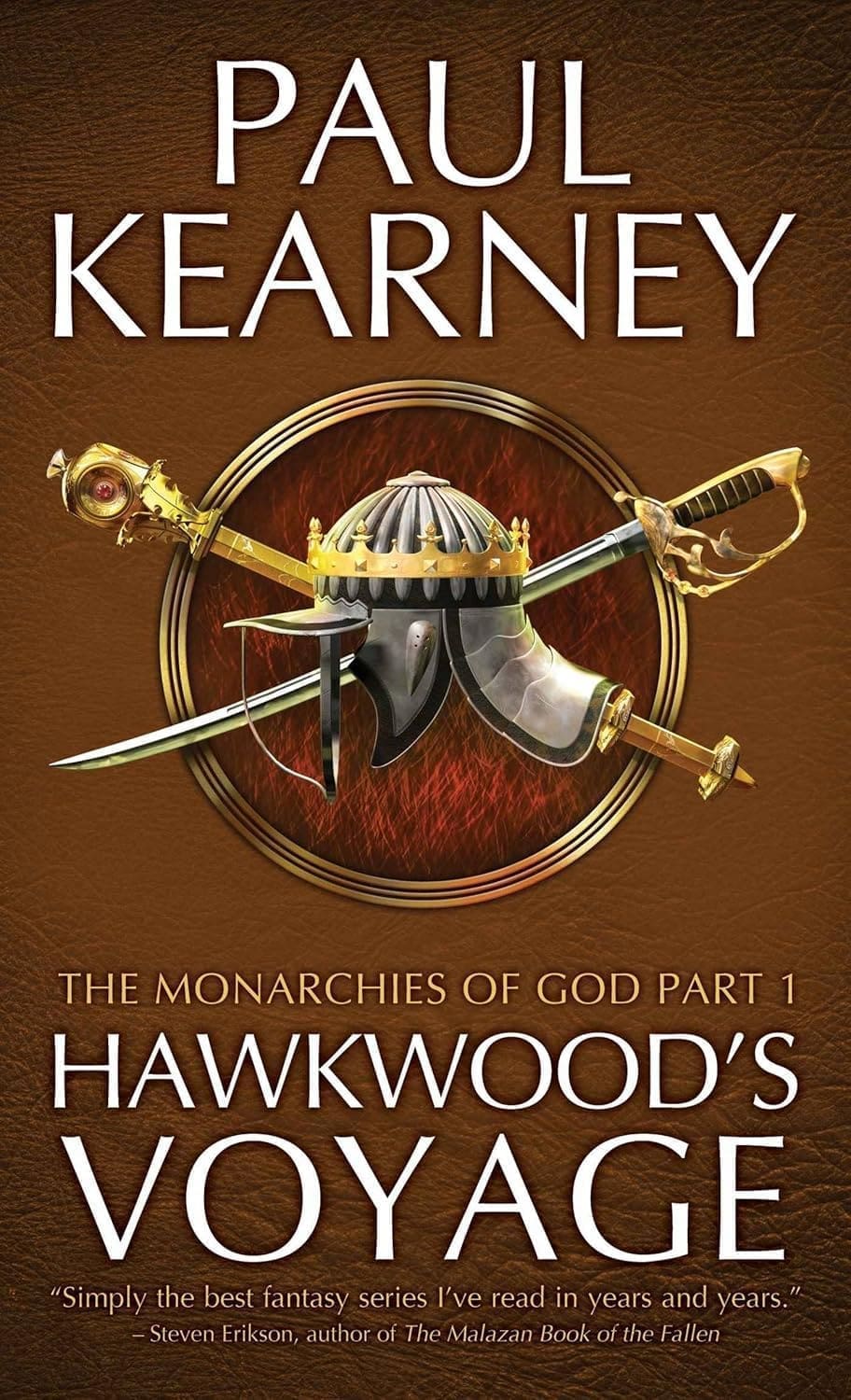
As the once great Fimbrian nations of the West begin to fall to heathen Merduk hordes, bloody religious fanaticism threatens to consume the land from within, and rogue mariner Richard Hawkwood embarks on an expedition across the Great Western Ocean to find a legendary lost continent and a safe sanctuary for survivors.
Review
During the long, long wait between A Feast For Crows and A Dance With Dragons over the course of the 2000s, I was often casting about, looking for the next series that would give me the same sense of scope and thrill in political maneuvering and internecine strife as Martin’s series. It turns out I’d have to wait for 20 years before I found The Monarchies of God.
First published in 1995, an entire year before A Game of Thrones hit shelves, Hawkwood’s Voyage kicked off Paul Kearney’s epic fantasy series with a bang.
The city of Aekir, regarded as the greatest city in the world and the seat of the Ramusian faith, falls to the invading Merduks after a lengthy siege. John Mogen, the greatest military commander in the western kingdoms of Normannia, dies along with his entire army—except for one officer, Corfe Cear-Inaf.
In Abrusio, the largest port in Normannia, the Ramusian prelate Himerius institutes a pogrom against magic users, sending thousands to their deaths in the flames. King Abeleyn, at the behest of his court mage and the Lord Murad, enlists Richard Hawkwood to take a few dozen surviving mages on an expedition across the ocean to establish a new colony on the rumored western continent.
The Merduks are here. The Ramusian Church is splitting after the apparent death of the Pontiff Macrobius. And in Charibon, the holy city, a monk in the library starts research that will uncover long-lost texts…
Hawkwood’s Voyage is a great book. It’s also somewhat a book out of time; Kearney sets up disparate and complicated conflicts across the theatres of politics, religion, and war. Like A Song of Ice and Fire, The Monarchies of God starts things with a creepy, almost horror-adjacent prologue before quickly shifting into the meeting rooms and grand halls of palaces and the muck of battlefields. Kings and priests and shadowy advisors appear in droves.
But unlike A Game of Thrones, Hawkwood’s Voyage is not 800+ pages long. It’s short, and Kearney packs an awful lot of setup and movement into its 300 or so pages. The pace is brisk, taking the reader from the battlefields of Torunna to Abrusio to Charibon to the deck of the Gabrion Osprey and back. It’s enough to leave one breathless.
Kearney’s prose, like many authors pre-2000, is rich. But he never gets lost in the weeds, and nobody will be accusing him of writing bloated books (as has, for instance, Robert Jordan). He writes punchy sentences, uses a broad vocabulary, and wields an omniscient narrator to great effect. If there’s one hangup readers might find, it’s that Kearney is a lover of all things nautical—there are a LOT of naval terms in these pages.
But despite the title, the actual voyage is only a fraction of the book. Corfe is just as much a main character as Hawkwood, and if anything a deeper character. His arc in this book is painful, yes, but also beautiful in its way. He begins the book having lost everything, and his journey to find a new life is gripping.
There is also a colorful supporting cast; I particularly enjoyed Odelia, the mother of the Torunnan King Lofantyr; and Shahr Baraz, the Merduk general.
Beyond the characters, there’s one other thing I’d be remiss to omit: the werewolves.
Going into this book, I was wary. I’m not a big werewolf guy, and I feel like they’ve been pretty played out in the traditional tropes. This book having come out 30 years ago, I was ready to roll my eyes at a lot of things. To my delight, Kearney eschews many of the usual beats with werewolves, building some compelling mysteries along the way.
Altogether, Hawkwood’s Voyage is a wonderfully fun start to a series that reminds me more of A Song of Ice and Fire than anything else I’ve read since 2005. Even some of the plot beats feel like precursors for what Martin would end up doing in his later books.
I turned the final page of Hawkwood’s Voyage and couldn’t stop myself from immediately starting The Heretic Kings. It was that good.


Leave a Reply