
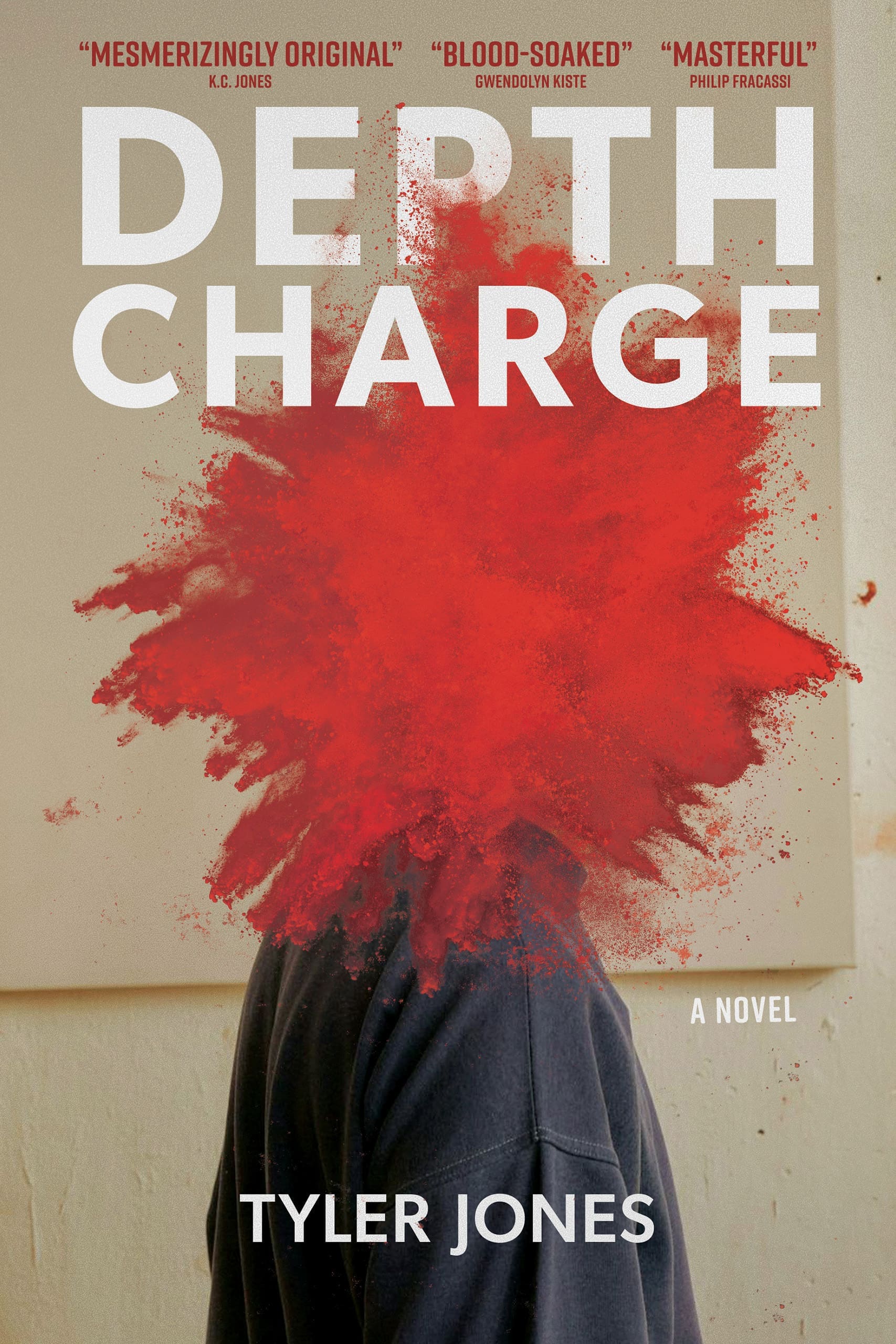


Synopsis:
Art world darling Julian Le Sang paints with passion, with abandon, and with his own blood. Inside these blood paintings, Julian sees more than art… he sees the future.
In fifth grade, Julian is bullied and alienated until Marcy befriends him and learns the strange boy’s dark secret: he sees visions of death in his own blood. Visions that turn out to be eerily accurate.
When Julian becomes a famous artist, he inadvertently pulls Marcy and her son into a world of secret government programs, murder, blood soaked canvas, and a terrifying version of the future that’s barreling toward them with all the force of a nuclear weapon. A horror story about fate and how every choice shapes what will become our world.
Review:
Tyler Jones’ “Depth Charge,” fucking rules, to the point where I don’t really know what to do with the wreckage of myself now. It’s riveting, emotive, intelligent, it put my brain on a spin cycle, wrung tears out of me and kept me up when this Brit needed something beyond his gallon of tea and anxiety to see the midterms through.
You know those songs where, if you skip a minute, it’s unrecognisable from what you were just listening to? Mr Bluesky, Bohemian Rhapsody, Paranoid Android– tracks where the constituent parts seem entirely disparate and yet cohere into something transcendent? Depth Charge is, in written form, a little like that. Jones gives us avant-garde horror about art and responsibility, a supernatural coming-of-age story à la Final Destination, a heart-wrenching road trip that would make for a superb piece of literary fiction independent of the terror that ensues, and a white-knuckle conspiracy. It will absorb and dismantle you. It’s an incendiary, blistering zinger that demands a sprawling review. I revert to this (very earnest!) literary evangelism, when I love a book as much as I loved this- this is soul cleansing. “Depth Charge,” is out November 10th from Shortwave- if you want your heart ripped out, you must read it
Marcy’s friend Julian Le Sang was not always so celebrated and admired. He was an odd little boy, a complete loner until they met, a strange initial encounter where the then 5th grader shuffled up to her and asked if she could see anything grim in his blood. Because he could. Julian is able to bleed illustrations of looming atrocities. Now they’re grown, Marcy’s raising her son Alex alone and Julian, despite not advertising his prophetic ability, is your favourite artist’s favourite artist. That’s the premise, and what follows is a thrilling, devastating, complex novel that I can only hope to do remote justice.
Julian’s ability inherently comes with some hefty existential baggage, commentary about life and death and whether, should there be a higher power, its cruel plans ought to be interfered with. Do we have the right to intervene in the course of events if we know they conclude terribly? Is preventing catastrophe an act of mercy or mortal arrogance? These questions have been posed countless times before in horror, and yet Jones approaches them with emotional intelligence and high stakes that had me well and truly grappling, like I was reading “The Dead Zone,” for the first time again.
In addition to that existential goodness though Julian’s blood-borne clairvoyance comes with some commentary on responsibility and trauma, the burden of having to witness suffering. As a child of the internet I’ve a long, dark catalog of things I stumbled across that I could have done without seeing. Julian is in a semi-similar position. The images in his blood are grotesque and haunting, and yet there’s an argument to be made that he must bleed and face them for the greater good, on the off chance he is able to prevent such fates from befalling the victims-to-be. Now whether that’s good and right or even possible is a different beast, but I’m fascinated with the dilemma Jones poses. Does the ability to witness suffering come with an obligation to alleviate it, or more broadly, how much can be demanded of a person just because they possess the means, however uncertain, to help? Is Julian’s suffering acceptable simply because it could spare somebody theirs? Regardless, this ability doesn’t seem like a gift to me, rather a curse.
We really do feel for the guy, and he’s not the only empathetic character in Jones’ cast. Having given you a glimpse of what “Depth Charge,” is about, I’d understand if you didn’t believe me when I tell you that this is a profoundly character-driven book, but it is, and that’s what makes it so effective in my mind. The relationships in this novel are the beating heart of it. They are what warm your own heart and make your knuckles whiten and your eyes leak great big salty tears. This book is apocalyptic and macro in its exploration of sliding doors and ‘threads,’ and the machinery of the universe, and remains still, deeply intimate.
It’s also hopeful, never in a saccharine sense, but in its belief that human connection and tenderness retain importance. Our time is always running out, the end is always close and every second is a second closer to death, as we’re reminded often throughout, but if that’s the case let’s spend our time loving. It’s almost Tingle-esque.
I (very much to my own frustration now) haven’t read any Tyler Jones for far too long, my last encounter his excellent “Midas,” which I read as an ARC in mid 2023. I did remember though that Jones’ writing is stunning, and 3 and a bit years later, I was glad to confirm that that’s not changed. Jones’ descriptions of blood itself were both repulsive and awe-inspiring, the vignettes of death and destruction within them also in juxtaposition with the beauty of the passage. This novel is, to an extent, about art, but it’s also a great example of craft. “Depth Charge,” is well-paced, although I’d have read another 300 pages of it quite happily. An assured piece of storytelling.
What a ramble this has been. I did warn you. Seeing as we’re now nudging 1000 words, entering essay territory, I’ll spare you any further bells and whistles and keep this brief. Tyler Jones’ “Depth Charge,” is one of the very best books I’ve read in recent memory. It demands everything from you- fear, grief, imagination, undivided attention, and repays it tenfold, with interest. Fucking exemplary, through and through. Read it.


Leave a Reply