
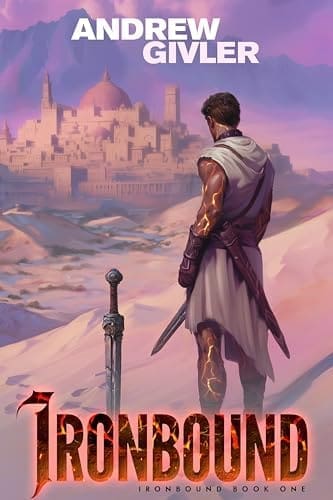


Synopsis
In the Iron Empire, only the strongest are given a chance to Ascend.
As long as he can remember, Castor has wanted nothing more than to fuse with a Cor Heart. Made from an otherworldly metal, it would give him the ability to bind a Symbol and manipulate the elements.
The day of trial has finally arrived—a chance for Castor to prove his worth. Only after winning the Empress’ blessing can he begin his life of adventure.
When his chance is interrupted by a vicious attack, he finds his home in ruins and his family in mortal peril.
Conscripted into the Legions, bound to a Symbol he never wanted, Castor must survive the Iron City, his enemies in the frozen North, and clandestine traitors within the rusting Empire itself.
But more than anything, he wants revenge against those who took everything from him.
This is the first step of the rise of the Ironbound.
Review
Ironbound does several things very well.
The characters are the heart of this book. Their progressions and the development of their relationships are easily the strongest aspect of the story, and Givler handles them with a confidence that kept me turning pages. There are multiple instances of genuinely good character growth throughout, and what makes them work is that they feel earned even when they happen quickly. Givler understands the stages people move through when their perceptions of someone shift, and he puts that understanding on the page in ways that feel natural and satisfying. Some of the best moments come when the story reflects on what it means for Castor to grow from boy into man, and those quieter beats land with real sincerity.
The pacing is also excellent. Givler knows when to speed things along with narrative summary and when to slow down and let a scene breathe. Important moments get the space they need without overstaying their welcome, and the action sequences are handled with real skill. There’s also a smart quality to how the plot sets up expectations and then delivers on them in ways that are just different enough to be surprising without feeling like a cheat. Victories and setbacks are always intertwined, and the story maintains a satisfying “failing forward” momentum throughout.
The world-building is interesting and imaginative, full of cool technologies, societal structures, and a magic system that grows more compelling as the book goes on. It does lean heavily on terminology that assumes familiarity with Roman titles and conventions, so readers less versed in that history may feel like they’ve been thrown into the deep end. The magic system in particular takes a while to reveal its full scope, and some of the internal rules could be clearer. But the ideas themselves are engaging, and comparison to James Islington’s Hierarchy series is apt: Givler trades explanation for pacing, which keeps things moving even if it occasionally leaves you piecing things together on your own.
The prose and dialogue are clean and serviceable. They never get in the way, and while they aren’t the kind of writing that stops you mid-sentence to admire a turn of phrase, they deliver the story efficiently and without distraction. The occasional line about life and growing up does hit nicely.
Like the Cradle series, this is popcorn reading in the best sense. It’s fun, it’s engaging, and it moves. The ending functions more as a pause than a conclusion, making this first book feel like a setup novel, but it’s a setup novel I genuinely enjoyed reading. There are so many interesting threads being laid down that I’m willing to wait and see where they lead. If you’re looking for an action-packed fantasy with strong character work, satisfying pacing, and a world full of potential, Ironbound is a great place to start.


Leave a Reply