
With the real world crumbling a little more beneath our feet every day, the urge to escape into fiction is strong, am I right? Tolkien said as much in his essay On Fairy Stories, likening escapism to a heroic act. Indeed, escapism can be a powerful tool in preserving our collective sanity, but it is certainly not the only reason to read books set in other (and sometimes better) realities. In fact, sometimes we read fantasy for the exact opposite reason.
Before we get too far into it, I should state that I’m speaking from a place of bias. I am a fantasy writer, writing on a website that caters specifically to fans of SFF fiction. My debut contemporary fantasy, The Café of Infinite Doors, tells the story of Marceline, a trapped housewife in San Francisco who finds a portal to a magical café where she can find empowerment and essentially escape the patriarchy—and which also happens to be entangled with an ancient deadly rivalry between two goddesses. The narrative hops back and forth between the café (outside of time and space), modern-day San Francisco, and ancient mythological Scotland—for reasons you will understand if you happen to read it when it comes out in April!
Obviously, I am not the first person to observe that fiction breeds empathy. As famed Indian writer Salman Rushdie once said, fiction gives readers perspective about people and places they haven’t directly experienced themselves. In a guest opinion piece for the New York Times, Rushdie elaborated: “I believe the books and stories we fall in love with make us who we are […] The beloved tale becomes a part of the way in which we understand and make judgments and choices in our daily lives.”
Think Rushdie has too much skin in the game? Take it from a psychologist, then. In his book Such Stuff as Dreams: The Psychology of Fiction, Dr. Keith Oatley argues that consuming fiction allows readers to understand social relationships. Novels place us in a variety of different social circumstances, thus allowing us to see how scenarios can be played out within different parameters, and this knowledge can be stored as information to use in real life at a later time.
There’s no denying that reading the inner thoughts of another being forces you to take in other perspectives and consider them. Imagine how different our current society would be if empathy was a priority! Inequality would implode! Xenophobia would evaporate! Racism would flee! Why? Because reading perspectives of people who are different from us forces us to face the truth of our universal similarities. Similarities like how we mostly all love our friends and families and want to do the right thing—even if some of us disagree about what the “right thing” is.
My novel, The Café of Infinite Doors, is a contemporary fantasy (I dislike the term “low” fantasy because to me it implies inferiority). It takes place primarily in the real world, but also involves magic and otherworldly realms. It could also be categorized as a portal fantasy, though its braided narrative takes the reader in and out of said portal quite frequently. But even the most complex second-world fantasies are populated by characters with relatable desires and goals. My protagonist, Marceline, wants to live life on her own terms. Quill, a deity modelled after the Celtic goddess Morrigan, wants to fulfill her destiny and make her mother proud, while also remaining true to her own values. The villainous Bronagh wants to avenge the death of her own mother. Characters attempt to overcome obstacles or overcome adversity, just like in our nonfictional world.
“Okay,” you might say. “Yes, fine, I get it. But what is it about fantasy that’s important specifically?” I’m so glad you asked. Fantasy merely takes things a step further. Speculative literature as a whole encourages us to escape reality while simultaneously holding a mirror up to said reality. What do I mean by that? Let’s think about it: apart from the total dystopia that is generative AI, fantasy novels are written by humans, yes? Humans who live in our world, and have thus been immersed in the general issues that society has presented to them since we first became conscious beings. Sure, not all humans experience the same reality, but at the same time, we all know inequality exists. We all know systems exist that support some and marginalize others. The fight for power, and by extension, the fight for freedom, is the oldest story in human history.
It is therefore no surprise that we constantly see this dynamic played out in our favorite invented worlds, giving readers opportunities to reflect upon how things are, how things could be, or how things might become if we aren’t careful. And although some people consume fantasy purely for fun (there’s no shame in that), I do believe that on some level, however unconscious, we cannot help but draw connections between what we read and what we already know of the world. Who among us has not read George R. R. Martin’s A Song of Ice and Fire books and thought “Wow, these people are ruthless! Thank goodness we live in a gentler world!” (Or at least, maybe we thought that *before* we were engulfed in the growing tide of fascism…) On that note, has anyone else noticed that quote by the Lord of the Rings character Samwise Gamgee about there being good in this world, and how it’s worth fighting for? Who else teared up after Trump’s reelection when this quote started circulating in meme form? I certainly did.
My point is, it’s impossible not to read about a different world without comparing it to our own. And in comparing two things, we form opinions colored by our own morals. And that, my friends, is what leads to critical thinking. As Aristotle said, “It is the mark of an educated mind to be able to entertain a thought without accepting it.” The thought in question, here, is the fantastical world we’ve entered. It is up to us to compare and contrast that world with reality, and to pull out our own conclusions.
Speculative fiction forces us to expand our minds and consider scenarios unrestrained by the parameters of reality, thus encouraging us to consider further implications. I’m thinking of the YA dystopian Arc of the Scythe series by Neal Shusterman. In these books, humans have “conquered death” so they no longer die naturally, and so a government organization of trained killers arises in order to systematically “glean” (kill) for the sake of population control. Also, people can reset to their preferred age whenever they want, and every human is fitted with “pain nanites” that prevent us from feeling too much pain. Obviously in our world, death and pain are very real, universal fears. But how would life be different if we didn’t fear death or injury? What are the implications of such an existence, and how does that reflect back on our reality?
That’s the magic of fiction: by simply staring at paper (or an e-reader, or ingesting stories through our ears in audio form—it all counts) we vividly hallucinate, thus exposing ourselves to other ways of thinking and being. We sharpen our ability to make connections, we expand our empathy, and draw parallels that allow us to strengthen our critical thinking. We contemplate other realities and use them to understand our own more sharply. Most importantly, we feel. And a world that nurtures feeling is a world that can inspire us to rise up and fight against tyranny, and when the fighting is finally done, allow us to heal.
About the Author

Zara Marielle is the product of two worlds: a rustic village high in the French Alps, and a California hippy town. A former ESL teacher, Marielle has lived in six countries. In 2015, she earned her Masters in Creative Writing from the University of Edinburgh. When she’s not writing, she spends her time teaching and performing longform improv, traveling, and hugging large dogs.
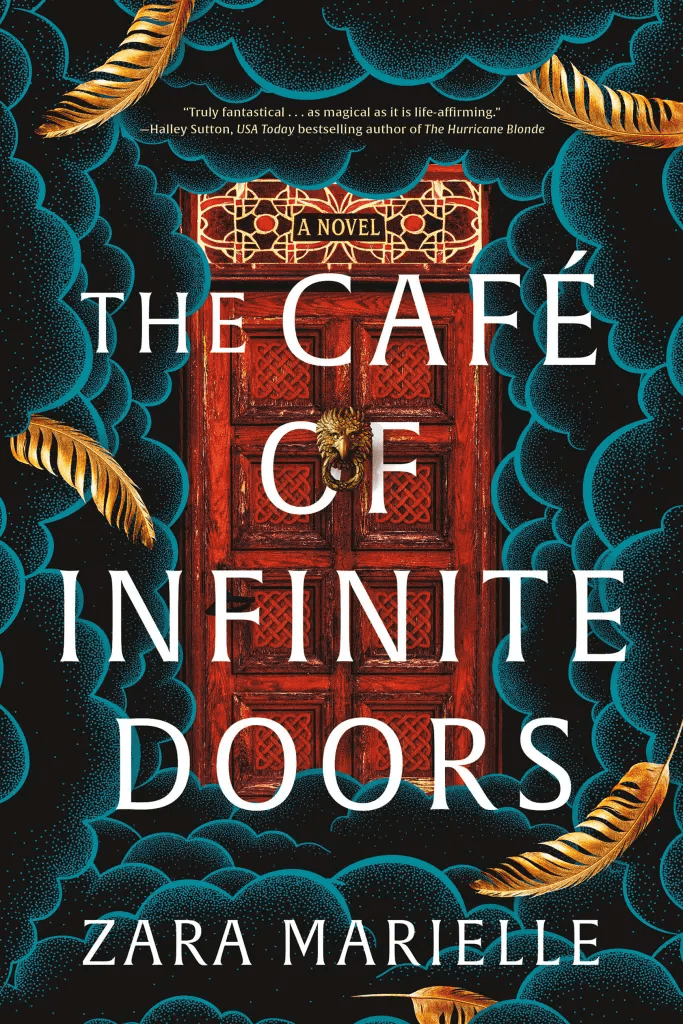
In a mythical Scotland of long ago, a goddess’s mortal surrogate dies in childbirth and leaves behind a vindictive firstborn daughter who seethes in the shadow of her new divine sister, leading to a violent clash that leaves both sisters imprisoned in separate worlds.
Millennia later in San Francisco, sheltered, isolated twenty-three-year-old Marceline is desperate for a job, longing for a temporary escape from her controlling, toxic husband, Baxter. One evening, a magical café appears after Baxter strands Marceline on a desolate street after a nasty fight. Run by a quirky, mysteriously feathered woman named Lucretia, her partner, Kilda, and a gentle Tahitian man named Sylvan, the café holds the safety, comfort, and companionship Marceline has craved. Upon learning that the café’s door is a protected portal that opens to those in need, she joins the cafe’s staff behind Baxter’s back.
But soon after Marceline has found her safe haven, the portals to the café begin closing one by one and the cafe’s sourceless light goes from warm and honeyed to dim and shadowy. Evil is looming that will endanger not only the café but the world at large; if Marceline is to protect herself and her newfound family, she must choose herself for good and escape her marriage once and for all . . . or say goodbye to her hard-fought freedom forever.
The Café of Infinite Doors by Zara Marielle | Hachette Book Group


Leave a Reply