
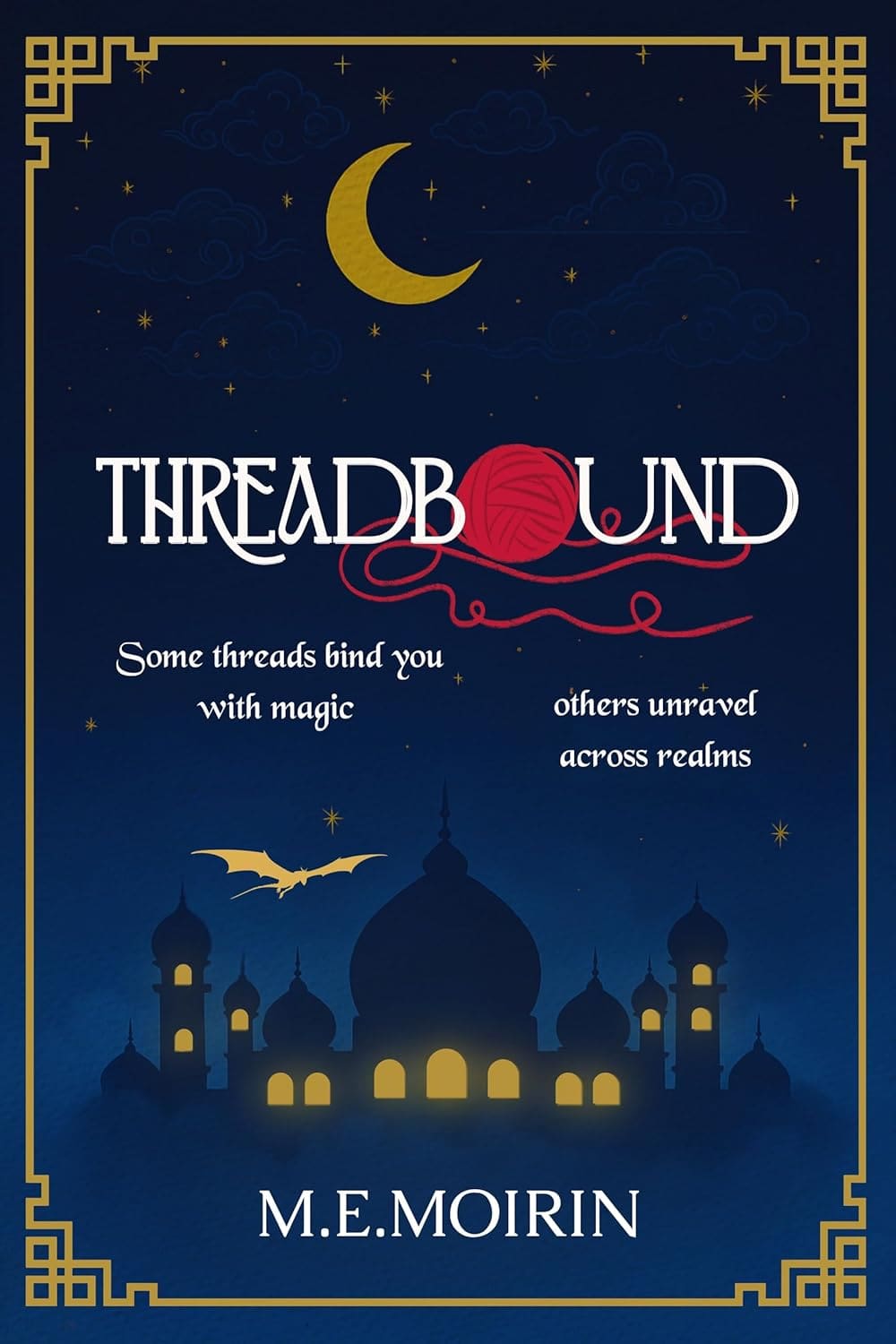



Synopsis:
When a powerful vizier curses Jasna, a red thread draws her toward his palace while death follows close behind. Her soul, bound to stone, begins to splinter until a desperate spell casts her into Syanka, a realm shaped by old stories.
To reclaim what was stolen and rescue Iliya, once her betrothed, who begged the vizier for her soul and is now a pawn in something darker, Jasna must face beasts and strike bargains with treacherous allies. But the thread is tightening, and if she cannot reach the vizier’s palace before it snaps, it will unravel the last threads of her soul.
Threadbound weaves dark magic, Slavic folklore, and Ottoman-inspired intrigue into a tale where wonder walks hand in hand with danger. For readers who grew up on Narnia and Alice in Wonderland and wondered what would happen if the magic turned dark.
Perfect for fans of Spinning Silver, The Bear and the Nightingale, and the dreamlike peril of Labyrinth.
Review:
I read this book as a judge for Fanfiaddict for SPFBO XI. These are my personal thoughts and do not represent the thoughts of the whole team.
Threadbound by M.E. Moirin bills itself as a folk story with its roots in Eastern Europe and the Middle East. There are hints of Shaharazad from The Thousand and One Nights — you know the one…Ali Baba and the Forty Thieves and Aladdin are just a couple of the tales from the famous collection. Moirin certainly wove a similar tale to some of those and I enjoyed my time in Jasna’s world.
Jasna is the central figure in Threadbound, and her actions are the catalyst for the entire narrative. After an introductory tale of a statue at the top of a well (told from a second-person POV), the story launches into Jasna’s POV when she is walking around her town only to be taken to where the Grand Vizier is holding court by the vizier’s mage. After a back-and-forth where she claims she is already betrothed, the vizier tells her that she will willingly come to him by the end of the summer. Then, he proclaims that he will have a statue of her erected at the well as a tribute.
From there, the story starts to fill in some of the blanks I was left with. Jasna goes home to her Nana only to find out some information about the vizier and mage from Nana. We also find out that the engagement Jasna talked about was literally from the very evening before. Her boyfriend (fiance?) Iliya is upset about the vizier’s actions, but something doesn’t feel quite right about his reactions to it all.
From there, there is a slow burn as the life-like statue is constructed only for Jasna to fall ill when the construction is finished. While ill, she dreams of a dragon (a Zmei in Slavic culture). She recovers a bit after the statue is cracked, but other magical beings come looking for Jasna, leading to her journey from home to eventually end the curse upon her and her family.
While there is a lot to like about Threadbound in terms of the main character and the folk story journey she embarks upon, the side characters need some work. Often characters just pop up without backstory and we are just expected to piece them into Jasna’s life. While she feels like a fairly fleshed out character, many of those she encounters are one-dimensional. We spend a lot of time with Nana…and then suddenly when Jasna’s life is threatened and she’s forced to leave, her other grandmother shows up and she seems to know even more about the land where Jasna is going than anyone else.
I felt the pacing was a bit backward at times. Moirin would present information about something in one chapter and then provide backstory and flashbacks later in the book. If that happened once, that would have been fine, but it often felt like I was reading the book with incomplete information. Sometimes that works and often in folk tales the narrator knows a lot more about what’s happening than the audience, but since it was a first-person POV, it never quite felt right to me.
But in the end, I couldn’t help but like what I found in Threadbound. The story is unique and different compared to a lot of books I’ve seen. Tapping into folklore from the Slavic area and the Ottoman Empire presents different themes than what many readers are used to and I really loved that aspect of the story.

Leave a Reply