
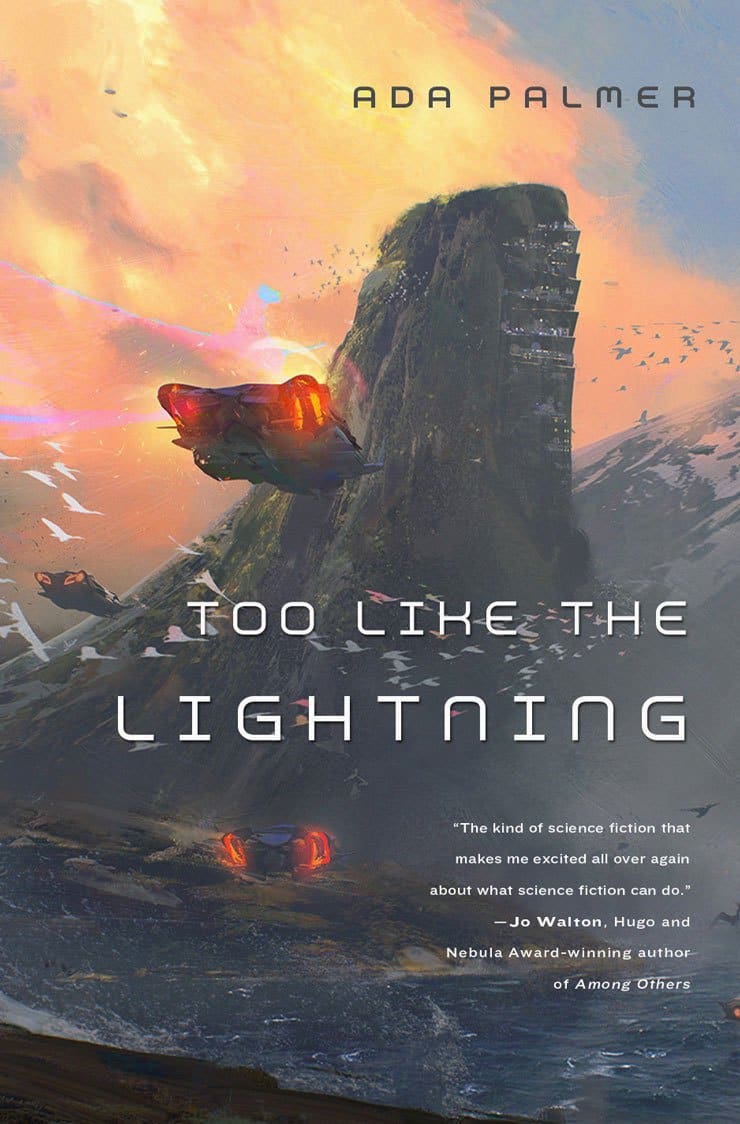



Synopsis:
Mycroft Canner is a convict. For his crimes he is required, as is the custom of the 25th century, to wander the world being as useful as he can to all he meets. Carlyle Foster is a sensayer–a spiritual counselor in a world that has outlawed the public practice of religion, but which also knows that the inner lives of humans cannot be wished away.
The world into which Mycroft and Carlyle have been born is as strange to our 21st-century eyes as ours would be to a native of the 1500s. It is a hard-won utopia built on technologically-generated abundance, and also on complex and mandatory systems of labelling all public writing and speech. What seem to us normal gender distinctions are now distinctly taboo in most social situations. And most of the world’s population is affiliated with globe-girdling clans of the like-minded, whose endless economic and cultural competion is carefully managed by central planners of inestimable subtlety. To us it seems like a mad combination of heaven and hell. To them, it seems like normal life.
And in this world, Mycroft and Carlyle have stumbled on the wild card that may destablize the system: the boy Bridger, who can effortlessly make his wishes come true. Who can, it would seem, bring inanimate objects to life…
Review:
Perhaps you’ve had the feeling yourself. A few pages into a book and you feel as though you’re in touch with a kindred spirit. The feeling deepens as you continue to read, and at some point, you have the feeling that this book was written just for you.
That was my feeling reading Terra Ignota by Ada Palmer. I initially meant to write reviews for each of the four books, but this is a case where the series is truly one story, and so it seemed wiser to hold my thoughts until I finished all four.
The story drops us into a hopeful future. Violence is rare. Nation-states are largely no more. The world is more connected than ever, thanks to vehicles that can drop a person off on another continent for lunch. It is not a perfect utopia, but it’s a better world than we know today.
Palmer then masterfully shows us the cracks and tests her vision, pries it open and explores its weaknesses. In a twist that opens the story, she also adds an element of the fantastic: a boy who can bend reality to his will.
From this, Palmer’s story explodes in ways both personal and epic. These are dense books, filled with references to theology, philosophy, and classical Greek mythology. There are frequent asides and extended metaphors, and every page is a treasure best consumed slowly.
Rarely do books manage to be so personal while exploring such weighty and enormous concepts, but Palmer does so well. There’s so much here to unpack I could write entire essays, but I’ll say that these books left me both intellectually awed and emotionally wrecked in all the best ways.
It’s true that no book is for everyone, but the saying feels doubly true here. Terra Ignota will absolutely be one of my top series of the year, but I love dense writing, philosophical exploration, and the questions these books raise. For all my love, though, I recognize that the very aspects I love will turn other readers off. This is not a fast and easy read, and I think it would be too dense for me to follow an audio version (a personal failing-I simply need to have the text in front of me for some stories). The writing sometimes feels like it has more in common with 18th century philosophy than modern storytelling conventions, and while this is a brilliant book, it requires a considerable effort to read.
But I would leave on this note. In the past few years, I’ve started reading more history, more biographies, and more classic literature that was written long ago, and a question I’m always left with is this: can humanity change? For all our technological advancements, Shakespeare still moves us because love, jealousy, revenge, and hatred are the same for us as they were for our distant ancestors. History often feels as though it moves in a circle, and I wonder if we, as a species can improve.
One of the many things that makes Terra Ignota special is that it presents a version of the future when humanity is better. Still recognizable and still deeply flawed, but better. It’s the kind of science fiction that makes me eager to watch the future unfold, and I think that’s one of the greatest compliments I can give it.


Leave a Reply