
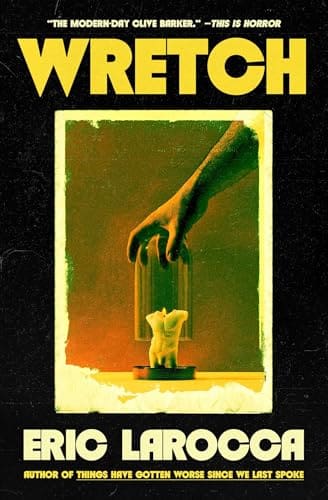




Synopsis
From rising horror star and award-winning author of Things Have Gotten Worse Since We Last Spoke comes a nightmarish, haunting, tech-Gothic thrill ride about sorrow, memory, and the unabashed complexity of love as a transgressive act.
After his husband dies, Simeon Link finds himself overcome by grief and seeking comfort in an unusual support group called The Wretches, who offer an addictive and dangerous source of relief. They introduce Simeon to a curious figure known as Porcelain Khaw-a man with the ability to let those who are grieving have one last intimate moment with their beloved…for a price.
Hallucinatory, fiendish, and destructively beautiful, Wretch transports us to a world where not everything is as it seems, and those we love may be the ones who haunt us most.
Review
“Hello, my name is Eric LaRocca, and I’m going to write a story that is going to completely destroy its readers.” In my head, I imagine that this is the conversation that Eric had with himself whilst staring into a mirror, just before sitting down to write this devastating piece of grief infused fiction.
What is Wretch (or The Unbecoming of Porcelain Khaw, as it is subtitled) about? Following Simeon Link, a man who, after his husband’s death, finds himself lost and grieving and alone, until he is invited to a secret group of grievers called The Wretches, who in turn, connect him with a mysterious figure called Porcelain Khaw, who may be able to help Simeon see his husband one last time.
Firstly, this isn’t exactly a fun book. In fact, it’s pretty devoid of any positivity whatsoever. So, if you aren’t in the greatest of head spaces, I think it’s fair to say that you may want to set this one aside until a later date. However, if you do go into it, you’ll find a story that explores the all-encompassing void that grief is, especially when that grief is surrounding someone who makes us whole. Where that person who has left us is so integral to our own being, that you yourself feel less than human. Just a shell existing in a colourless world. LaRocca captures this heartbreaking sense in its totality, and it’s truly something I wouldn’t wish on my worst enemy. Simeon is a broken figure, and his continued self-loathing, his marinating in this loss until the grief becomes all he knows, is horrific to witness.
Simeon’s also, strangely, not that nice of a person. At least, I think so. LaRocca has a way of writing POV characters who I’d normally bounce off, but there’s something within that conversation of character that feels ripe for discussion. And this way of writing always feels purposefully intentional. Simeon is a taker, a self-centred man, seemingly before his husband’s death and even more so afterwards. His own emotions and thoughts about others always put him at the centre, the emotional and loving core of other people’s lives – particularly the lives of his ex-wife and teenage son. The dynamic between Simeon and his ex-wife mirrors Simeon and his husband, at least in Simeon’s head, and seeing his dismissal of others for his own greed and selfishness made me falter in my empathy towards him. LaRocca always writes the depraved worst of human emotions, and in this case, Eric writes one source of human nature – death, and the effects it leaves on those who are still living – in a way that feels real and ugly.
The idea of a reverse haunting is original to me. The idea that the living can haunt the dead, when they just want to rest, is explored in interesting detail. Simeon’s own surrender into his grief is overwhelming, and the moral questions – should we leave the dead to lie in peace – keeps returning to me well over two weeks since I finished the novel.
I read all 250+ pages of this book in one day, and afterwards, I was hollow and tired and filled with an emptiness that begged to be explored. In short, Wretch is a story not to be read on an empty stomach, or one to be consumed in a low state of being. But, when you do read it, you’ll find LaRocca’s most interesting, philosophical, and conversation worthy novel to date.
Thanks to Titan Books and Eric LaRocca for the ARC.

Leave a Reply