
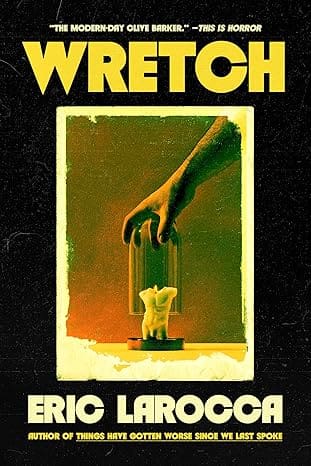







Synopsis:
After his husband dies, Simeon Link finds himself overcome by grief and seeking comfort in an unusual support group called The Wretches, who offer an addictive and dangerous source of relief. They introduce Simeon to a curious figure known as Porcelain Khaw—a man with the ability to let those who are grieving have one last intimate moment with their beloved…for a price.
Hallucinatory, fiendish, and destructively beautiful, Wretch transports us to a world where not everything is as it seems, and those we love may be the ones who haunt us most.
Review:
Eric LaRocca’s latest “Wretch,” may have a shorter title than pretty much anything else they have written, but it does not lack the same icky body horror, epistolary elements, gorgeous prose and aching, weeping, and yearning as the rest of their oeuvre. It will press its mouth to your ear and murmur things best left unsaid, leave that same bitter taste on your tongue, that same film on your teeth and gums. “Wretch,” is grief horror at the most intense and all-consuming I’ve read in recent memory, and is loomed over by an analog, iPhone generation, urban-legend, trauma-echo type figure: nasty and creepy. In my very humblest of opinions, worth the read, “Wretch,” is a novel that asks something of its readers in advance, a token, an object of significance. When you meet Porcelain Khaw March 24th (from Titan in the UK and Saga Press in the US) don’t forget it, and do make sure your affairs are in order.
We follow Simeon Link, a man hollowed out by the loss of his husband Jonathan, an absence that has spread into every available cavity of Simeon’s life- his work, his relationship with his son Carter, everything. In his fugue state, he is trawling online chatrooms one evening, when one anonymous conversation floats to him a strange support group, who seek out the faces of loved ones in everyday photographs- in storm clouds and antique teapots and so on. He befriends a member and it’s through him he is introduced to Porcelain Khaw. The figure is elusive and hard to access, existing largely in forums and private letters, but Simeon is determined, as it is promised that in return for an item of significance, Porcelain Khaw can reunite you with a departed loved one.
LaRocca thrives in writing about the harm we can cause to our loved ones, and Simeon Link certainly does, inadvertently perhaps, but hurt is everywhere in his wake. He broke his ex-wife, a tragically patient woman who continues to stand by him in spite of all the hurt he has caused her, his son Carter is continuously sidelined and backgrounded, and he grieves Jonathan in a way that is so unhealthy, so in pursuit of what is already gone- grief that does not metabolise his loss but refuses the finality of death. It’s often said that grief is the price we pay for love, and LaRocca proves this to be correct in the most ruthless of ways.
The concept of the dead being haunted by the grieving living is an idea I first stumbled across in a wonderful novella called “Linghun,” by Ai Jiang. Eric LaRocca also explores this idea, reverse hauntings, in “Wretch.” Such a niche of grief horror is always a compelling and really very potent one, as like it or not (not) as readers, it’s hard not to find ourselves considering whether we would go to the same lengths as Simeon. Pareidolia for example, which is the very real practice of perceiving shapes and patterns, but generally faces, in everyday objects, might sound like a strange idea, but who among us hasn’t stared too long at the grain of an old table or a cloud, or a sunset and wanted to believe? The very idea of starting correspondence with Porcelain Khaw might sound like a laughably, catastrophically bad Pet Sematary-esque idea, but if really offered the chance to speak one more time to a loved one- would you not? Could you turn it down?
And so for all the damage Simeon causes, the shrapnel embedded in those he loves, it’s not easy to condemn him. His grief is harmful but it’s intimate, human and recognisable. We may not approve but we understand, sympathise, perhaps even relate. It’s LaRocca’s use of a motif of mirrors and the fact they would have no qualms about us tearing ourselves up over this, that suggests to me that Eric is aware and exploitative of this conflict, and it makes for a visceral reading experience. LaRocca does literally raise an accusatory mirror to the reader, and it’s Simeon who holds our gaze. We don’t like how it ends. It’s twisted and twisty and it’s not a spoiler to say that nothing good happens for us.
A beautifully written and entirely ruthless novel that exists in the queasy slippage between empathy and indictment, “Wretch,” is a novel I am a massive fan of. It is intimate but not tender or kind. LaRocca is loud about their love of the transgressive authors that came before him, Dennis Cooper, Kathe Koja, Clive Barker, and such DNA thrums in their own work today, without being pastiche. A novel that cares not about being liked, but being felt, absorbed and endured, finished in a quiet state of ruin, “Wretch,” succeeds in all that it sets out to do, and for the record, I happened to like it too.

Leave a Reply