




Synopsis
Something darker than the devil stalks the North Carolina woods in Wolf Worm, a new gothic masterpiece from New York Times bestselling author T. Kingfisher
“I saw the devil in these woods.”
Sonia Wilson is a talented scientific illustrator—but she is only able to follow her dream because of her father’s reputation as a renowned scientist. Such is the lot in life for a woman in science in 1899. And after his death, she is left without work, prospects, or hope.
So when the reclusive Dr. Halder offers her a position illustrating his vast collection of insects, Sonia jumps at the chance to move to his North Carolina manor house and put her talents to use.
Once there though, she encounters dark happenings in the Carolina woods, and even darker questions come to light, like what happened to her predecessor? Why are animals acting so strangely, and what is behind the peculiar local whispers about “blood thiefs?”
With the aid of the housekeeper and a local healer, Sonia discovers that Halder’s entomological studies have taken him down a twisted road. His ground-breaking discoveries come with a cost—one that Halder is paying with human flesh.
If Sonia can’t find a way to stop the monstrosity, she may be next under the knife.
Review
Thanks to Netgalley, Tor Nightfire, and Macmillan Audio for the arc!
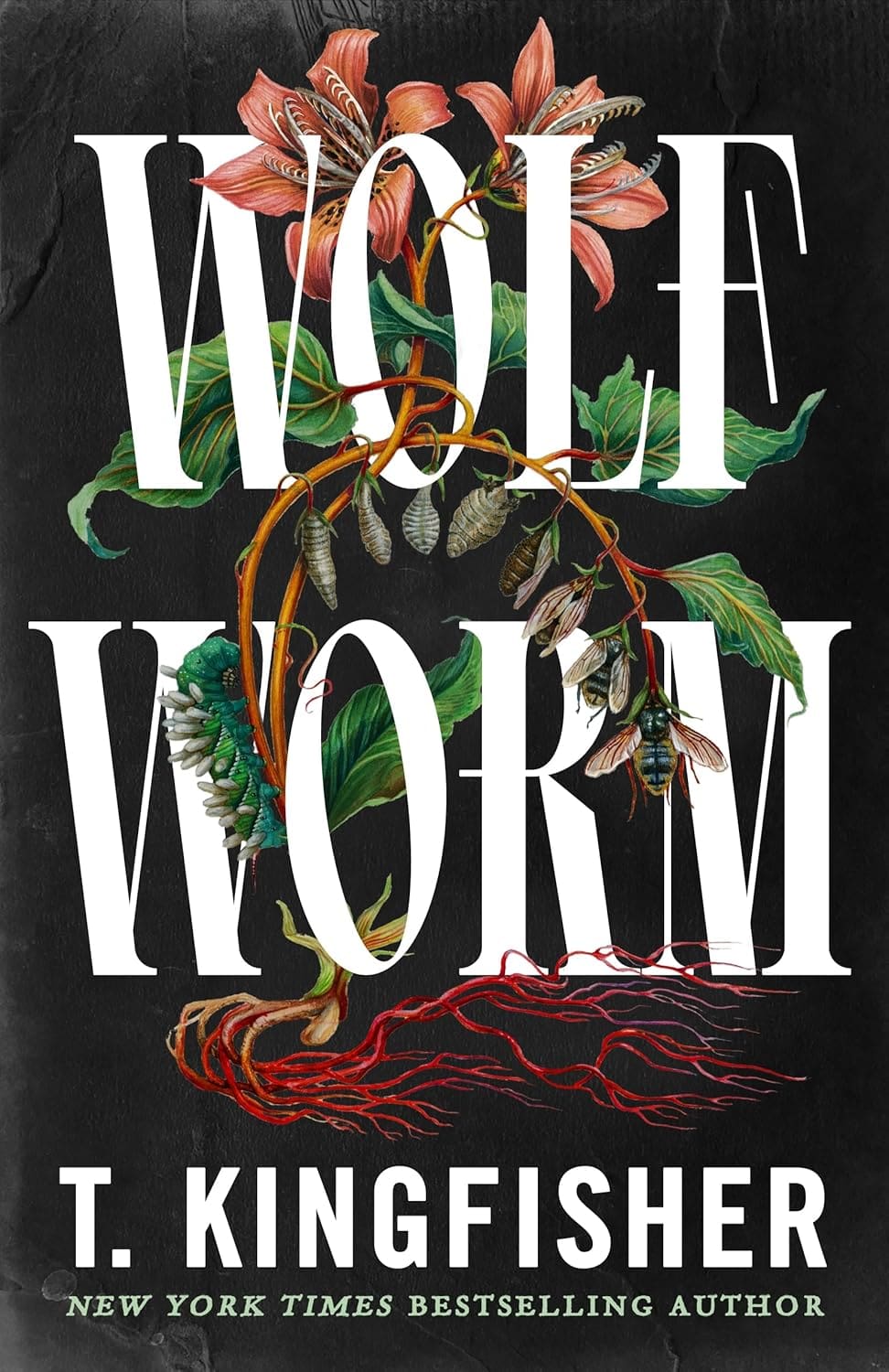
This is my third attempt reading the author, and definitely my best experience to date. There were definitely things of genuine enjoyment in this release! The thing that keeps bringing me back is that the author honestly has some of the best covers in the industry…continuously.
Sonia is a naturalist and illustrator, who, after the death of her father, finds herself struggling for scientific work and recognition. But so is the life of an educated woman in 1899. Still, she has found herself with an offer to illustrate a scientific text, a job that includes lodging, food, and pay—and best of all, is not at the school she’s been forced to take employment with just to exist. She takes the offer and finds herself traveling to North Carolina. The house she is staying in borders on more of a mansion, however, it hardly has anyone living or even working within it. She finds that awfully strange, but gets to work. Her employer, an eccentric hothead, has an extensive collection to work through, but unfortunately, it just so happens to be bugs. So many bugs, in excruciating detail and color. The likes of which may have you questioning ever entering the woods again…and wouldn’t you know it, it just might contain something of a darker nature there too.
So, the positives? The story wasn’t overlong, and I mean that as it helped with pacing, not because it was unenjoyable. Much of this is to the point, with little to no unnecessary or sidebar sequences. The author has given readers a streamlined novel that does flow rather effortlessly. The dialogue is light, and even when it is on the edge of scientific, I at least found it of interest. The character of Sonia, is both an unusual and typical personality for the author. She has a knack for creating strange yet persevering women set in times, places, or at task that may be out of the ordinary. I enjoyed Sonia, and while her father was a naturalist that raised her to be one as well, she still embodies her own being of interests and intellect. There are some nice descriptions throughout the book as well, as the POV allows the narration to depict the world in brushstrokes and paint colors. And also, without spoiling too much, but the “something darker” in the woods was a really interesting take. Kingfisher always has a twist into a somewhat fantastical realm, and I enjoyed that this had a twinge of the vampiric.
On the other hand, the issue I continually come back to with this author is that they have a very distinctive voice in their writing, and while it is fully fledged and hammered to a sort of perfection, I don’t think it’s fitting for some genres. This one in particular, which was or should have been a period piece, felt entirely modern, with the synopsis just stating it was 1899. The narration, by Mary Robinette Kowal, was well produced but felt out of place in its modernity. Take for example author Tanya Pell, whose most recent Her Wicked Roots delivered an entirely different voice and prose from her previous Cicada. It is possible to switch, it just didn’t happen here. There was also so much room for this to be tense and atmospheric. A giant house, moderate isolation, an undertone of nefariousness. These were all the things I expected, were why I tackled this one. While I am not against books stepping away from expectations, I still think this one went too far the other way from a Gothic. Things kind of just happen. The buildup is minimal, the fright not really existent. Maybe Sonia spends too much time in her head? Perhaps the author’s attempt at keeping her levelheaded and scientific simply bleached all the struggle? Overall, I finished this book happy to have read it, I did just want even more out of it.
I’ve seen removal videos online, and I can tell you now after reading these descriptions, if I ever find out I am in an area where botflies inhabit, I am full on sprinting out of there. Not happening.




Leave a Reply