
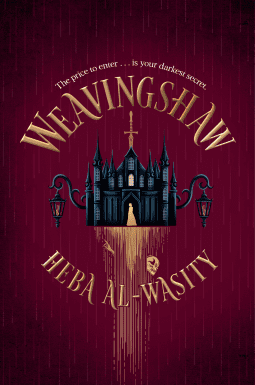





Synopsis:
Leena didn’t believe in monsters until she saw Weavingshaw.
The Saint of Silence trades coins for every sordid divulgence uttered to him. The darker the secret, the higher the price.
Leena has a secret, one that has haunted her since she was seventeen—she can see the dead. When her brother falls ill, she knows what she must do: seek the Saint.
But Leena’s secret is more valuable to him that she could have imagined. To save her brother, she must make a deal with him to find the ghost he’s been searching for.
All paths lead to Weavingshaw, a cursed estate on the moors. As Leena grows closer to the Saint, and is plunged into his world of danger, deceit, and desire, she learns that he is hiding his own secrets—ones that have the power to destroy them all.
Review:
Hello again dear reader or listener, I come to you today with thoughts on the latest Gothic fantasy romance I had the luck of reading early – even though technically I am a little past its release. Life, eh?
With thanks, as always, to the Del Rey team for the eARC, allow me to share my honest review.
Given the algorithmic “trope list” nature of book promotion that we’ve (somewhat regrettably imo) evolved into over the last few years, it seems that a lot of books are being presented to readers with a lot of watered-down versions of said tropes in an effort to check as many boxes as possible, so as to reach as many social feeds as possible. This is not a hot take, it is a known fact. For instance, did the characters look at each other a little funny in the first chapter of the book? Doesn’t matter if all the rest of the time they actually get along pretty well or politely at the very least, we shall be listing this one as an Enemies-to-Lovers! It can be disappointing to experience because expectations aren’t met but at the same time, it’s so common place that all it elicits from me is a shrug these days.
However!
Weavingshaw, I am pleased to say, is not one such trickster.
Al-Wasity regales us with a true slow-burn of old, the eventual lovers are most definitely enemies for a more than sufficient amount of time to meet the criteria and, most importantly, the yearning induced in the reader is sensational. This book may not be bringing forth super fresh takes on known themes, or blowing you away with unexpected plot twists you would never see coming, but what it does do is comfortably fit within its genre and its tropes, delivering them in a satisfying manner that pleases and keeps you reading. Just because you have a pretty good idea of where the plot is going and what the next reveal will most likely be, it doesn’t mean it’s the lesser for it. Which is also something that seems to have become a big no no in publishing but also media in general. But that is a longer ramble for another day.
The protagonists, Leena and the Saint of Silence, are multilayered and intriguing each in their own right, with the former being a great vehicle for the reader into this darker world of demons and the supernatural that she didn’t know even existed previous to the events of this first entry of the trilogy. Through her, Al-Wasity also tackles themes of colonialism, revolution, class oppression, racism, war, and being a refugee. It’s not on the nose when it is still so damn relevant… just look at the news. The author doesn’t mince words on any of these topics, while also centering familial bonds, duty, and love that perseveres through it all. The Saint, on the other hand, is already entrenched in the aforementioned darkness and is fighting to get out of it. His journey is just as, if not more, compelling than Leena’s – at least it was to me– for its antiheroic spin that I’ve always had a soft spot for. It’s not that you can define Leena as a naïve protag because she isn’t in the general, “bit of a goody-two-shoes” sense of the term, but she is most definitely not as worldly in some ways as she thinks and her development through it made for a satisfying character evolution that I was glad to see by the end. I also found the villains interesting and the highlighting of the fact that the rich tend to want to preserve their status quo regardless of sacrifice/fallout very topical.
Finally, I think Al-Wasity delivers on the aesthetic and atmosphere necessary for a Gothic Fantasy, wherein setting is just as an important a character as the protags, albeit not to its full potential. What I mean by this is that the author treats us to a decidedly excellent debut which showcases very promising narrative skills that I feel will be honed with future books into truly memorable writing craft. As such, I am very much looking forward to the next entry in this series, both for the overall vibes and the characters who hooked me and got me to care for them. Moreover the way Al-Wasity is slowly building the bond between Leena and the Saint is unhurried and all the richer for it, so I cannot wait to see how the author will get them out of the tight corner they’re in by the end of this first book.
Until next time,
Eleni A.E.


Leave a Reply