
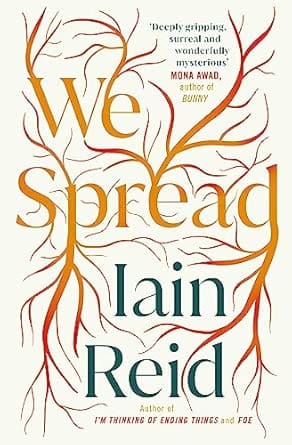





Synopsis:
Penny, an artist, has lived in the same apartment for decades, surrounded by the artifacts and keepsakes of her long life. She is resigned to the mundane rituals of old age, until things start to slip. Before her longtime partner passed away years earlier, provisions were made, unbeknownst to her, for a room in a unique long-term care residence, where Penny finds herself after one too many “incidents.”
Initially, surrounded by peers, conversing, eating, sleeping, looking out at the beautiful woods that surround the house, all is well. She even begins to paint again. But as the days start to blur together, Penny – with a growing sense of unrest and distrust – starts to lose her grip on the passage of time and on her place in the world. Is she succumbing to the subtly destructive effects of aging, or is she an unknowing participant in something more unsettling?
Review:
“We Spread,” by Iain Reid is a slim, sly, ambiguous and cryptic little read that will have your brow furrowed and your suspicions aroused from the word go- such suspicion is, of course, the only rational way to engage with Reid’s work. With the uneasiest of atmospheres, an unreliable narrator and a cold administrative sort of horror at its sinister core, Reid’s latest certainly shares a lot of DNA with his previous work, including one of my all time favourites, “I’m Thinking of Ending Things,” with its slipping details, quiet coercion and malleable reality- but frankly does not quite pack the same punch. Whilst it may not have hollowed me out completely, it remains, though, as much of a masterclass in dubiety and obscurity as the rest of his body of work, and a pacy, easily consumable novel. Should you be looking for a quick hit of dread and confusion, neat, or to engage in the tireless pursuit of answers that were of course, never going to be just handed to you, “We Spread,” is certainly that.
We follow Penny, a fiercely independent former artist who has lived alone since the death of her partner. Despite her best efforts to cling to her autonomy, notes to herself and complete denial, she is not as sharp as she remembers being, and after she takes a nasty tumble whilst changing a lightbulb, her landlord insists she move into care. She instinctively loathes the very idea but is assured that the residence is exactly what her and her partner planned years ago. Despite her doubts, she finds herself admiring the scenery, both the idyllic woodlands and another resident Hilbert- she feels good, at first, but something feels subtly out of alignment, and she and us both can’t seem to shake the feeling that something sinister is afoot.
Reid is a fascinating writer who has long been preoccupied it seems with identity, and the unsettling idea that the self is never secure- rather subject to erosion, revision and erasure. In “We Spread,” such existential horror occurs within the character of Penny, whose struggle with identity is inseparable from her experience of aging. Whilst we see her come into her own when she takes up residence at the home, she begins to paint again, and allows sparks to fly between herself and Hilbert, things we might interpret as proof of continuity, these reprieves turn out to be temporary. Yes, “We Spread,” broadly remains a sorrowful and existential novel, concerned with the unimaginable (but inevitable) terror of knowing you’re on borrowed time, the anguish of retrospection and the piercing realization your life has been a squandered one. Reid’s characteristic manipulation of reality and ambiguity nicely entwine with themes of aging, legacy and what makes something meanwhile, and that can’t really be faulted.
I was never expecting explicit terror that comes blood-soaked and roaring out of the gate from Iain Reid, but in “We Spread,” the “type,” of horror is particularly subtle, cold and administrative. The mundanity of routine, protocol and structure, and its encroachment on selfhood is yet another way in which Reid uses identity and the loss of it to create horror. Penny’s life, built painstakingly, is now subject to oversight reduced to a state managed by a force that insists upon its own kindness. Whilst she may be reassured gently that such a life is one that she and her partner planned for themselves in abstraction, one that she, long ago, she is told, consented to for herself, the horror of her situation is undeniable, and we are sympathetic to her.
If I may be honest with you, as I always am, I struggle to write reviews about books that I feel largely indifferent toward. “We Spread,” is one of those books. I did not feel the urge to hurl it bodily toward the nearest Oxfam, but nor did it consume me in the way that Reid’s best work has. A novel muted by design, concerned with managed lives, softened autonomy and the erosion of the self, “We Spread,” is in my experience, a novel administrative in both its horror and reception. I liked it well enough.



Leave a Reply