
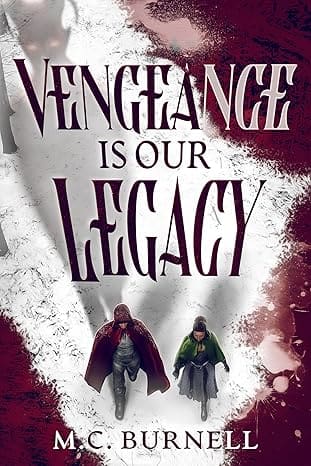






Synopsis:
The difference between justice and revenge may come down to having a friend.
The Tabbaqeran Empire is defended by the Scolate, governed by the Illiumate, guided by the Hakam; its people worship and quarrel with a thousand-thousand gods. But there are none more revered than the masters of martial arts who serve as living cages to the Archetypes of War, primal spirits created by Chaos before the dawn of time to destroy the mortal world.
A complex class system holds Qanath back from her chosen career, sitting on one of the senates. Her mother, a Senator herself, could change that with ease; it’s a matter of convincing her. Ink drying on her diploma from Magic U, the next step in Qanath’s perfect plan is to get herself apprenticed to Xar anKebbal, the Embodiment of Vengeance. Everyone thinks they know he stopped taking students several years ago, and she isn’t prepared to run up against the prickly, hostile foreigner who is secret heir to Xar’s Legacy.
When calamity strikes, she follows her new enemy out the door without a strategy. Havec is determined to go home, to find out who had him disappeared six years ago and punish them. Qanath can’t stand in his way; he has become Kebbal’s Embodiment and vengeance is his calling. The border between Tabbaqera and his homeland is restive, though, tensions swelling between their peoples. They find rampaging giants, tight-lipped spies, an unnatural winter season that doesn’t want to end. Innocents killed in the name of ambition.
The cynical, bitter, frightened, angry person Qanath first met wouldn’t have been willing to involve himself. That man refused to care about anyone else. Then he got to be friends with a stubborn young woman with a chip on her shoulder and a pocket full of crystals.
Review:
This book has a couple things I really enjoy in fantasy: gods who are active and affect the world around them, and monsters/creatures that are somewhat unique.
It’s a dual POV story, with half the book featuring Quanath and the other half Havec. They’re an unlikely duo at first, and both are dealing with conspiracies and schemes put in motion by people they’d once trusted (not going to say who, as that’s a big part of the story for both of them.)
Quanath has training as a sorcerer, but she’s new at the job, and in this world, magic often requires two people in order to conjure anything significant. She can make lights and heat stones solo, but not much else. She’s kind-hearted and loyal, and thinks the best of people even when they’re fairly rude to her, like Havec is at the beginning.
Havec was a difficult character to like at first. He’s arrogant and angry (with good reason for his rage), and at times, pretty insufferable. But as the story progresses and his past is revealed, he got much better. I ended up liking him best by the end. Havec’s story is more entwined with the gods of the world than Quanath’s is. Watching him learn about his role in society and what he’s expected to do was probably my favorite part of the book.
I think I’d characterize this book as “adventure fantasy.” The two main characters undertake a journey and encounter various obstacles along the way; sometimes it’s in the form of creatures like the dhrogos or the siren, and sometimes it’s navigating political schemes. There isn’t a lot of action, but the few scenes that have it were a lot of fun. Havec is a trained warrior, and his skills are put into play a handful of times.
I didn’t find this book easy to read, however. It’s written in a style that was sometimes hard to follow (for me), and the exposition sections could be pretty long. But I really liked the story, and that’s what kept me reading.
Speaking of the story, there were some plot twists (yes, multiple) that I didn’t anticipate and sent the story in completely different directions. I enjoyed that unpredictability and the additional mysteries that had to be solved because of it.

Leave a Reply