
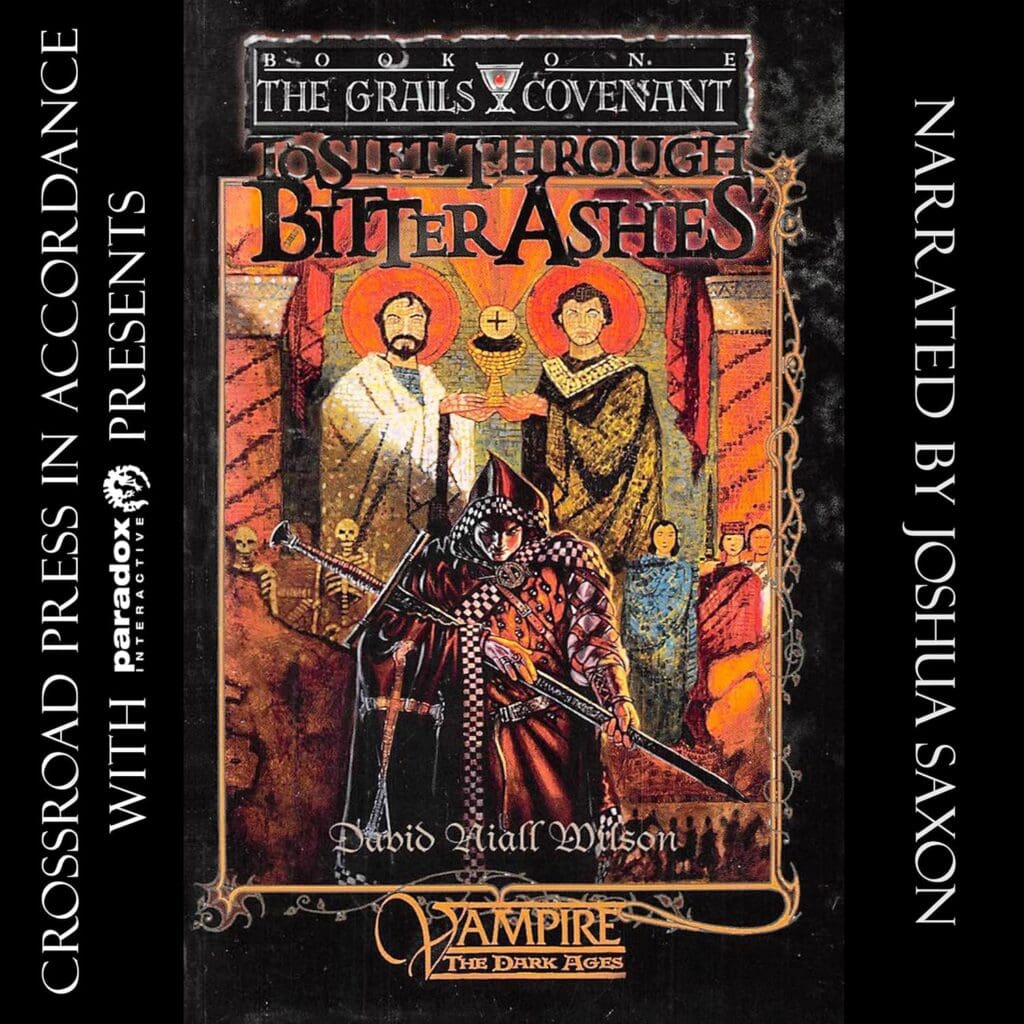
Synopsis
Obsessed with the acquiring the Holy Grail for the Lasombra clan, the vampire Montrovant sets out on a quest that leads him through the establishment of the Knights Templar, the lair of an ancient Egyptian evil, and the deserts of the Holy Land. Dark forces are pitted against him, and each ally must be watched in turn, as treachery leads to deceit and back agan in a race against time, the Church, and the mysterious Kli Kodesh, who is more ancient, even than Montrovant’s sire.
Only persistence, luck, and the power of his own will can see him through to his goal, and any mistake could mean his destruction.
Review
To Sift Through Bitter Ashes (The Grails Covenant Trilogy #1) by David Niall Wilson was originally published for White Wolf’s fiction line during the long forgotten epoch of Goth vampire fiction we call the Nineties. It had a premise that I absolutely loved: what if you combined the Holy Grail, Knights Templar, and vampires? It’s like taking Indiana Jones and adding vampires! Like taking the Assassins Creed game and adding vampires! Vampires make virtually everything better! Well, except teenage girl fiction but my wife would vehemently disagree.
The premise is that in the 12th century, a Lasombra vampire named Montrovant is seeking the Holy Grail. Montrovant is not motivated by religious reasons, however. Instead, Montrovant assumes that the Holy Grail works far more like Dungeons and Dragons than it does a religious relic. He thinks drinking from the cup and Jesus’ blood will enhance his vampire powers. To this end, Montrovant manipulates Hughes de Payen (real-life founder of the Knights Templar) to head to the Holy Land to form an army for him.
Montrovant lucks out beyond his wildest dreams in that the newly formed knightly order is assigned the Al-Aqsa mosque (renamed the Temple Mount) is possibly where the Holy Grail might be kept. Montrovant ignores an ancient Cainite, Kli Kodesh, suggesting that his entire quest is pointless though. Kli says that the Grail was not a physical cup but just Jesus’ inner power that a vampire might benefit from in other ways. I liked this twist because it fits perfectly with the World of Darkness’ cynicism and highlights Montrovant is unable to see beyond what benefits he might derive.
I really enjoyed To Sift Through Bitter Ashes because it manages to feel historical in a way that doesn’t overwhelm you with details. The Kingdom of Jerusalem is well-realized but much of its themes are about how the vampires exist apart from the larger historical changes. David Niall Wilson writes a cynical but not unbelievable take on the church, Templars, and secular authorities of Jerusalem. It’d be easy to simply treat them as monsters but in a book about vampires, we have the contradictions of corrupt clergy who nevertheless believe alongside genuinely pious knights who engage in rampant slaughter.
I liked most of the supporting cast but my favorite of the characters is definitely Kli Kodesh. The ancient Nosferatu is a genuinely pious being that may have actually known the historical Jesus but he’s also someone whose memories can’t be trusted (perhaps because they contradict popular conceptions of the time). Kli isn’t a purely good figure, though, and whether Golconda or salvation have affected him, he’s also someone primarily concerned with staving off the endless ennui that comes with being millennia old.
If I had to make a recommendation over whether to get this book in text or audiobook form, I would recommend the latter. The former is fine but I think Joshua Saxon does a fantastic job as narrator, giving all of the characters a suitable level of gravitas and personality. There’s few, if any, female characters so he doesn’t have to stretch his range too much. I enjoyed it so much that I am eager to get into the next book.
In conclusion, To Sift Through Bitter Ashes is a fantastic book and if you’re looking for dark fantasy that covers history, religion, and corruption with VAMPIRES then this is definitely the book for you. David Niall Wilson is a Stoker award winning author and this is among his best work. It doesn’t require a familiarity with Vampire: The Masquerade to enjoy but that certainly helps.


Leave a Reply