
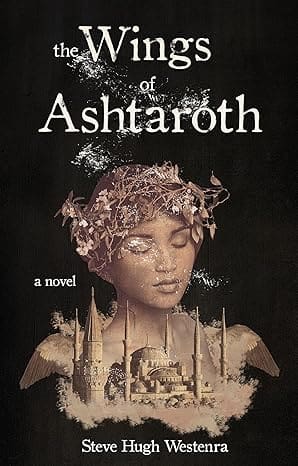






Synopsis:
The great city of Qemassen is at a crossroads. A powerful empire from beyond the ocean threatens to reignite a centuries-old feud. A slave rebellion brews in the tangled labyrinth of tunnels beneath the city streets. And Crown Prince Ashtaroth, the city’s supposed saviour, is considered unfit to rule even by those closest to him.
When the high priest burns one of the royal children alive as a desperate offering to the city’s absentee gods, it destroys the fragile peace within Qemassen’s scheming first family. Seeking revenge for the death of her child, Ashtaroth’s mother calls on a powerful demon named Lilit.
But Lilit cannot be trusted. Her cruel machinations pit brother against sister and father against daughter, laying waste to Ashtaroth’s family. Then Lilit approaches Ashtaroth with a demonic pact of his own-one that could save his people and his home. But between war from without and a revolution erupting within, even a demon may not be enough to keep Qemassen standing.
Review:
With rich worldbuilding and deep lore, The Wings of Ashtaroth had an almost mythological feel. There’s war, politics, succession, and treachery, all set in a world where magic is possible and the gods are always watching.
There are 3 main settings in the book: Qemassen, Lorar, and Indas. Qemassen is the one featured most often, with the most characters involved. It’s the capital city of an ancient kingdom that is teetering on the brink of war with the Lora Empire, but the war isn’t forefront on the minds of most of the characters until much later in the book. No, most of the characters are concerned only with scheming for personal gain—whether it’s for freedom, power, or money. And the politics in Qemassen are a complex web, where very few people can be trusted.
Caught in the middle of both the war and Qemassen’s politics is Ashteroth, the unlikely heir to the throne. He’s the youngest child of the present king, but due to prophecy, he’s expected to succeed his father and save Qemassen from destruction. Ashteroth is sickly and considered weak by many, who believe his older brother, Aurelius, is better suited to rule. Of all the characters in the book, Ashteroth is the most genuine. He doesn’t scheme as so many of the others do, but he’s mired in plots that were hatched years ago, some of which aren’t even related to his succession. And some that are tied firmly to the realm of the gods, most notably Lilit.
Lilit is called a goddess of vengeance by some, but is considered a demon by others. Based on her interactions with Ashteroth, I think both titles certainly apply. I liked that Lilit was portrayed as just human enough to understand, but otherworldly enough to feel more powerful and dangerous than any mortal.
While the main focus of the story is on Qemassen, we get to see Lorar from the viewpoint of Kirin, a slave-turned-gladiator who catches the eye of one of Lorar’s most powerful men: Marianus Rufus. To my mind, Lorar was reminiscent of ancient Rome in how its government was portrayed, how its society functioned, and its constant desire for conquest. Kirin isn’t a complicated man to begin with, but as the book goes on and certain things happen, he starts to rethink his beliefs on the Empire.
And in Indas, which is a nation conquered and governed by Lorar, we have Iridescia. She’s young (maybe a teenager?), and she’s idealistic. She wants to see Indas freed, and uses her position in the governor’s court to glean information. Her story arc features the most arcane elements in the book (I hesitate to call it magic, because it feels like something else entirely. After reading her final chapters, I have a theory about what it is, but to avoid spoilers, I won’t mention that here.) Iridescia isn’t as free as her position implies, however. She’s under almost constant supervision by her great aunt, Star, who is as ruthless as she is ambitious. Star is one of the great villains in this tale.
With all I’ve said so far, it should come as no surprise that The Wings of Ashteroth is a very big book. I didn’t realize its length until I was a couple chapters (and as many hours) in and my ereader said I was only at 3%. After looking it up, I realized it’s well over 1000 pages. But it was worth the time I spent on it, and there’s a part of me that wishes it wasn’t over. The worldbuilding was exquisite and every character had their own motivations, some of which weren’t clear until the very end (and some who are still a bit of a mystery.) I don’t know if the author is planning a sequel, but based on the ending, I could see the potential for one.
If you’re a fan of fantasy with a sort of mythological feel and a lot of twisted political schemes, definitely check out The Wings of Ashteroth. (Don’t let its length scare you away—it’s well worth the read!)



Leave a Reply