
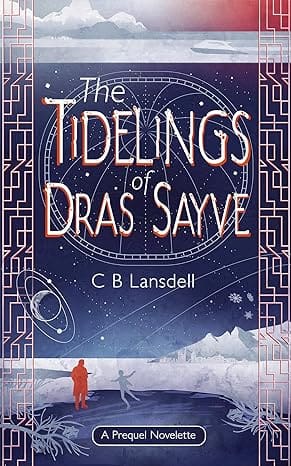



Synopsis
Maverick diplomat Emis Rindar travels to the northernmost clan in the Dras Channel, seeking the assistance of an old friend. After a lifetime of adventures across Knyadrea, a large moon, his next planned endeavour will be unlike anything he has attempted. Isolated and enigmatic, the knyads of Dras Sayve keep even their neighbours at a distance, and few welcome the unorthodox ideas Emis brings from abroad. But all his breakthroughs happen here, and the Sayvians are the most technologically progressive knyads on the moon. Can Emis convince them that he will make a worthy mentor to one of their more curious juveniles?
This story is set 30 years before the events of Far Removed (C.B. Lansdell’s debut sci-fi novel).
Quick Review
The Tidelings of Dras Sayve is a low-stakes novella with worldbuilding deep as the seas. The world is as much a character as the people in it, and Lansdell immerses us in it from the first page.
Full Review
Before reading The Tidelings of Dras Sayve, I had just finished The Left Hand of Darkness by Ursula K. LeGuin. While the two books tackle much different topics, I found myself feeling as though they were very similar reading experiences.
LeGuin’s book offered a deep world to get lost in, and a truly alien cast of characters. The stakes, while not quite low, were often muted. Even in moments of great risk, the way LeGuin wrote them almost dismantled the characters’ peril into its components. Ai and Estraven’s flight was not so much a struggle for survival, but a calculated trek across ice sheets and volcanoes.
The Tidelings of Dras Sayve has a lot of that same feeling for me. The story revolves around Emis Rindar’s search for a kind of heir, a student who he can impart some knowledge to. Along the way, we get a lot of worldbuilding, not unlike the way LeGuin built the setting of Winter and the aliens who live there. The people in Lansdell’s book—the knyads—are not human. They emerge from the sea as children, each island they wash upon has its own culture, and the people of Dras Sayve appear to have a very particular culture that hints at a battle between insular and global interests. There’s a lot to dig into here, and it informs much of Emis’ search.
Unfortunately, we never see much of that ideological duel on the page. The story is rooted in Emis’ perspective, and the issues he faces with the Sayvian governors—and their concerns about the outside world—only extends as far as Emis’ interests. Lansdell writes well and hints at much deeper goings on, but the actual events of the story seem to be resolved just as quickly as they appear. I realize this was meant to be a novella, an introduction to the setting and some characters, but an extra twenty pages digging into some of the politics here and providing a bigger challenge for Emis to overcome would not have been unwanted.
However, keeping these politics at arms length does keep the story lower stakes, almost cozy in some ways. While I found myself wanting for more conflict, I do think that this choice worked, and some readers will love what’s here.
I recommend The Tidelings of Dras Sayve. It is a low-stakes story with rich worldbuilding, and has an interesting perspective: a coming of age story from the perspective of the mentor. The setting and the knyads are also wholly unique. If any of that sounds interesting, it’s absolutely worth a try.
I’ll add that this book also serves as an origin story for one of the main characters in Lansdell’s Apidecca Duology—however I read The Tidelings of Dras Sayve before those books. I’m pleased to say that this novella also works on its own, though I’m sure there are plenty of easter eggs and references that will delight those who read the main series first.

Leave a Reply