




Synopsis:
The Subtle Art of Folding Space , is the exhilarating debut science fiction novel from Nebula and Hugo-winning author John Chu channels unhinged physics, generational trauma, and the comfort of really good dim sum. This isn’t your usual jaunt through quantum physics.
Ellie’s universe, and this one, is falling apart. Her ailing mother is in a coma; her sister, Chris, accuses her of being insufficiently Chinese between assassination attempts; and a shadowy cabal of engineers is trying to hijack the skunkworks, the machinery that keeps the physics of each universe working the way it’s supposed to.
Daniel, Ellie’s cousin, has found an illicit device in the skunkworks—one that keeps Ellie’s comatose mother alive while also creating destabilizing bugs in the physics of this universe. It’s not a good day.
If she can confront her mother’s legacy and overcome her family’s generational trauma, she just might find a way to preserve the skunkworks and reconcile with her sister…but digging into her family’s past is thornier than it seems, and the secrets she uncovers will force Ellie to choose between her family and the universe itself.
Review:
In terms of originality and innovation with sci-fi concepts, John Chu blew me away with his novel The Subtle Art of Folding Space. This book does not lack for imagination in its world-building. I found a lot to like as I was pulled into the story, but ultimately that was where the book let me down — the storytelling. I really wanted to like this book just a little bit better, but the characters and the situations they are in throughout the book are just a little too unbelievable for my taste, even as Ellie and Daniel work to save the entire universe.
John Chu’s author bio notes that he is a “microprocessor architect by day, a writer by night.” Here he takes the day job and uses science to propel his characters through the skunkworks of the universe. Ellie’s family has intimate knowledge of the fundamental workings of the universe — what it takes to keep it ticking and running smoothly. That knowledge is physically represented by a machine they call the skunkworks where they can go and make minor changes that reverberate throughout the world.
As the book starts, Ellie’s mother is dying and her sister, Chris, is being the “good daughter” by taking care of her without any help from Ellie. Ellie discovers an issue in the skunkworks that is artificially keeping Ellie’s mother alive and she makes the tough decision to fix the world, dooming her mother. We also find out quickly that Ellie has survived countless “assassination attempts” from Chris over the years. She treats the attempts on her life with such a blase attitude that it seems like maybe there is another explanation at hand, and it kept me reading to see what else could be going on.
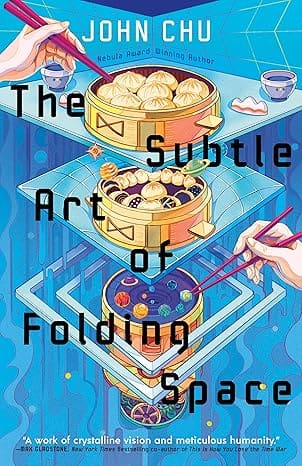
My favorite character throughout The Subtle Art of Folding Space, however, was Daniel, Ellie’s cousin. Daniel is basically a quality-assurance technician of the skunkworks and throughout his process he creates food (like what is shown on the beautiful cover) from thin air to represent how the skunkworks is working. If the food is bad, there is something wrong that needs attention. In all his interactions with Ellie, Daniel consistently tries to tell her that the relationship she has with her sister is toxic. Ellie has normalized the violence from Chris against her and it takes an almost frustratingly long time for her to come to grips with the reality of her own life.
Like I said, the world-building is clearly the best part of The Subtle Art of Folding Space as John Chu uses physics and quantum mechanics to toss his characters around. I had fun with the story, but I was left with a fair number of questions when I was finished with Chu’s novel. I would definitely recommend picking up this novel, if nothing else for the imaginative world he put around Ellie and Daniel as they try to fix the universe.
Thank you to Tor Books for providing this book for review consideration. All opinions are my own.



Leave a Reply