
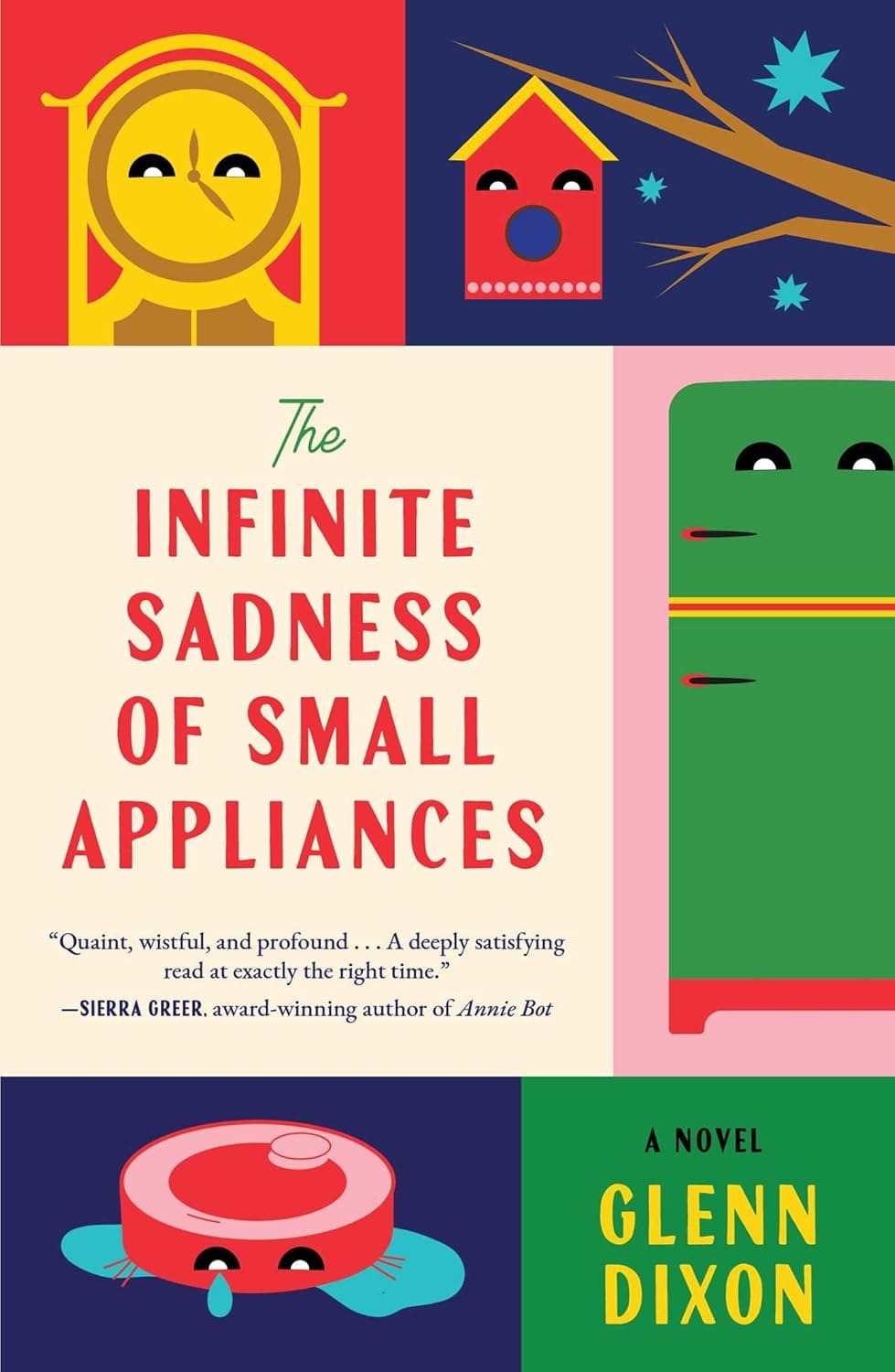






Synopsis:
In a near future, where even the smallest of appliances are sentient, a young Roomba vacuum sets out to save the humans of her house from a rising technological power in this compelling, original novel.
In a self-running, smart house, a young and sentient Roomba listens as her owner, Harold, reads aloud to his dying wife, Edie. Mesmerized by To Kill a Mockingbird and craving the human connection she witnesses in Harold’s stories, the little vacuum renames herself Scout and embarks on a journey of self-discovery.
But when Edie passes away, Scout and her fellow sentient appliances discover that there are sinister forces in their midst. The omnipresent Grid, which monitors every household in the City, seeks to remove Harold from his home, a place he’s lived in for fifty years.
With the help of Adrian, a neighborhood boy who grows close to Scout and Harold, as well as Kate, Harold and Edie’s formerly estranged daughter, the humans and the appliances must come together to outwit the all-controlling Grid lest they risk losing everything they hold dear.
Review:
Glenn Dixon is sneaky clever. Picking up his latest, The Infinite Sadness of Small Appliances, I looked at the cover and peaked at the synopsis, and I thought I was getting a retread of The Brave Little Toaster. Dixon himself acknowledged the connection in the Author’s Note, but this story, even with all the whimsy and charm, has something important to say, especially given the prevalence of Artificial Intelligence in our society today.
The opening chapters of TISOSA open a bit like the montage in the first ten minutes of Pixar’s Up, showing us a loving, but elderly married couple — Harold and Edie — who are in the final stages of Edie’s life. We’re treated to an innocent view of this tragedy through the eyes of the house’s sentient vacuum — a little bot who claims the name “Scout” after hearing Harold read To Kill a Mockingbird to his dying wife. In those opening chapters, there is a sense that everything isn’t quite right, but it doesn’t start cascading until after Edie’s death.
Before long, we realize this isn’t quite the utopia we might expect. Everything looks nice and shiny with the fridge ordering food when it runs out and the household appliances almost knowing more about their humans than the humans themselves. But, there is a dystopic foundation just below the surface. There are shades of Wall-E here where humanity has allowed itself to be totally governed by the bots they created.
The greater issue that Dixon hovers around is what we are giving up by letting technology run our lives. At one point in the novel, Harold and Edie’s daughter, Kate, comes back home after the death of her mother. Kate and her father go for a walk around the neighborhood and she comments that there are no street signs. Since everyone is simply driven everywhere by self-driving vehicles, Harold points that out, noting “You don’t have to know the streets.” Kate comments back, “Maybe I want to know.”
Just five words sums up what a lot of us generally feel about the ubiquitousness of A.I. today.
A.I. can write your paper for you…A.I. can make the image for you…A.I. can…
Maybe we are losing ourselves in the process. If A.I. just does everything for us, what’s left for us? Where’s the passion, the creativity, the soul of humanity? It’s not always easy, but writing my own words is important to me. Maybe I’m not the best writer, but at least the words are mine and no one else’s.
And I think Dixon hints at the lethargy of humanity with this as well. The more we simply allow technology to run our lives, what’s the point in anything? In living? In having children? In Dixon’s seemingly whimsical novel, populations are shrinking worldwide and as they do, the bots are doing what bots do — performing their tasks with efficiency. And as that happens, we see that the bots have a different value on things than humans do. Within days of Edie’s passing, there is a process begun by some algorithm that begins to strip any trace of her from Harold’s home — and eventually Harold himself. There are elements of Asimov’s Three Laws built in, but they have a different view of them in some ways.
Dixon shows the joy of not simply letting technology do everything as Adrian, a neighborhood boy, shows up to Harold’s house in the days after Edie’s death, needing to practice piano for an important piece. Slowly the boy improves with the only technological help being Scout acting as a metronome for the young pianist. In the end, the act of creating is more important than the efficiency that the Grid demands.
There are some really great philosophical moments in TISOSA where the Fridge, Clock, and Scout debate existential questions. For them, however, the questions are often answered differently than we humans would and that provides some wonderful scenes, especially early on in the book.
I really enjoyed The Infinite Sadness of Small Appliances, but not how I thought I would when I started. The subtle, yet stark, warnings about A.I. and the role we allow technology to play in our everyday lives is the real throughline of this novel, told expertly through the eyes of a small vacuum and the humans it cares for.
Thank you to Atria Books for providing this book for review consideration via NetGalley. All opinions are my own.

Leave a Reply