
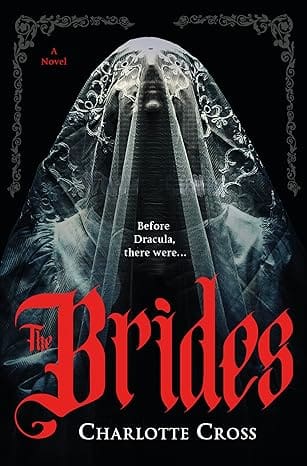





Synopsis:
‘Come to me, and be mine for eternity’
1884. When Mafalda journeys to Budapest to care for her grieving aunt, her secret love, Lucy, hurries from London to comfort her, with chaperone and lady’s maid in tow.
But lady’s maid Alice, blessed and cursed with the Sight, is tormented by terrifying visions. When chaperone Eliza falls prey to a disturbing wasting illness, the women hope to seek the healing waters of Transylvania. At a nobleman’s invitation, they set out for Castle Dracula.
In the depths of the forest, miles from civilization, their host reveals his true intentions; a monstrous ambition which will tear the women apart.
And not all of them will survive.
Review:
Dracula’s brides do appear in Bram Stoker’s seminal work, but all too briefly I have always maintained. I was once content with these three immortal women who haunt the imagination far more than they grace the page, but no longer. Luckily, Charlotte Cross’ debut “The Brides,” is the answer to my subconscious prayers, a velvety, epistolary gothic that has the chilling atmosphere of Peter Straub’s “Ghost Story,” simply with more fangs and decadence. Cross nods to the 1897 masterpiece she has preceded in format, telling this historical horrormance entirely through journal entries and letters, and even including some familiar faces. Whilst the shadow of Dracula may loom, Cross does not merely retrace its outline, “The Brides,” being focused unapologetically on its women. This is a story of captivity and escape, forbidden love and unruly desire. A reverent and rebellious gothic, well worth your time, “The Brides,” is out from Tor Nightfire in the UK March 19th and Hanover Square Press July 7th in the US.
It’s 1884 and Mafalda Lowell, accompanied by her mother, is Budapest bound, to care for her Aunt Reka in lieu of her uncle’s untimely death. She leaves behind Lucy, whom she shares both her home and heart with. Lucy in Mafalda’s absence stays with their mutual friend Eliza. However, when Mafalda’s letters grow far more sinister than the reassuring dispatches of a dutiful niece, reporting grim, dark and mysterious events, Lucy and Eliza, accompanied by Alice, a lady-in-waiting cursed with preeminence- decide its best they join her. What occurs in Europe is inconceivable, impossible and unpleasant.
In 1903, Dr John Seward takes up a position at Oxford Public Asylum, where he meets a patient ruined by a brooding figure from his own past. She seems to have been unfortunate enough to encounter the sort of trouble that follows in the wake of Count Dracula.
Similarly to “Dracula,” “The Brides,” opts to tell its story through scattered testimonies- letters and diary entries. It works just as nicely- Cross allowing the awful, romantic, slow-blooming nightmare to unfold in fragments. This novel has a generous cast of characters, an intricate web of complex relationships and a lot of geographic movement- frankly it is, for a little, rather difficult to follow. However, when the rhythm settles, the voices separate and clarify, you will find you have slipped into this book. Inviting irony, paranoia and intimacy, it feels as though we have discovered a locked drawer and cannot quite stop ourselves from rifling through its startling contents. In the end, “The Brides,” epistolary format is one of its greatest strengths.
Another one of those greatest strengths would be our 4 lead characters however, those being our brides, and the one that got away. They are the voice and heart and, let me have it, fangs of this novel. They are given depth and agency, a stage large enough for their desires and resentments. Even outside of our core quartet, “The Brides,” is populated with formidable women. In a genre filled with damsels locked in towers, stuck wandering candle-lit corridors or draped in velvet, Cross allows her characters to slip out of the margins and onto centre-stage. It’s gorgeous.
“The Brides,” is a novel that feels as though it has been stored for a century in a dusty writing desk before being pressed into my eager hands. Fang fiction has wandered through city nightlife, integrated into quiet suburbia and even cropped up in bureaucratic satire in recent years, but Cross has reminded me that Transylvania remains fertile ground for a good vampire novel.


Leave a Reply