




Synopsis:
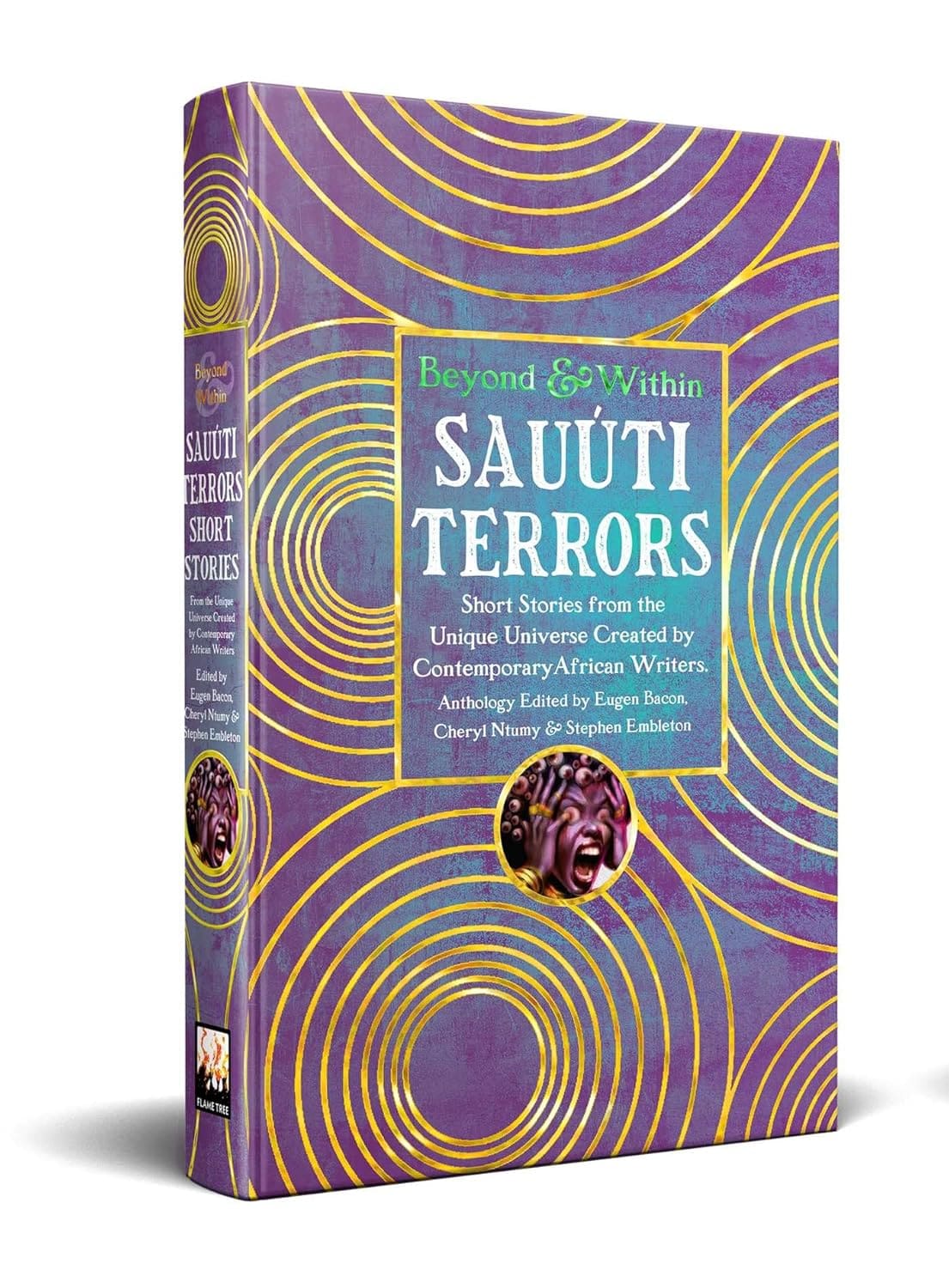
Co-editors Eugen Bacon, Stephen Embleton and Cheryl S. Ntumy bring us a powerful and haunting collection of short stories from the groundbreaking Sauútiverse, following the success of Mothersound: The Sauútiverse Anthology. Sauúti Terrors tells of the doomed, the damned, the shunned, the cunning, the destroyers, the noxious, and more, in the worlds of the living, the in-between and the dead. Unravel the darkest stories in the deepest parts of the Sauúti five-planet system with its two suns, and orbiting a binary star.
Bringing together African and African diaspora writers, the collection features five-time Bram Stoker Award winner and recipient of the Bram Stoker Lifetime Achievement Award Linda D. Addison and other prominent speculative fiction authors, including T.L. Huchu, Xan van Rooyen, Jamal Hodge, Ishola Abdulwasiu Ayodele, Wole Talabi, Mazi Nwonwu, Kofi Nyameye, D.S. Falowo, Shingai Njeri Kagunda, J. Umeh, Moustapha Mbacké Diop, Miguel O. Mitchell, DaVaun Sanders and Nerine Dorman.
The Flame Tree Beyond and Within short story collections bring together tales of myth and imagination by modern and contemporary writers, carefully selected by anthologists, and sometimes featuring short stories from a single author. Overall, the series presents a wide range of diverse and inclusive voices with myth, folkloric-inflected short fiction, and an emphasis on the supernatural, science fiction, the mysterious and the speculative. The books themselves are gorgeous, with foiled covers, printed edges and published only in hardcover editions, offering a lifetime of reading pleasure.
Review:
Last year I had the opportunity to read Eugen Bacon’s The Nga’phandileh Whisperer and was thrust into the shared and Afrocentric, Sauutiverse. Bacon’s story was unique and wildly inventive, so when I was given the chance to read more in the Sauútiverse, I leapt at the chance. While horror isn’t my first choice, I ended up really enjoying Sauúti Terrors, the latest short story anthology from the Sauúti Collective.
Of course, with every short story anthology or collection, there is variation between authors. Writing styles. Themes. The creepiness. The worlds that they only get a few pages to both set up and tear down all at once. I’m happy to report that the writing and imagination is top notch in this wonderful collection. There are a few stories that managed to dig somewhere inside of me and it’s going to take some work to draw them out and forget about them. And that’s not necessarily a bad thing.
While I have read a piece of the Sauútiverse, I did not have an opportunity to read their previous collective anthology, Mothersound, which featured many of the same contributors as this anthology. There are threads of connectivity between stories in this collection, but they are there because of the established planetary system that the authors of the Sauúti Collective have established. From their website:
The Sauútiverse is an Africa-inspired secondary world with both humanoid and non-humanoid creatures living in a 5-planet, binary star system. All the humanoids have a shared history, having evolved from a much older race that developed on one of the planets – Wiimb-ó – before spreading out. The basic Theme and Focus of the Sauútiverse is an exploration of the nature of sound as power. Focus is given to sounds, music, language and speaking and it is linked to their shared biologies and cultures and histories.
That theme of sound, music, language and speaking is definitely an ever-present foundation for much of the collection, whether explicitly stated or implicit in its execution. It can be hard to grasp for some as Western culture often doesn’t have much of an oral tradition when it comes to stories, but it was fascinating to see executed here.
Whenever I review anthologies, I like to choose a few stories to highlight, and Sauúti Terrors is no exception.
- The Final Flight of the Ungu-ugnu by Wole Talabi is an after-action report of a missing spaceship told through various reports, voice recordings, and flight logs. What we see is a slowly (although not too slowly — this is one of the shorter works in Sauúti Terrors) developing tale of something…horrifying happening to the ill-fated crew of the Ungu-ugnu.
- I also loved The Unspoken by Kofi Nyameye. When I was in college, I saw the Denzel Washington film, The Fallen and reading this short work had some of the same hallmarks of that under-rated movie. There is a cosmic horror aspect to this one and something inescapable about the fate of our characters no matter what choices they make.
- The second full story in the book, Kyi’yaji by Xan Van Rooyen is a marvel. From the book’s own description of the story: “On the planet Wiimb-o, over 800 people died when the anti-music group Zaxulo committed ritual suicide on stage. Their method? An unholy combination of ear-shredding, mind-breaking sounds.” There is some similarities to Talabi’s story in its formatting, but there is more of a narrative that plays out as its revealed what happened when the “anti-music” band commit suicide and also induce mass death in the audience as well.
I found many of the stories to be a “slow burn” type of horror, but there were definitely some where I felt some terror from the very start, providing some variety to the collection. Throughout much of the writings in Sauúti Terrors, whether story or poetry, there are themes that (seemed to me) wouldn’t be there without the generational trauma from European colonization that led to the African diaspora. Of course, the Sauútiverse is merely inspired by African cultures, not actually taken from Earth and placed on other planets, so it isn’t a one-to-one comparison, but in the many authors’ writings the pain of colonialism still rears its ugly head and is perhaps well-suited to a horror collection such as this.
When I decided to devote time to writing reviews of books I’d read, I made a conscious decision to pick up more works by women and people of color. I’ve found some amazing works over the past few years by simply being more open to literature from other cultures and outside my typical insular bubble. If that’s something you aspire to as well, Sauúti Terrors is the perfect book for you. Reading through the biographies of the authors and contributors to this volume blew me away with the diversity and what they had to share with readers of all backgrounds.
I highly recommend Sauúti Terrors as both a short story collection as well as a place to find some of your new favorite voices in the fantasy, sci-fi, and horror spaces on your bookshelf.

Leave a Reply