
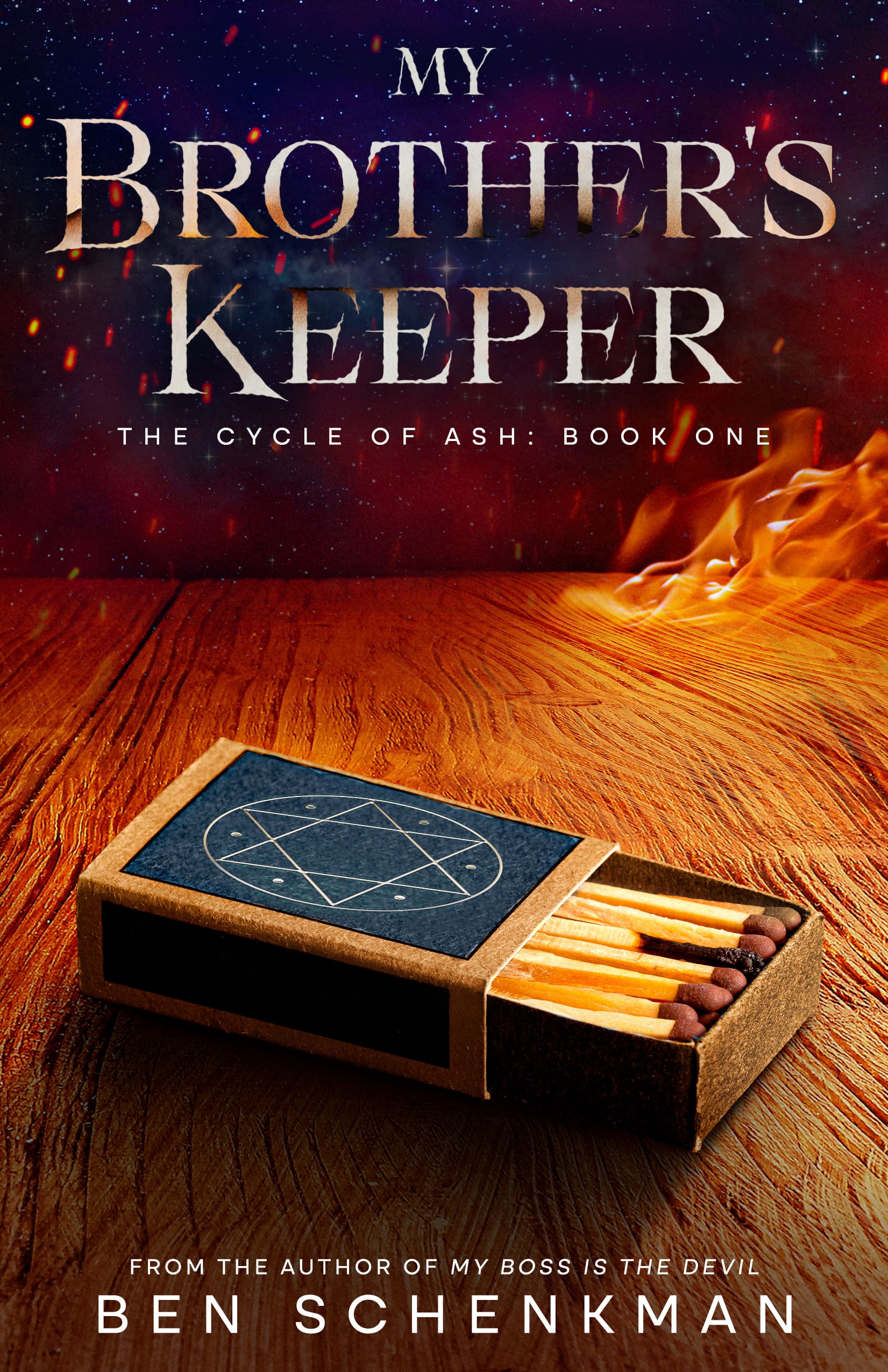



Synopsis
Magic is real, demons walk the earth, and Max’s brother is dead.
Max Asher, Jewish mystic and private-eye, never thought he’d be coming back to his home town to bury his twin brother, Solomon. He definitely never thought the funeral would turn into a case, but when Sol’s widow Gabby asks him to investigate the cause of death, “Uncle Max” is on the job.
When Max kicks the demon’s nest, he uncovers a conspiracy that forces him to reevaluate everything he thought he knew about his brother. Unfamiliar local politics blur the line between the supernatural and the mundane, and soon, fighting for justice becomes dangerously literal. If Max can uncover the murderer, he might just save his brother’s soul—but if he can’t, he’ll fall victim to the same deadly fate.
Putting the past to rest is going to take more than a shovel full of dirt.
Review
My Brother’s Keeper offers a grounded, engaging take on urban fantasy, blending investigative storytelling with a strong sense of culture and spirituality. What begins as a steady, methodical mystery gradually builds into something far more gripping, especially as the story moves into its final stretch.
The emotional impact is subtle for much of the book, but the final quarter really delivers. The ending, in particular, stands out—a reveal that feels both surprising and inevitable, clicking perfectly into place in retrospect. It’s the kind of payoff that elevates everything that came before it.
Max, the protagonist, has a familiar feel—reminiscent of a classic urban fantasy lead in the vein of Harry Dresden—but with meaningful differences that give him his own identity, particularly through his connection to his Jewish heritage. That cultural lens adds a layer of depth to both his character and the story as a whole. Interestingly, some of the side characters often steal the spotlight, bringing extra texture and personality to the narrative.
Plot-wise, the novel is well-constructed and easy to follow. The investigation unfolds in a logical, satisfying way, with each step building naturally on the last. The pacing is smooth, and the integration of Hebrew terms and concepts is handled thoughtfully—clear enough to understand without ever feeling heavy-handed. The magic system, intertwined with elements of Jewish folklore and spirituality, is one of the book’s highlights, giving the story a distinct flavor that sets it apart within the genre.
The prose is straightforward and functional, allowing the story and characters to take center stage. While it doesn’t call attention to itself stylistically, it supports the narrative effectively and keeps the pages turning.
Overall, My Brother’s Keeper is a solid, steadily building urban fantasy with a unique cultural perspective and a particularly strong finish. Readers who enjoy investigative plots, folklore-infused magic, and stories that reward patience with a powerful final act will find a lot to appreciate here.



Leave a Reply