
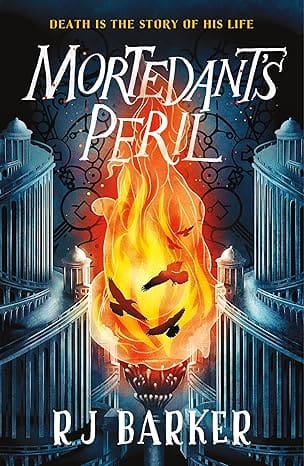





Synopsis
In a city of ancient automata, strange spirits, and sleeping gods, a cleric of death finds his own life on the line in this vividly imagined fantasy murder mystery from the acclaimed author of The Bone Ships and Age of Assassins.
Irody Hasp is a Mortedant, a cleric tasked with reading the last thoughts of the dead―though no one thanks him for it. No Mortedant is popular, but Irody is scarcely tolerated even by the other members of his own guild, and rarely selected for anything but the lowliest of jobs.
This impoverished existence would be dismal enough―but after reading the corpse of a low-level records keeper, Irody’s troubles quickly multiply when his own apprentice is murdered, and all fingers point to him as a suspect. The only way to save his own skin is to find the real culprit himself, an investigation that quickly attracts powerful enemies with few scruples, and draws him into a plot that threatens the entire corrupt yet wondrous city he calls home.
Review
Epic doorstoppers. Grimdark. Dystopian Sci Fi. Cozy Fantasy. Romantasy.
Science Fiction and Fantasy have pretty much always been dominated by trends. Whether it’s the wave of Tolkien-inspired heroic fantasy of the late 20th century, the mega epics after The Wheel of Time got huge, the explosion of grimdark fantasy in the mid-2000s, a legion of Hunger Games copycats in the 2010s, or A Hype of Dark Guys and Sex Scenes, we can all point at some trend that took over the SFF space for a time.
Well, Mortedant’s Peril seems like a herald for the newest trend on the block.
Robert Jackson Bennett has been around for a while, writing various horror and fantasy books over the last decade-plus (including the spectacular Divine Cities trilogy). But it wasn’t until the breakaway success of The Tainted Cup that good ole RJB finally hit mainstream SFF fandom, and winning the Hugo for Best Novel was the cherry on top.
And guess what? It looks like he’s ground zero for the next big trend in fantasy: detective fantasy.
Oh, sure, we’ve had mysteries and detective stories in the genre for a while. You have the (largely) romantasy-progenitor urban fantasies of Laurell K. Hamilton, Patricia Briggs, and Seanan McGuire; you’ve got The Dresden Files and Alex Verus in the crime-solving wizard category. You even have hardboiled fantasy going back to the 80s with Glen Cook’s Garrett, P.I. series.
But after reading Mortedant’s Peril, it was clear that fantasy is primed for a new wave of mystery-driven stories to take the spotlight. R. J. Barker, known best for his Tide Child and Wounded Kingdom trilogies, is clearly hot on Bennett’s heels.
The book opens with a murder in the fantasy city of Elbay, a sprawling, tiered metropolis where spirits move side-by-side with humans (and other races), where Mortedants read the final memories of the dead, where a god sleeps deep beneath the streets. Irody Hasp is a Mortedant, but not part of the In Group. He struggles to find work, so when he gets word of a poor widow in the first tier of Elbay looking for a Mortedant to read her husband’s body, he takes what work he can get.
But Irody’s erstwhile job puts a target on his back, and his apprentice—or neophyte—is murdered. Hasp is accused of the crime, and given only a few days to prove someone else did it before he will be executed.
What develops is a brisk, fraught adventure as Hasp is joined by the nonhuman Whisper, a giant sharklike warrior; and the street urchin Mirial, sister to his murdered neophyte.
Barker brings us up and down and inside the city of Elbay, giving himself lots of time and space to build out a rigorous world. We gain insight into all areas of Elbay’s life, from its religion (and many splinter factions) to its economy and politics. As with all good worldbuilding, the magic of this world is woven into every layer of the social strata, with spirits delivering messages and tending to the massive infrastructure of the city. It is easy to find this story immersive, to find yourself lost in the streets of Elbay along with Hasp and Mirial and Whisper.
If there’s one element of Barker’s worldbuilding that falls short, however, it’s in his immediate descriptions. There were several notable moments in the book where the details of a mechanism or a particularly jarring part of the city simply did not make logical sense, and I found it difficult to picture just what he was describing. I found myself, on more than one occasion, simply giving up and reading on, hoping that the story would provide more context; it did in some instances but not all.
But of course this book is not just a worldbuilding treatise. In the tradition of mysteries, Hasp slowly peels back the layers of conspiracy, moving from clue to clue. Barker provides enough of this to make for an engaging read, though it’s far from the most difficult mystery to unravel yourself, long before Hasp finally puts the pieces together. Sometimes this is done in a manner that makes it feel satisfying, but in this case it was a tad underwhelming.
One aspect of this came from the characterization of Hasp. It is actually the strongest part of the book, though it results in a certain amount of frustration. Hasp is painfully realistic in how his prejudices prevent him from seeing what should have been obvious—he is simply unwilling to entertain certain notions that practically leap from the page because he is part of this society and has grown to expect certain things, while us readers are not so limited.
This double-edged sword makes Hasp one of the best-realized characters I’ve encountered in recent fantasy, but also prevents the plot from punching with as much impact as it could have. Nonetheless, Mortedant’s Peril is a solid new offering from a longtime voice in the fantasy space. Highly recommended for fans of The Tainted Cup, The Lies of Locke Lamora, or Mistborn.
Mortedant’s Peril releases May 7, 2026 from Tor.

Leave a Reply