
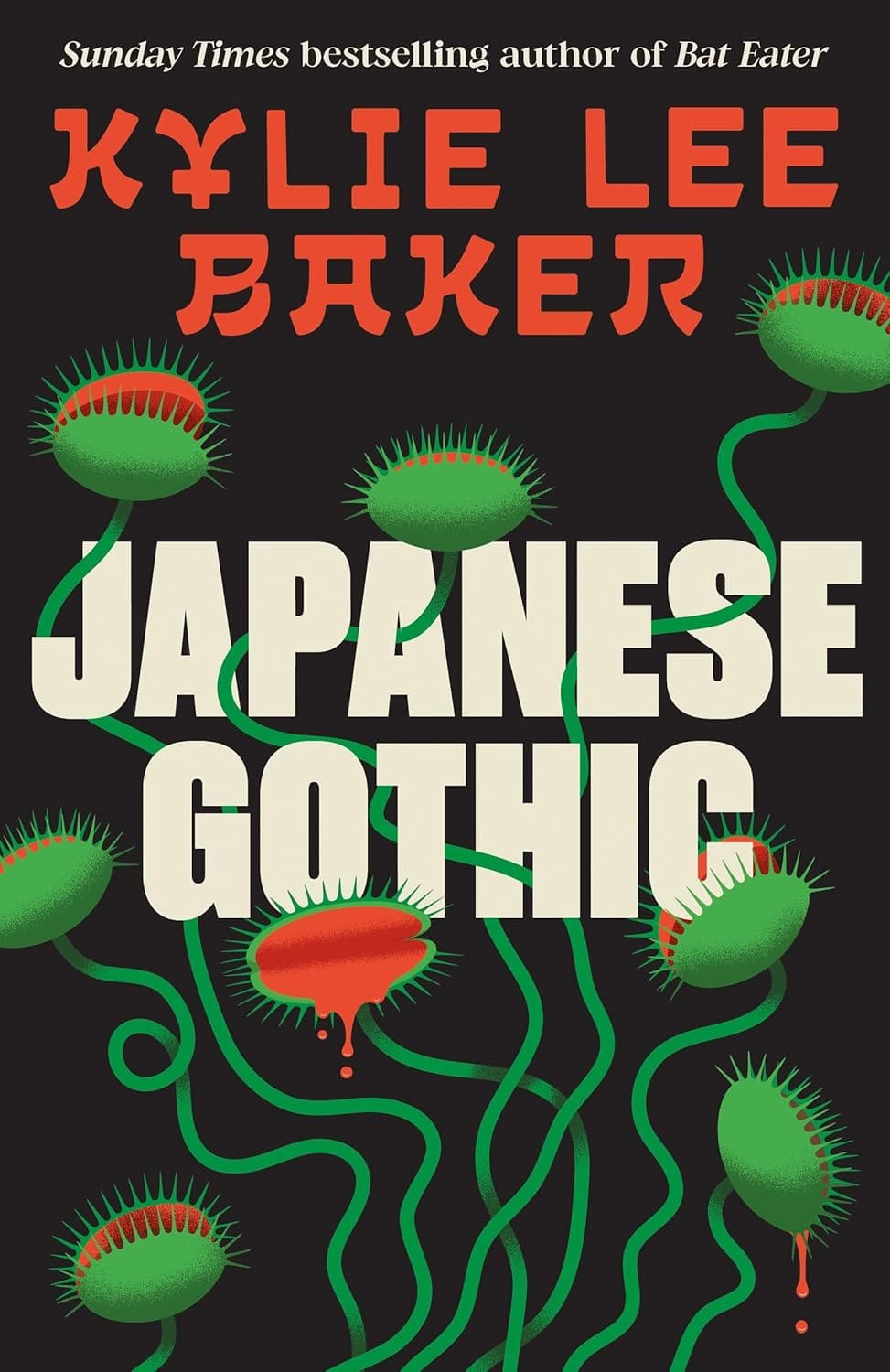






Synopsis:
2025
Lee can’t remember exactly where he hid the body, but he can remember the blood. Hiding out at his father’s centuries-old home in Japan, Lee knows something is wrong with him, and he knows it has something to do with his mother’s disappearance almost a decade ago.
1877
A female samurai, Sen, stalks the borders of her home to protect her family from slaughter after the abolition of the samurai class. She’s not sure how they’ll ever survive, not without her father, who has returned from war with a different soul behind his eyes.
Review:
I don’t quite know where to begin with a book as high-concept and reality-warping as Kylie Lee Baker’s “Japanese Gothic.” A dual-timeline head-spinner that reads like 11/22/63 meets Poe meets Cat Ward, in her latest- set in both modern day and Meiji era Japan, Baker pulls no punches in terms of ambiguity and cosmicism. A (perhaps literally) dizzyingly gorgeous ghost story that Escher would be proud of, “Japanese Gothic,” comments upon perception, mistakes- how we are haunted by them, and how place too, earth, soil, stone, remembers the atrocities committed upon it. There’s a whole lot to think about and grapple with, and I’m still chewing on it as I type- it is slippery and shimmery and unlike anything else I’ve been lucky enough to read as of late- just genius. “Japanese Gothic,” is out from Hanover Square Press April 21st in the US and Hodder & Stoughton April 30th in the UK.
In 1877 we follow Sen, a ferocious samurai in training. A female samurai is certainly unconventional, but following the abolition of the samurai class, and considering her brothers are still so young, it is Sen who her father, a critical motivator, is training. Something is amiss with the man though, for samurai such as he can not return from a battle lost, alive and honorable, and something in him is changed.
It’s 2026, and Lee Turner has killed his NYU roommate. Having routinely, or recently, less routinely, taken sleeping pills for years, his head is a little foggy- all he knows is that he has fled to his dad’s house in Japan, and that James Baldridge is dead. Should he remember what really happened that night he has to stop taking those damn pills… and when he does so, something truly impossible happens.
These two stories intersect in the most peculiar and brilliant of ways, a really important, big way, that is as rich thematically as it is mind-boggling structurally, but alas I’m hesitant to spoil it for you. You can seek it out if you wish but I shall have no part in it. Anyway, in a manner one might not expect, these two different stories do intersect, and it’s dazzling. I’ll tell you, rather than how Baker does it, some of the commentary that arises from it. As I mentioned “Japanese Gothic,” is a book that quite rightly points out the consequence of our choices and behaviours, and how place specifically holds the residue of them long after, perhaps even spanning centuries. Baker achieves this best through this gorgeous (no, not an oxymoron) recurring motif of stains. Literal blotches, largely here, in this horror novel, of blood, if I’m honest, but also as reminders of what caused them, or as Baker (through Sen) so beautifully puts it herself “Scars that our mistakes leave behind.” Also, read the afterword.
Baker’s writing is beautiful and lucid and easy to get lost in. I mean that- its buttery pages slip through your fingers and then you realise you’ve read it cover to cover, and, speaking from experience, are rather bereft. I also mean though (a double entendre look at me go) that there are points where, presumably due to design rather than my lack of intelligence (but you never know) you have no idea what is going on- where you’re lost. That’s largely because we only know what Sen and Lee know when we’re reading within their timeline. There’s also what they think they know, an important distinction in this novel, and what they might know, and eventually in the final part, what they will never know at all- it’s all a little disorienting, in a challenging but really quite fun way. It’s epistemologically ambitious, and in my eyes anyway, it very much worked.
All of that is increasingly entwined with a piece of Japanese mythology, “The Legend of Urashima Tarō.” It’s a pretty wonderful, albeit existential little story anyway, and how it fits into Kylie Lee Baker’s weird little jigsaw is a little devastating and truly magical. It really is fair to say “Japanese Gothic,” has this distinctly fairy-tale, folkloric viscosity- it’s wistful, dream-like and shimmering, and we can’t help but be tugged into its undertow.
Sometimes I receive thanks, from generous authors and kind readers, for these reviews, and it’s wonderful that people appreciate them, but I must tell you that I write selfishly, largely as a mechanism to pin down my own wriggling thoughts and see what shape they take. A post-reading clarification ritual. Never has that been quite so apparent. Thank you for joining me. To sum it up then, Kylie Lee Baker’s “Japanese Gothic,” is not a novel that I claim to completely comprehend- but comprehension feels like the wrong metric anyway. It’s a wholly enchanted and utterly horrifying book that shifts in your hands- not to be parsed. I adored it and consumed it rather hungrily. A novel to be experienced and absorbed, “Japanese Gothic,” won’t leave you as it found you.



Leave a Reply