
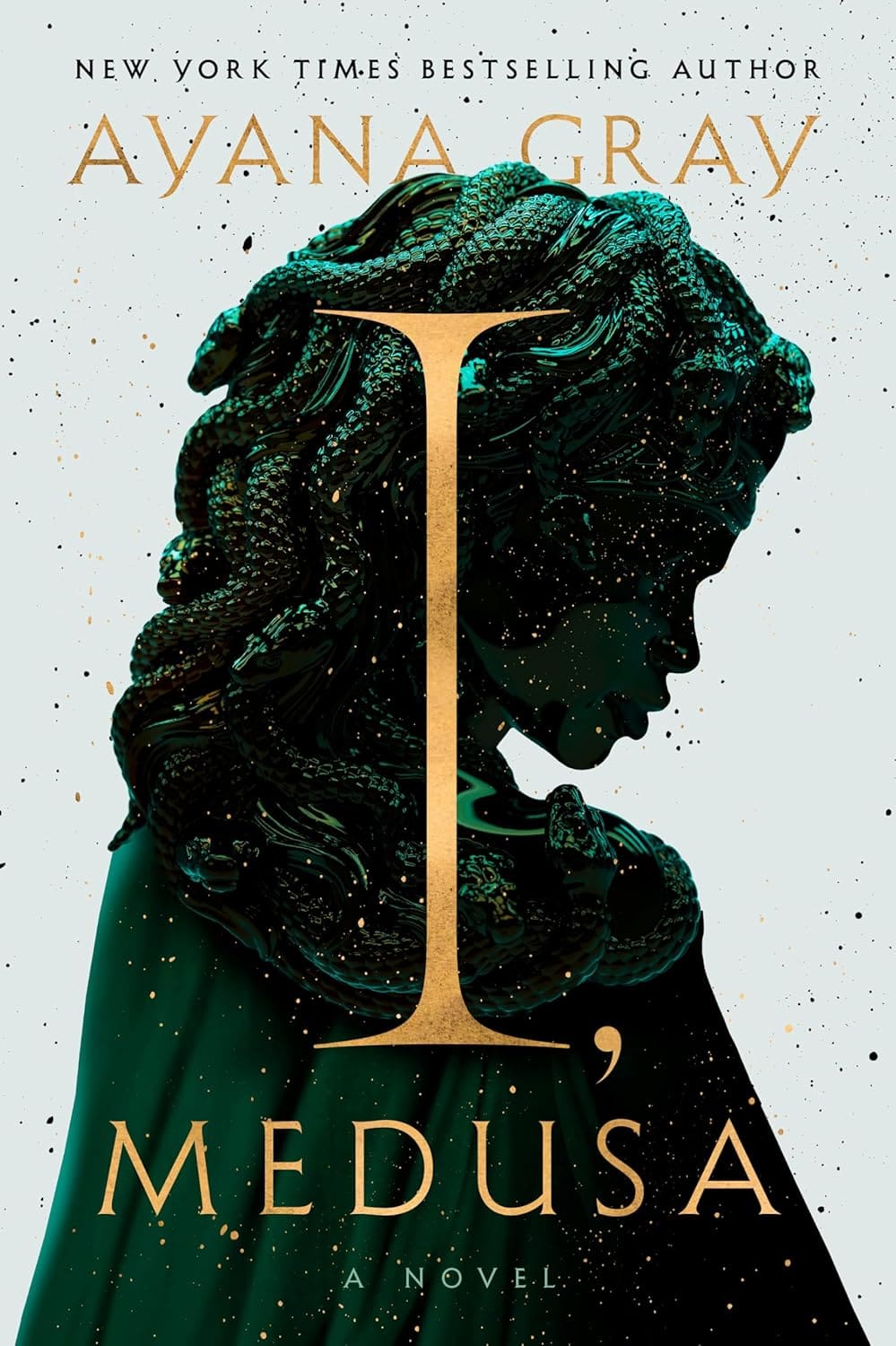






Synopsis:
Meddy has spent her whole life as a footnote in someone else’s story. Out of place next to her beautiful, immortal sisters and her parents—both gods, albeit minor ones—she dreams of leaving her family’s island for a life of adventure. So when she catches the eye of the goddess Athena, who invites her to train as an esteemed priestess in her temple, Meddy leaps at the chance to see the world beyond her home.
In Athens’ colorful market streets and the clandestine chambers of the temple, Meddy flourishes in her role as Athena’s favored acolyte, getting her first tastes of purpose and power. But when she is noticed by another Olympian, Poseidon, a drunken night between girl and god ends in violence, and the course of Meddy’s promising future is suddenly and irrevocably altered.
Her locs transformed into snakes as punishment for a crime she did not commit, Medusa must embrace a new identity—not as a victim, but as a vigilante—and with it, the chance to write her own story as mortal, martyr, and myth.
Exploding with rage, heartbreak, and love, I, Medusa portrays a young woman caught in the cross currents between her heart’s deepest desires and the cruel, careless games the Olympian gods play.
Review:
Re-imagining Greek Myths is all the rage these days. Three of the books I read this past year have it as their main storyline and a few others had a tangential relationship with Ancient Greek myths and heroes. Ayana Gray took the tragic story of Medusa and crafted her own version of the tale, sticking fairly close to the agreed legend, while creating a heartbreaking backstory with friends and family of the snake-haired villain that transforms her from evil to a woman who is a victim of power, abuse, and those that enable that abuse.
I won’t say that I “enjoyed” Gray’s story of I, Medusa — seeing a young woman with hope and promise for the future slowly fall victim to grooming, a system that puts men’s words and desires over women’s, and the inevitable end to her story that we’re all familiar with. But, Gray tells a compelling story. Once I started, I was riveted to the story, but all along the way, I wanted to shout at Medusa in some of her choices. In Gray’s novel, Medusa is flawed, yes, but ultimately is more of a victim in the end. She makes a few poor choices, but the choices that led to her curse by Athena are mostly beyond her control.
By putting Medusa’s original hair in locs and as an outsider in Athens, she manages to portray a sense of the racism of 19th, 20th, and 21st century America towards African-Americans within a context of Greece and the Mediterranean well over 2,000 years ago. Then, with the power structure present not only between the constantly quarreling gods from Mt. Olympus but also the patriarchal society of the city-states of Greece, Medusa is forced to accept a role that she would rather not. I found all the parallels to modern Western society fascinating. I didn’t always understand some of Medusa’s decisions – at times she seemed like one of the smartest people in the room, but at other times she was poorly informed and ignorant of social norms. She was understandable at times, but at other times she was frustrating in what she did or didn’t do. In many ways, I Medusa read as a Young Adult book…until it didn’t. I found it to be engaging, but also a tad inconsistent.
Ultimately, this was a book that I couldn’t put down and would recommend, especially for fans of ancient cultures and Greek mythology.
Thank you to Random House for providing this book for review consideration via NetGalley. All opinions are my own.




Leave a Reply