
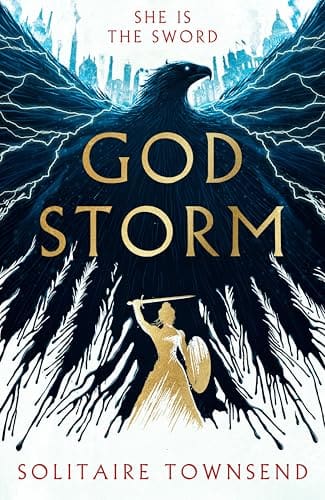



Summary:
A Female Gladiator’s Vow. A Stolen Child. A Storm to End Empires
In a petrol-fuelled Roman Empire which never fell, Arrow, a gladiatrix turned governess must rescue the child she has loved as her own, a girl who could tear down the world.
When Livy is abducted during a devastating Godstorm, Arrow must unleash years of the gladiator training she’d sworn to forget in order to save her. Defying her owner, a heartless Consul, Arrow turns to her ex-lover and the illegal druid underworld in a desperate attempt to rescue the girl she has come to think of as her own.
Her search will take her across Londinium, a city of petrol-powered chariots, to the pagan Old Town, and eventually the edge of the known the Amazon, where destiny and destruction intertwine
Facing battle and betrayal Arrow must reclaim her past as a killer—or risk everything for the child who calls her “mother.”
Review:
I might as well start off with the fact that I have a dual undergraduate degree in Classics and Archaeology, so when I see fantasy books use Ancient Rome as a worldbuilding basis, my attention is immediately going to be peaked. Throw in a beautiful cover and a blurb like this, yeah, I’ll be reading this book.
Godstorm is a fairly simple book to break down in terms of plot. Arrow is a former gladiatrix and is now a nanny of sorts for a politician’s ward. She’s raised this girl for eight years and upon the eve of her time to let the girl go to school, said girl gets kidnapped. Cue Liam Neeson’s ‘But what I do have are a very particular set of skills, skills I have acquired over a very long career. Skills that make me a nightmare for people like you. If you let my daughter go now, that’ll be the end of it.’ monologue of badassery.
Arrow is an interesting character, one I wasn’t exactly expecting based on what information I was sold on going in, and I mean that in a good way. While she definitely knows how to kill and hurt, she isn’t just that. She has a lot of depth to her, a lot of fears and anxiety about her role. She’s incredibly clever, and knows when to use her wits in place of her fists. She also cares deeply for Livy, her charge. The pair’s interactions were a highlight for me, there was real love between the two of them, so you truly do feel like Arrow would go through hell to get Livy back. And Livy is also a well-rounded character, despite only being eight years old. We do get a lot of other characters, some with some good characterization, others not so much, but that’s fine. This is Arrow and Livy’s story.
The prose and pace is fairly good, but there are times when we get some lengthy exposition that could’ve been slimmed or shown. This book is also dual timeline, where we have our present day dilemma and then interludes of Arrow’s training as a young girl. Personally, I could have used more of young Arrow as they were few and far between and only served to highlight something from her past that plays a direct role in her present day so as not to seem dues ex magica. One thing that might be confusing for readers is the transitions between the timelines uses Roman Numeral dating, so those unfamiliar might need to pop these into their phone oracles to determine the date.
So that leads us to the world, and this is where I’m torn, not only as a reader, but someone who studied Ancient Rome (I know this is a bias, so I tried to keep it shoved in the corner…). Essentially Rome never fell and this takes place over a thousands years later in a version of London. And it is steampunk, Victorian style. And while there are some great parts to this world, I do feel it wanted a foot in both but doesn’t do enough with either. There are gladiators (obviously), Roman political hierarchy, chariots powered by oil, advanced sciences, but mashed with corsets and bonnets.
And this is where my bias comes in, unfortunately for this reader, I couldn’t look past some of the inaccuracies or lack of depth, as I’m too close to the source material. The Roman pantheon is used here, but then for some reason we get the Greek versions of the gods. There is a number of mentions of Hades and Gaea, which should be Pluto and Terra respectively. And really other than the stuff mentioned above and some Latin swearing/Roman titles, there just wasn’t enough for me to feel Rome. It would’ve worked better for me if this was a secondary world inspired by Ancient Rome instead of saying it is Rome.
Now, that said, I did really enjoy this thriller plot. And the use of Druids and Amazonians was neat. I really did like how the titular ‘godstorms’ were believed to be from Jupiter and how this played into the magic system. I enjoyed the queer normative world within, the witty dialogue, and heightened emotions/tension throughout. There is a ton to like about this book.
Godstorm is perfect for fans of classical inspired stories such as Circe or Piranesi. Arrow’s drive is a treat and Townsend nails the desperation of a woman seeking her (almost)child. A quick read that breezes by. Check it out!
*Thank you to the author and publisher for sharing this ARC in exchange for an honest review



Leave a Reply