
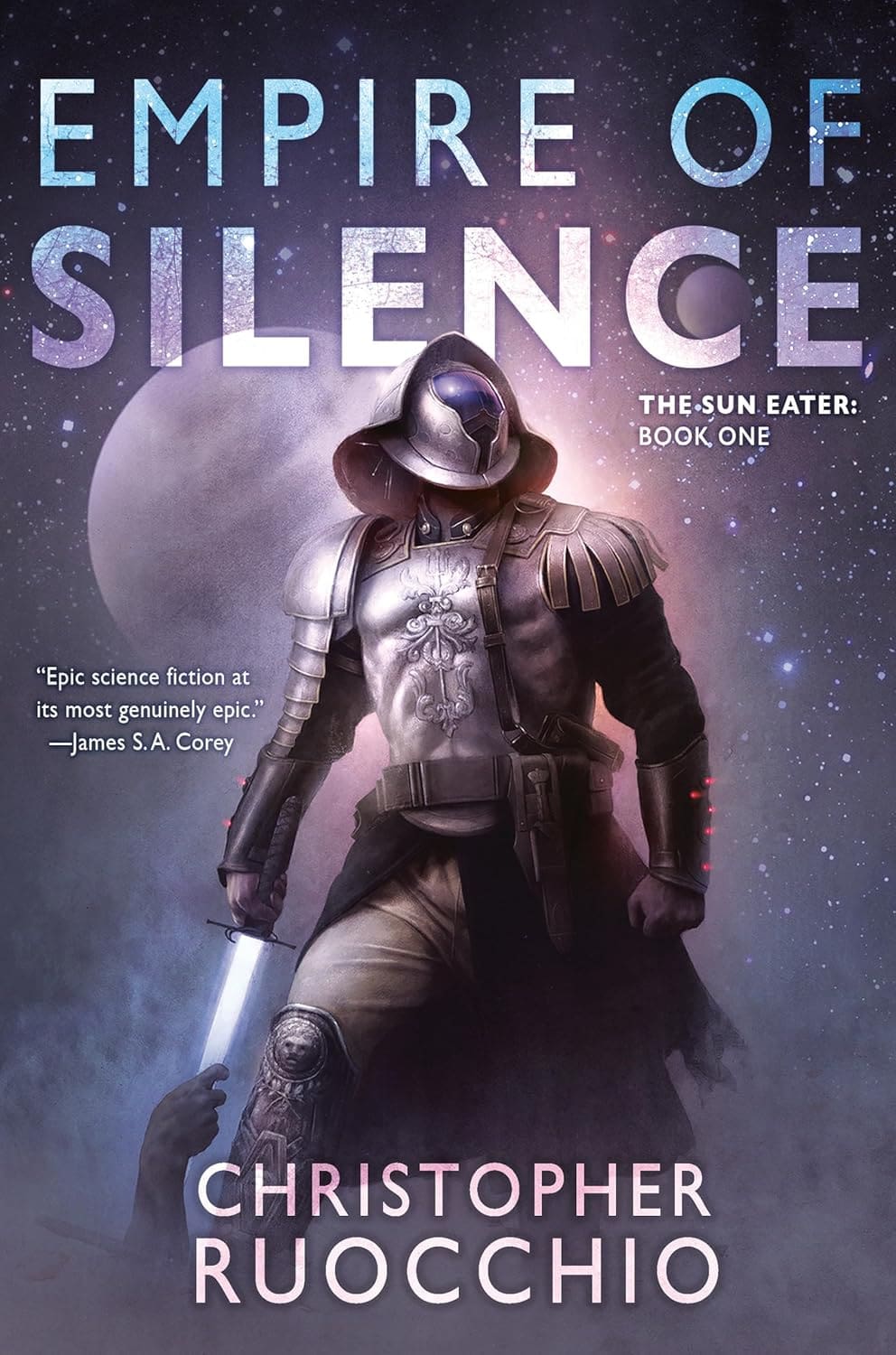




Synopsis
Hadrian Marlowe, a man revered as a hero and despised as a murderer, chronicles his tale in the galaxy-spanning debut of the Sun Eater series, merging the best of space opera and epic fantasy.
It was not his war.
The galaxy remembers him as a hero: the man who burned every last alien Cielcin from the sky. They remember him as a monster: the devil who destroyed a sun, casually annihilating four billion human lives—even the Emperor himself—against Imperial orders.
But Hadrian was not a hero. He was not a monster. He was not even a soldier.
On the wrong planet, at the right time, for the best reasons, Hadrian Marlowe starts down a path that can only end in fire. He flees his father and a future as a torturer only to be left stranded on a strange, backwater world.
Forced to fight as a gladiator and navigate the intrigues of a foreign planetary court, Hadrian must fight a war he did not start, for an Empire he does not love, against an enemy he will never understand.
Review
From the very first passage, Empire of Silence reads like a masterpiece, and it holds up to that promise almost flawlessly. Though it is told in first person by our protagonist, Hadrian Marlowe, as a young man, Ruocchio uses the device of the much older Hadrian telling his own story. Mostly it is told in the moment, but the older Hadrian pops in now and then to add an omnicient perspective. I found this worked quite well.
The thing that grabbed me immediately was the distinctive, beautiful prose and the voice of the character, commanding attention and respect. I listened to the audiobook for the most part, narrated by Samuel Roukin, who did a fantastic job.
The story starts off with Hadrian, the eldest son of a nobleman, still living at his father’s home, his well-born mother away pursuing her own artistic projects for much of the time. Sibling rivalry, a cold father, and a beloved tutor set the scene. Hadrian does not fit the mold his father wants to cast him in. The story progresses with one of my favorite tropes of the quietly rebellious heir. In this case, he is a good guy but is dealt a bad hand.
Not to give spoilers, let’s just say that—as in any good space opera—he ends up traveling to other planets. The worlds are richly imagined, with truly alien beings, an attractive researcher, and motley crews. Political intrigue, gladiators, archaeological digs, and star travel all weave a rich tapestry in this epic story. One of the more interesting aspects is the inquisitor religious sect.
Where it fell ever so slightly flat for me was the transition from the various wanderings and situations he finds himself in to the climactic events. It all worked for me, it just felt a little clunky at times. Ruochhio succeeded in tying together the political aspects of the galactic empire and Hadrian’s role in it.
There were plenty of rough experiences, intrigue, and manipulative scheming, which moved the story along and kept it entertaining. Hadrian’s character was deeply developed, and the worldbuilding was solid and imaginative.
Although it felt a little bit like epic fantasy at times, I would say it was just well-crafted science-fiction, with enough imagination to feel otherworldy. Gritty, sometimes brutal scenes were balanced with hope and friendship, preventing the story from drowning in despair.
Hadrian is a heroic character, for sure, but has set himself up for a nearly impossible task—which leads me to want to pick up the next book.

Leave a Reply