
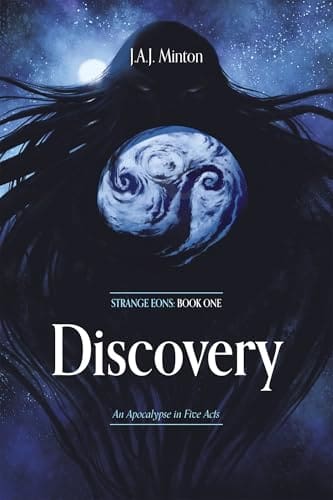



Synopsis
In 1992, at the dawn of the age of technology, disgraced ex-game show host Manny di Martini schemes for a comeback with a deep-sea television special in the South Pacific. He quickly finds himself in over his head, attracting the attention of a cosmic being who will lead Manny to a television broadcast event much bigger than the entire planet bargained evidence of a slumbering alien in a ruined city at the bottom of the ocean. One look at the monster on TV, and humans collectively freak out.
The narrative leaps between a cast of unforgettable characters, revealing their connections to cosmic gods who play with their lives. If humanity can’t save itself, and the cosmic beings do not have humans’ best interests in their cold hearts, humanity will have to pull itself together to prepare for a war that not only threatens Earth, but the very fabric of reality.
Review
Set in 1992, just as the technological age is beginning to reshape the world, Discovery opens with a premise that is both strange and irresistible: a disgraced game show host chasing a comeback inadvertently stumbles into something far larger than television ratings—a cosmic revelation that could change humanity forever. What begins as a deep-sea spectacle quickly spirals into a mystery involving ancient forces, alien ruins, and powers far beyond human understanding.
One of the novel’s greatest strengths is its ability to create tension and transfer that tension directly to the reader. As the mystery unfolds, I found myself wanting answers just as urgently as the characters did. There’s a powerful sense of watching history unfold from the inside—like being an observer studying a pivotal moment decades later, yet unable to remain emotionally distant from the events themselves. That sense of witnessing something monumental gives the story a fascinating momentum.
The character work is exceptional. Discovery features a large cast, but each voice feels distinct and memorable, making it surprisingly easy to keep track of who’s who. The Mintons populates the story with a mix of everyday people and more eccentric figures from the fringes of society, creating a colorful tapestry of perspectives. Structurally, the novel almost reads like a form of epistolary fiction—less about following one central protagonist and more about tracing a historical event through the experiences of those caught up in it.
Despite the relatively brief time spent with many of the point-of-view characters, they feel remarkably alive. Each person carries their own fears, motivations, and personal struggles alongside their role in the larger mystery. That attention to individuality makes even short appearances feel meaningful, and it’s easy to become invested in what each character thinks, suspects, and ultimately experiences as the situation escalates.
The plot itself is driven by curiosity and discovery—true to the title. What’s particularly impressive is how the story manages the unknown. I’m usually not a fan of narratives that keep readers too far in the dark, but here it never feels manipulative. Instead, the mystery unfolds at the same pace as the characters’ understanding, creating a steady rhythm of revelation that keeps the pages turning. Over time, the narrative begins to settle around a core group of characters, giving the broader story a stronger emotional center as the stakes escalate.
From a craft perspective, this is an especially interesting novel. Discovery breaks several storytelling conventions—jumping between perspectives, focusing heavily on internal thought rather than physical scenes, and building its narrative through a mosaic of viewpoints. And yet, it works. The book feels almost like a study in narrative technique, and I suspect it will linger particularly strongly in the minds of writers and readers who appreciate bold structural choices.
The dialogue is another highlight. Characters speak in vibrant, distinctive voices that often reminded me of the conversational energy found in works by Stephen King. There’s a delightful contrast between the cosmic gravitas of the story’s themes and the blunt, modern way characters sometimes talk to each other. That mixture—high-concept speculation paired with very human, often profane reactions—gives the story both humor and authenticity.
The worldbuilding is equally compelling. The novel asks an intriguing question: what would actually happen if something magical or cosmic suddenly intruded into the real world in the early 1990s? The Mintons clearly put considerable thought into exploring the societal, psychological, and cultural consequences of such a revelation. Rather than glossing over the impact, the story examines how humanity might realistically react to discovering forces beyond science and comprehension.
Not every reveal lands with equal subtlety—toward the end, a few twists feel a bit more heavily foreshadowed than necessary—but the overall journey remains deeply engaging.
Ultimately, Discovery is a fascinating blend of cosmic mystery, character-driven storytelling, and bold narrative experimentation. It’s entertaining and thought-provoking, but it’s also the kind of book that invites readers—especially writers—to admire the craft behind it. Long after finishing, I found myself reflecting not just on the story’s events, but on how cleverly those events were woven together.
For readers who enjoy speculative fiction that challenges structure while exploring big ideas, Discovery offers a memorable and ambitious ride.


Leave a Reply