






Synopsis
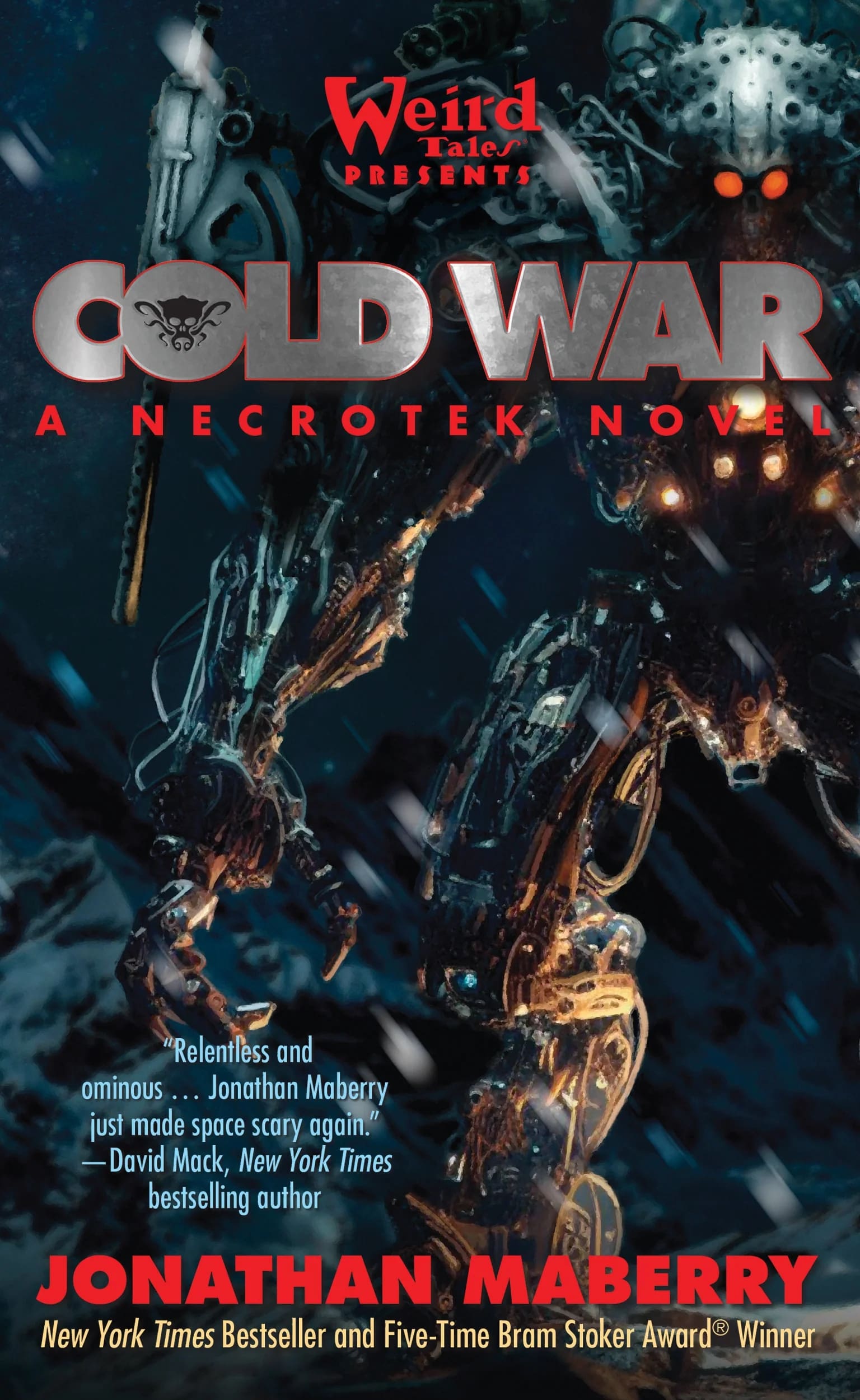
From New York Times bestselling and award-winning author Jonathan Maberry comes the sequel to NecroTek. Cold War is an action-packed sci-fi thriller full of weird science, kick-ass heroes, humor, passion, heroism, and sacrifice!
In NecroTek, the space station Asphodel was accidentally teleported to the far side of the galaxy, where they became embroiled in a never-ending war against ancient cosmic horrors.
But there is much more to the story …
On Earth, scientists uncover an alien spacecraft buried for millions of years beneath Antarctic ice. Inside are terrible secrets and a creature desperate to escape.
Soon the scientists studying the Artifact begin to have terrifying dreams, driving many of them to madness and acts of shocking violence. Dr. Evie Cronin and her team struggle to find answers, fully aware that they may only be discovered out among the stars. Their investigation brings them to the orbit of Jupiter moments before the WarpLine gun misfires. Destiny is a vicious and devious thing.
On Asphodel Station, the newly created ghost-driven NecroTek fighting machines are engaged in a desperate battle for survival against the deadly shoggoth fleets. But a new and far more dangerous race of creatures is poised to attack, both with their own fleets and with nightmares forced into the minds of the dwindling human defenders.
The group of scientists from Antarctica and the survivors on Asphodel are pitted against an unstoppable enemy. If they fail, Asphodel Station will fall, and the Outer Gods will be free to wage a war of conquest across the galaxy-to Earth itself.
Review
Jonathan Maberry sends readers back to frontlines of the far-flung star system of Shadderal in his second NecroTek novel, Cold War. The action kicks off a bit closer to home, though, with the discovery of an alien vessel by a team of Antarctic researchers a year prior to the WarpLine Disaster as covered in the previous book.
Evie Cronin’s find of the millennia dovetails with the preparation of Asphodel Station for the WarpLine experiment to transpose matter across the stars (think Star Trek’s transporter technology), and the two events eventually converge across time and space. In between is all kinds of military sci-fi action and Lovecraftian horror as Cronin’s team, which eventually grows to include hired shooters, learns that the artifact has a shapeshifting passenger. The alien construct begins wreaking havoc with the researchers’ dreams, pushing some to suicide, while conflict brews in their waking lives, between one another and with the creature out on the ice.
Over in orbit of Shadderal, the stranded survivors aboard Asphodel brace themselves against further attacks by Shoggoth warships, while their NecroTek allies continue to learn and adapt to their newfound post-death powers. If you missed out on NecroTek, the souls of Asphodel’s dead fighter pilots were put into alien technology, essentially turning them into robotic kaijus that can alter their shape at will.
If it isn’t clear by now, Maberry’s latest series has a lot of big, crazy ideas, borrowing from a hodgepodge of various science fiction and horror properties and mixing them all up in an insane blender before giving them a fresh coat of paint. Cold War reads a lot of like The Thing meets Transformers by way of Pacific Rim if it were told by H.P. Lovecraft after watching Aliens on an unending loop. I don’t envy whoever has to write the book’s synopsis for this series because trying to explain how all this works together without sounding like a mental patient high on ‘shrooms feels like an impossible task. It does make for a pretty fun read, though, and one with plenty of high-octane action.
And while the action scenes are pretty damn kinetic and fiery, it’s really the human element that grounds it all and makes the story digestible. The burgeoning love story between Cronin and a mercenary, Jennifer Spears, is worth the price of admission alone. Their attraction felt real and well-developed, escalating naturally into mutual love and trust, even as they both face the insanity of the Antarctic and, later, far worse.
As with NecroTek, I still find Dr. Lars Soren’s theories of cosmic philosophy intriguing and wish that Maberry probed them a bit deeper and in more challenging ways. As mankind moves deeper into the stars and spreads across space, new cultures and beliefs are bound to form. And what of Earth’s religions when they move beyond the confines of our planet and inevitably come into contact with extraterrestrial cultures and alien religions? Placing the Bible and mankind’s relationship to God and Earth, for instance, on a world in which no human has stepped foot on, if taken literally shows that it “is either inaccurate or insufficiently broad in scope.” One can’t help but wonder, when placed in Soren’s shoes and flung far across the cosmos and constantly under the threat of eldritch horrors, what exactly would Jesus do in the face of Lovecraft’s Great Old Ones, whose existence (in the context of these particular stories) predate all of Earth’s religions. The plurality of Lovecraft’s pantheon of Elder Things and Outer Gods certainly give lie to God’s demand that there shall be no other gods before Him (and which in its own phrasing acknowledges that there are, in fact, other gods besides Him anyway, particularly given the very long line of gods and religions that predated Him and His in reality).
Of course, religious philosophy is hardly the provision of books involving city-sized transforming robots and shapeshifting aliens fighting marines, but it’s certainly interesting to think about. I’m pretty sure most of us are here for the gonzo violence and pulp horrors, even if I, personally, wonder what Christopher Hitchens’ take might be on all this. I’m sure that would be one hell of a lecture! I suppose that’s something to think about while I wait for NecroTek 3 to release.



Leave a Reply