
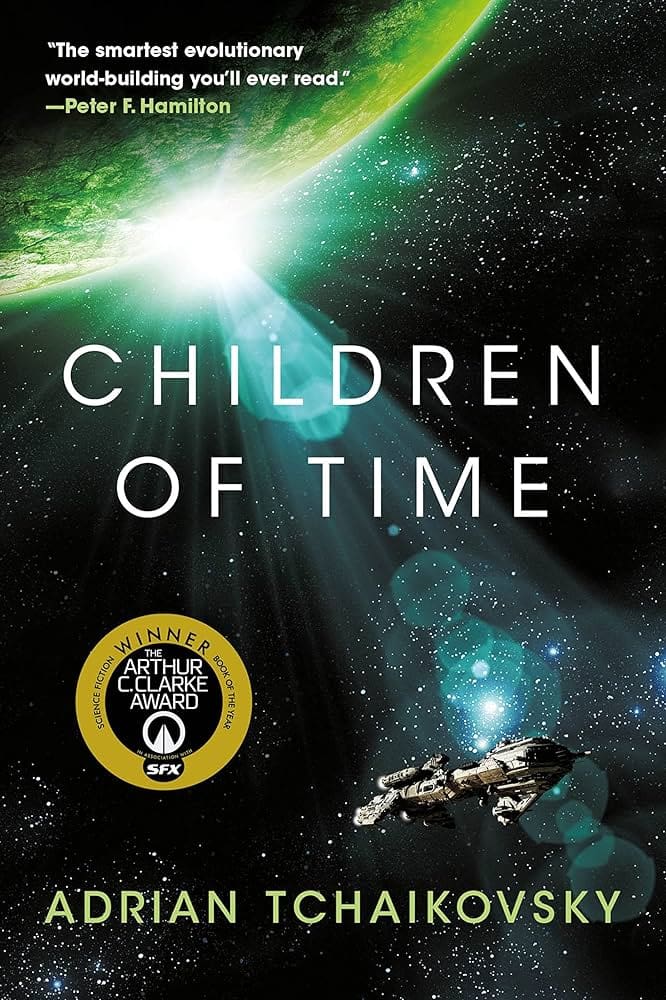







Synopsis:
The last remnants of the human race left a dying Earth, desperate to find a new home among the stars. Following in the footsteps of their ancestors, they discover the greatest treasure of the past age — a world terraformed and prepared for human life.
But all is not right in this new Eden. In the long years since the planet was abandoned, the work of its architects has borne disastrous fruit. The planet is not waiting for them, pristine and unoccupied. New masters have turned it from a refuge into mankind’s worst nightmare.
Now two civilizations are on a collision course, both testing the boundaries of what they will do to survive. As the fate of humanity hangs in the balance, who are the true heirs of this new Earth?
Review:
Children of Time is a brilliant story of survival and evolutionary biology, with a fascinating look at what a non-human intelligence might look like. In short, this book made my biologist’s heart very happy.
The story is split between two main perspectives: That of the ark ship Gilgamesh’s human crew, and that of the Portiid spiders inhabiting the “green world.”
But it all begins a couple thousand years before that, with Doctor Avrana Kern, an arrogant scientist from a fallen human empire who traveled to the newly terraformed green world to conduct an experiment on what was supposed to be monkeys. Unforeseen circumstances arise, the monkeys never reach the planet’s surface, but the viral strain created to accelerate evolution—and potential sentience—in what she deems “lesser” species arrives without issue. The virus was supposed to be tailored only for primates, leaving all other mammals uninfected… But no one considered the tiny arachnids already colonizing the planet.
As someone who has always been fascinated by spiders, I absolutely loved that they were the focus of so much of this book. The way the author crafted the spiders’ society, their means of communication (and overcoming communication barriers with others), and their unique style of technology/biotechnology was endlessly fascinating.
The other half of the book, focused on the crew of Gilgamesh, focuses on the last remnants of humanity from Earth and their desperate bid to find a new world to colonize. Their ancestors’ war led to a poisoning of their world, and their only chance to survive was to leave for the stars, following in the footsteps of those same ancestors, whose technology they don’t fully understand.
Inevitably, the Gilgamesh finds its way to the green world and two very different cultures are primed to collide.
While this was a very big book (about 600 pages in print), it didn’t feel that way. It was an insanely good read, and one I’d recommend to anyone who enjoys sci-fi with a focus on biology.
I want to thank Ed Crocker for bumping this book up on my TBR.



Leave a Reply