
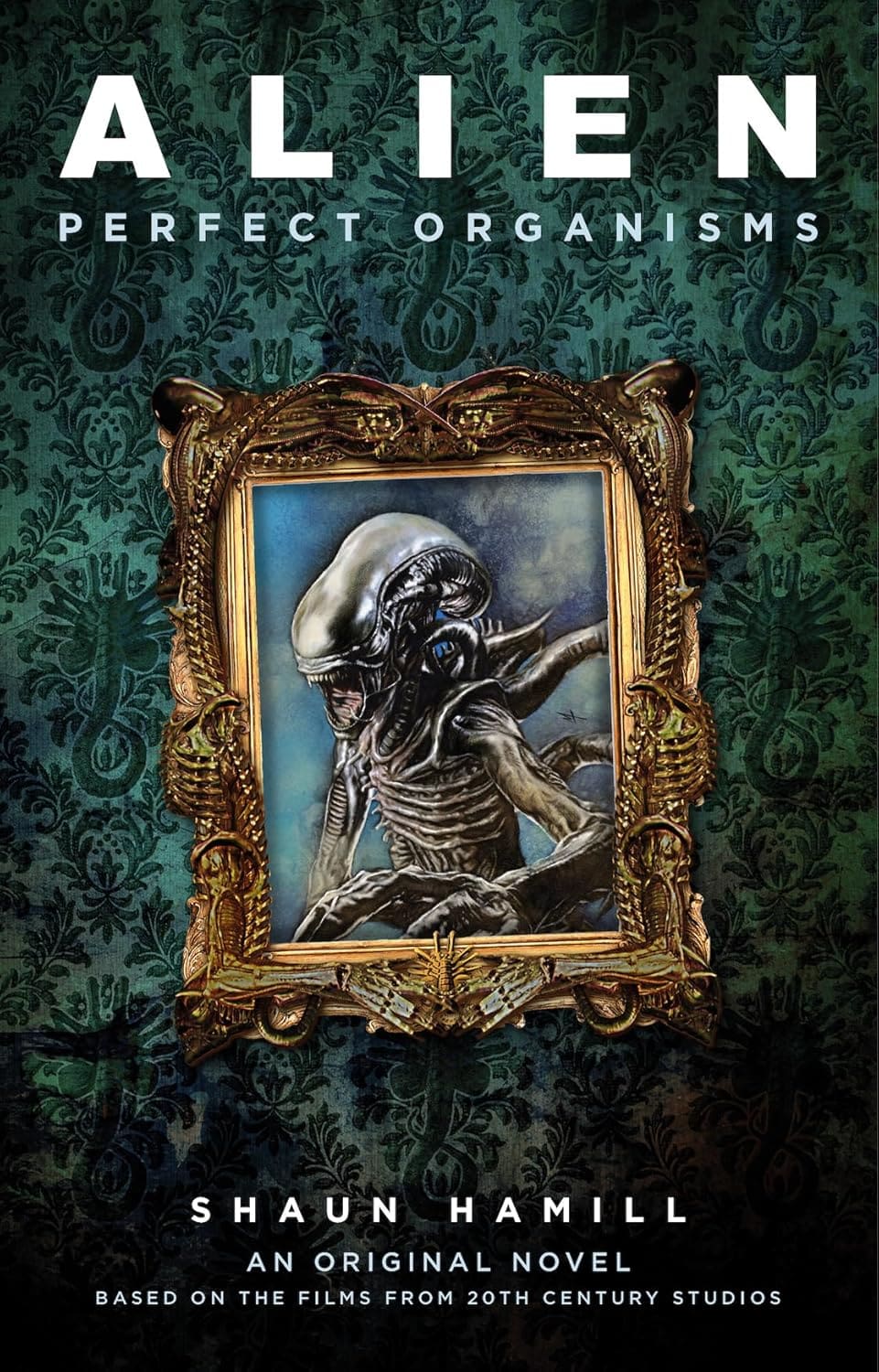



Synopsis
Some years after the events of Aliens and Alien 3— an artist obsessed with the disturbing visceral potential of the xenomorphs is pursued to an abandoned colony. Written by the much-celebrated Shaun Hamill, author of A Cosmology of Monsters and The Dissonance.
Desperate, depressed and nearly destitute, Cynthia Goodwin goes against her better judgement to keep her ship the Chariot and its crew in work: she agrees to meet with the reclusive billionaire Roman Fade.
Fade’s request is unorthodox: go to the abandoned colony of New Providence and bring back his former lover, the renowned artist Corinth Bloch.
The job is rife with uncertainty. No one knows what happened on New Providence or why it is under quarantine. And Bloch may be brilliant, but he is also deranged. As Cynthia follows his path to the colony, she learns of a mind obsessed with images of dark and horrifying creatures… Of an almost religious fervour for the ultimate subject for his art… Of the drive to capture the sublime terror of the perfect organism…
Review
In the acknowledgments section of Alien: Perfect Organisms, Shaun Hamill admits to having his mind blown as a middle-schooler in the ’90s by the discovery of Alien and Predator tie-in fiction. That led him to two obsessions: devouring every bit of Alien media he could, and to one day write his own book in this franchise.
Hamill’s devotion to the Alien universe is apparent right from the start. The book’s epigraph is a quote from Alien: Covenant’s antagonist, the artificial person and xenomorph obsessive, David. If you enjoy the two Alien prequel movies, Prometheus and Covenant, this epigraph will either scare you away or ensure you that you’re in good hands with an author at ease with the depth and breadth of the long-running franchise. For me, David’s quote was a positive affirmation of what was to come.
Personally, I quite enjoy Prometheus and have grown into quite the sucker for the god-like Engineers responsible for the creation of both mankind and the black goo that would eventually give rise to the killer xenomorphs at the heart of this series. Opening Perfect Organisms with a quote from David also clues readers into the nature and style of the book’s subject matter. That Captain Cynthia Goodwin’s ship is named Chariot certainly feels like a deliberate choice, too, recalling Erich von Däniken’s Chariot of the Gods and its claims of alien visitors to Earth that itself echoes in the opening moments of Prometheus.
Like David, artist David Bloch is obsessed with the perfection of the xenomorph, and his desire to learn more about the subject that has become the focal point of his paintings approaches religious fanaticism. Bloch was himself very nearly the victim of an alien outbreak as a child, when his miner father discovered a room containing the sculpture of a massive humanoid face and rows of black vases. Ever since, he has been seeking answers as to where the creatures that wiped out his family and colony home came from.
When, years later, Bloch goes missing on a colony world that Weyland-Yutani has erased all information on, Bloch’s lover hires a down-on-her-luck Goodwin and her crew to locate him and bring him back. Goodwin, like Bloch, is also haunted by the specter of the insectile xenomorph and dreams about them regularly. Finding Bloch could be a way for her to understand her own obsessions with these creatures and why her life has been marked by them via half-formed nightmares.
Perfect Organisms is all about the titular aliens, but funnily enough they take a backseat until very late in the proceedings, similar to how the movie Jaws is about the shark but the monster itself has only limited screentime. Hamill is more concerned with the impact the existence of these horrors has had on his central leads, and their yearning for deeper discoveries.
For a franchise as long-lived as this one, with so many tie-ins across video games, table-top roleplay games, books, movies, comics, and now a television series, it’s incumbent on the writer to find a new angle into such a well-known premise. There are only so many stories that can be told from the viewpoint of the Colonial Marines or people getting facehugged and mauled to death before it all gets to be the boring same-old, same-old. Authors like Alex White, with their shockingly good Cold Forge, has previously showed us that there’s still room for originality in this universe, and movies like Prometheus and Alien: Romulus have introduced new wrinkles and antagonists to freshen things up a bit.
Hamill finds his own unique hook into the familiar. We get hints of all those old reliables, but Perfect Organisms is blessedly free of gung-ho marines and many of the typical staples of this series. In fact, there’s only one firearm in the book’s entirety, and gunplay is kept to an absolute minimum. Even Weyland-Yutani’s conspiratorial machinations, while certainly present, are more deeply rooted in the mythology of these stories rather than a focal point; it’s all just part of the world-building that helps to shape and inform these characters and their outlooks. No, Perfect Organisms is about Bloch and Goodwin, two survivors of trauma, and the ways in which they try to make sense of the heartless, uncaring cosmos that surrounds them. At the center of this cosmos is an unspeakably deadly figure, a chitinous, god-like horror that lives only to consume and reproduce, violently.
Perfect Organisms is about mankind’s slavish devotion to iconography and the ways we take concepts and events we don’t understand and transfigure them into religious experiences. This is a story of the god of the gaps and the search for meaning in an otherwise meaningless existence, set against the backdrop of another over-reaching, heartless monstrosity that is late-stage capitalism and corporate greed. More importantly, it’s about the people – relatable, otherwise everyday common folk – that find themselves impacted by the wider goings-on of the universe they inhabit, and Hamill is deeply focused on their interior lives, their relationships, their beliefs and passions, and how all those things drive them. That what drives them just so happens to be unrelenting alien terrors hidden deeply in the fabric of their lives feels almost secondary. Hamill has also smartly shifted the perspective of how xenomorphs can be viewed. By framing them through the window of religiosity and the uncaring unknown, he has created a story that’s about as close — not quite all the way, but certainly close — to cosmic horror as this franchise has ever gotten, and it’s all the better for it.


Leave a Reply