
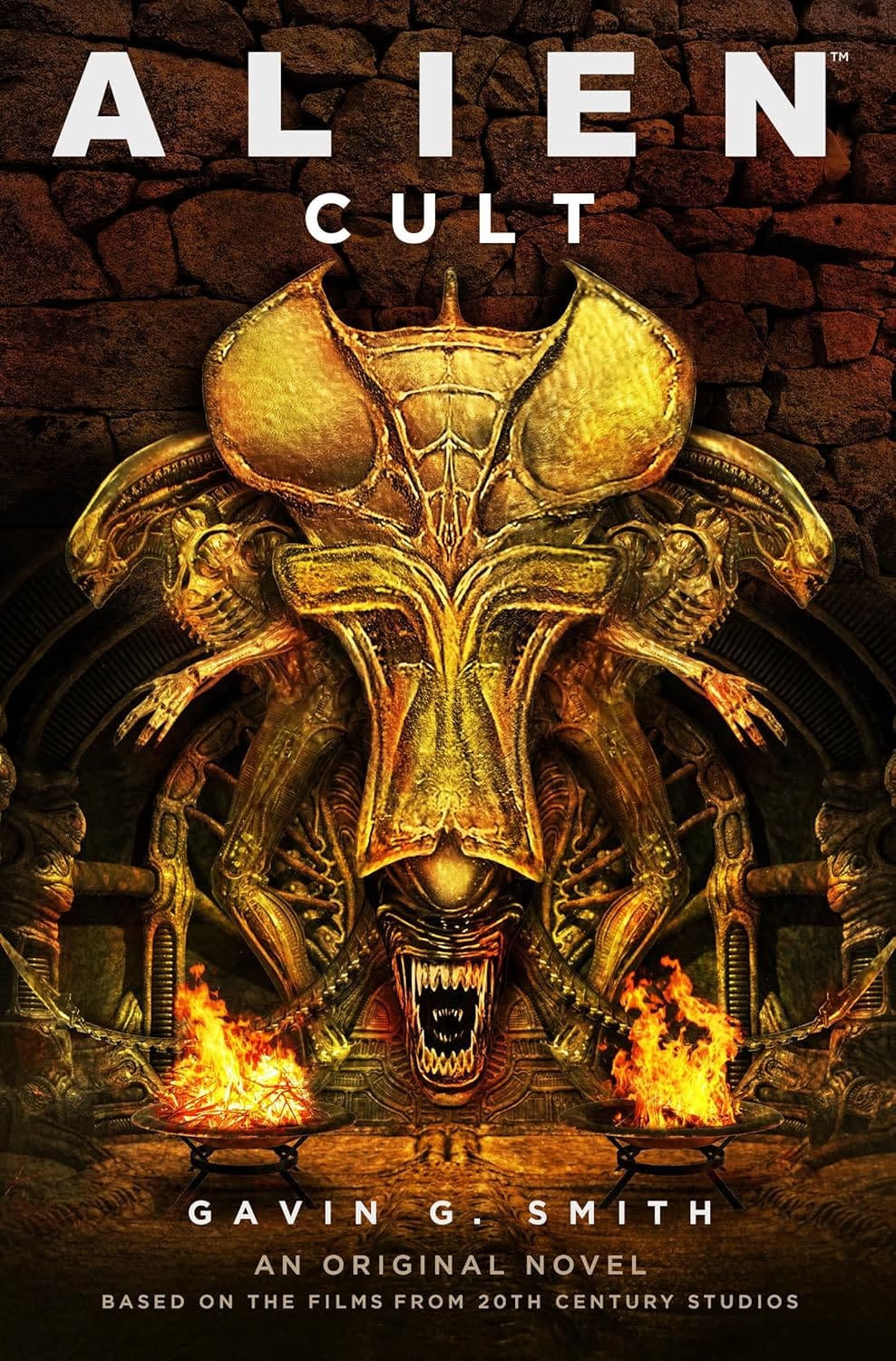




Synopsis
An FBI agent on the trail of a brutal serial killer gets caught in the web of a Xenomorph-worshipping religion in this thrilling murder mystery twist on the Alien universe, for fans of Scott Sigler’s Aliens: Phalanx and Alex White’s Cold Forge.
In the affluent, technocratic Alexandria Colony, people are disappearing. And witnesses are dying in grisly, mysterious ways—it all reeks of Xenomorphs. At a loss, the Hume City police call in Special Agent Tyler Matterton to solve what they can’t. Tyler is a rising star in the FBI’s Esoteric Crime Unit, investigating crimes involving exotic tech or first contact situations—the weird murders.
With the local police department baffled, Tyler and his synthetic partner Serena are set on the case, tracking the killer through the underbelly of Hume City only to find themselves in the middle of something much larger and more horrifying than they possibly imagined. There is a cult at the heart of the Alexandria Colony, and it will stop at nothing to serve its Goddess.
In this latest original novel, discover the world of Alien as you’ve never seen it before. Veteran sci-fi author Gavin G. Smith’s deliciously twisted crime thriller is a terrifying thrill ride sure to hook readers from the first page to the last.
Review
In my review of Alien: Perfect Organisms, I applauded Shaun Hamill for finding a fresh and unique hook into such a well-known and well-trodden universe. Hamill gave readers a rich, character-first take that viewed xenomorphs through the lens of religiosity and put the titular alien species in the backseat for much of the narrative. Titan Books’s second Alien offering of 2025, Gavin G. Smith’s Cult, tacks a similar course while proving to be a completely different beast altogether.
As the title implies, Alien: Cult is all about religious nuttery in a galaxy of Engineers, black goo, facehuggers, and an ultimate race of killer bugs. FBI Agent Tyler Matterhorn and his artificial person partner Serena are investigating a missing persons case on a colony world that quickly puts them at odds with serial killer Darius Snell. The discovery of Snell kicks open the door to a wider conspiracy of a cult of Engineer-worshipping genehackers who are modifying themselves to take on the appearance of the bald, alabaster-skinned giants introduced in Prometheus.
Smith smartly inverts expectations of what an Alien book can be in a few clever ways. As with Perfect Organisms, the infamous xenomorphs are held back until the very end, and the Engineers seen throughout Cult aren’t really the Space Jockeys of the films but good, old fashioned human wannabes. Gone, too, is the customary grungy, industrial feel. For the first third of Smith’s book, Cult reads more like a riff on Blade Runner, with its bustling, neon-lit criminal underworld, impoverished streets, and illegal biohacking dens. Given the supposed Easter egg-level connections between the two properties, this makes sense and the shiny cyberpunk ethos Smith cultivates in the book’s opening chapters immediately piqued my interest for what was to come.
And then Smith pulls the rug out from under readers, taking Matterhorn’s investigation, and the Alien franchise as a whole, to a completely different world and genre – the Western.
Yes, dear readers, Alien: Cult is a dusty, sci-fi oater. The action shifts to the sparsely populated Steer City, on a colony world devoted to livestock farming and the headquarters of the Church of Biological Transcendence, of which Snell was a member and whose congregants bear an uncanny resemblance and similar modifications to. Embattled Marshall Cass Stock finds herself squaring off against corrupt Big Agriculture, drunken violent cowboys, and a sniveling deputy who wants her job. Cult expert Matterhorn is the fish out of water here, in more ways than one.
The melding of genre tropes works incredibly well, and Smith lays up a few set pieces unlike anything I’ve seen in previous Alien entries. We get a farmhouse siege for one, and an action-packed finale set amidst a cattle run through the city in the middle of a violent dust storm. Filtering the Alien series through the Western genre makes for a welcome change of pace and is exactly the kind of creativity I’m looking for in an Alien book these days after so many decades of Colonial Marines same-old, same-old. After so many too-familiar riffs on ground already covered in the movies, Cult is a breath of fresh air.
Unfortunately, Cult suffers from an anticlimactic ending that left me wishing for just a few extra pages to flesh things out a little bit further and provide a deeper resolution. Instead, we get an abrupt and transparently obvious zinger in the form of the Alien franchises’s version of the hand rising from the grave. I wish there’d been a bit more falling action and some degree of resolution before Smith hightailed it out of Dodge. Cult also has more than its fair share of editorial mishaps and proofreading errors, and certainly more than should be expected of a major publisher. The number of misplaced commas, transposed or repeated words, and typos found in the finished copy is galling.
If one can overlook all the typographical errors and poor proofreading, the worldbuilding Smith puts into Cult is worthwhile and nicely differentiated from typical Alien stories. Yes, underpinning it all is the future conservatives want, with so much of humanity reduced to chattel for corporate overlords and unwitting test subjects of bioweapons experiments, and workers kept not only poor but at odds with one another to deflect their attention away from who the real villains are. Smith’s portrait of law enforcement in late-stage capitalism is certainly dire, and somehow even more depressing than the systemic racism our current legal system revolves around, yet it certainly feels like the natural evolution of our current hellscape. Anybody with even a passing familiarity with the Alien universe and a lick of common sense won’t find themselves too surprised at who’s all behind the machinations behind the Church of Biological Transcendence, but Smith’s explorations of body modifications, transhumanism, and genetic engineering, and his fresh set dressings to stage it all against, certainly make for stellar focal points.


Leave a Reply