
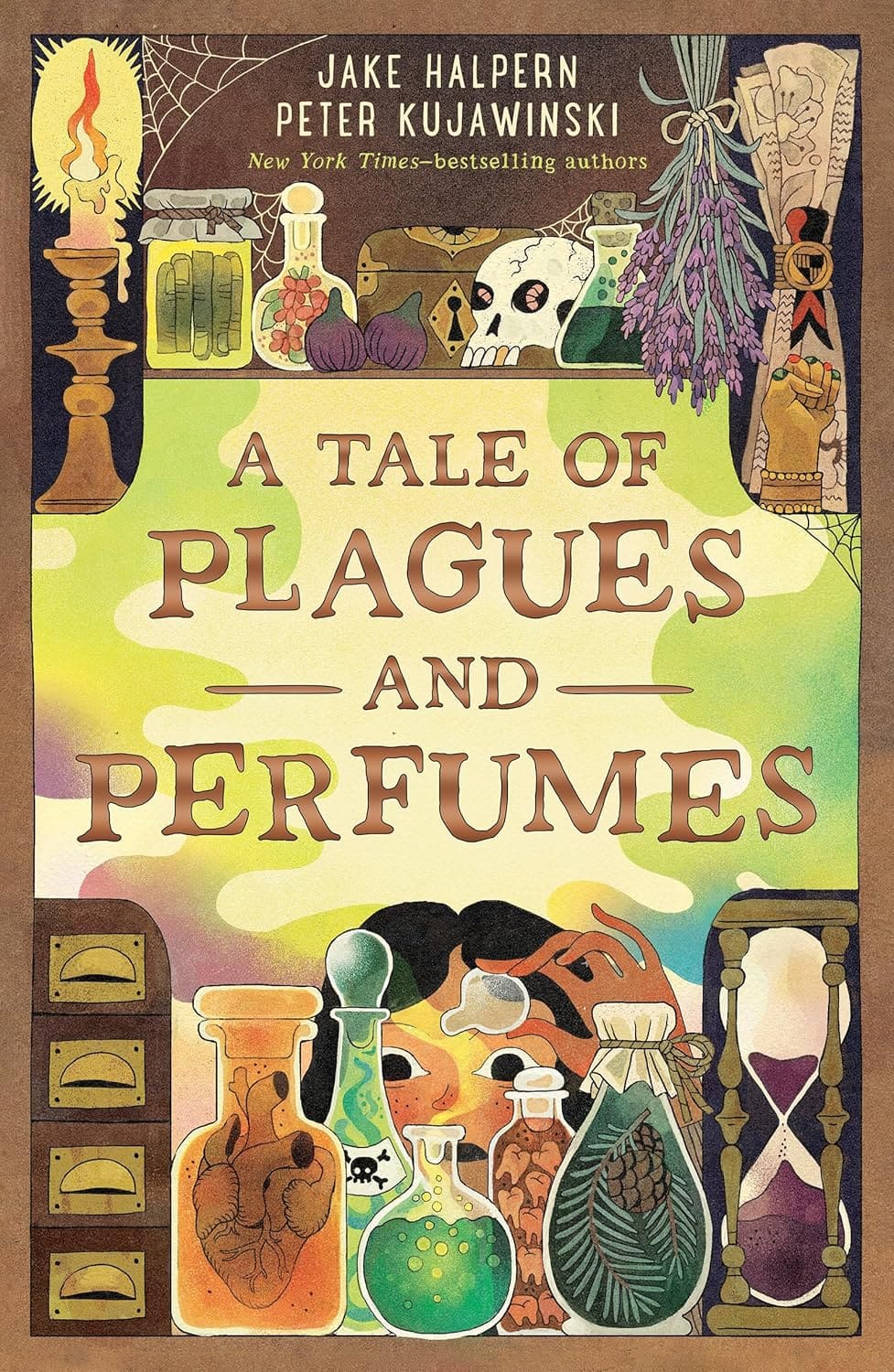





Synopsis:
Every scent tells a story.
The last thing Nia wants is to be branded a “Sinsory.” Where she comes from, that’s just as deadly as the devastating plagues that sweep through their land. That’s why she keeps her unusually keen sense of smell a secret. Only two people in the city of Yerat know of her special her beloved Auntie and her best friend, Fox. But when the worst plague in a century hits their desert continent, all of that suddenly changes.
An invitation arrives in the shape of a jar of blackcurrant jam for Nia to attend the Cloister, a select and secluded school for children with heightened senses. There she meets Scentiers, like her, but also Gazers, Whisper-Gatherers, and many more, whose sensory powers go far beyond what regular folk can smell, see, or hear.
It’s there that Nia learns her nose knows far more than she ever dreamed . . . maybe enough to find the cure for the plague. Or even sniff out the sinister secrets hiding in the Cloister’s walls.
The Inquisitor’s Tale meets Impossible Creatures in this immersive middle grade fantasy adventure that follows a girl who must use her remarkable sense of smell to save the world from a perilous plague.
Review:
A Tale of Plagues and Perfumes is a really interesting novel. I found the magical system used in the book by authors Jake Halpern and Peter Kujawinski to be really inventive, taking a unique spot in the Young Adult book market. The beginning third and final third of the novel propelled me along and I found myself pushing to read the book, but the part that dinged it for me was the middle third.
As a history teacher, it’s morbidly fun to teach about the Black Death that struck Europe in the 1300s. The lack of scientific knowledge in the late Middle Ages played a key role in exacerbating the plague and even today a “Black Death Plague Doctor” is a popular costume (even though the infamous “beak” isn’t historically accurate). One of the key things about the Plague Doctor mask is the “Miasma” theory, where unpleasant aromas contributed to the disease (well before they could see microscopic bacteria or viruses).
And it definitely feels that the authors took the Miasma theory and applied it to their magical system in A Tale of Plagues and Perfumes, where Nia can literally sniff out the cure to plagues with her nose. A not-insignificant portion of the book turns into a detective story as Nia has to figure out the source of a crippling plague that is on the verge of wiping out society.
I found myself really enjoying the beginning as Nia is selected to attend the Cloister, a school and home for children like herself that are blessed (or cursed) with heightened senses. While she can smell better than the other noses, she befriends a girl, Lime, who can taste the sweat of the lady who made the cookie that would otherwise be enjoyable, as well as a boy, Lowe, who can take the recipe of her “curefume” and manufacture it to perfection.
The middle portion of the book almost lost me, however. Halpern and Kujawinski tried to turn it into the standard Dark Academia book like Harry Potter where Nia just had to be bullied by the mean girls who had already been there. I struggled with that portion, but eventually, Nia and her friends had to leave the Cloister to save themselves and everyone else and that’s where the book really finds its magic. If more of the book was just Nia, Lime, and Lowe going on detective adventures, I probably would rate it even higher.
Overall, A Tale of Plagues and Perfumes is a fun Middle Grade/Young Adult Fantasy adventure book that is a bit uneven, but ends on a high note for an enjoyable read.
Thank you to Roaring Brook Press for providing this book for review consideration via NetGalley. All opinions are my own.


Leave a Reply